
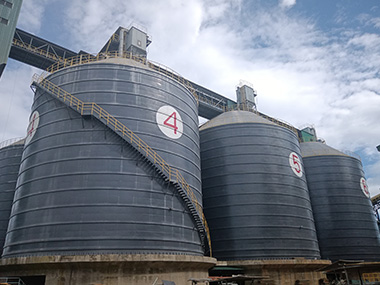

Silo Cleaning Best Practices: Manual vs Mechanical Methods for Industrial Bulk Storage Silos
When should you send a person inside a silo vs. using a mechanical system? Send personnel in only when mechanical methods physically can't reach the problem — rat-holes with complex geometry, hardened deposits on cone walls, or structural damage that needs visual inspection. Which method costs less per event? Mechanical cleaning runs $3,000–$6,000 per silo versus $8,000–$15,000 for manual entry, but the real savings come from avoiding 48–72 hours of plant downtime.
1. Why Silo Cleaning Isn't Optional — It's a Production Decision
Here's the thing most operations managers don't realize until it's too late: a silo that hasn't been cleaned in 18 months isn't just dirty. It's losing capacity. It's developing dead zones. And one morning, the discharge gate opens and nothing comes out because a cement bridge the size of a car is sitting 4 meters above the hopper.
The Real Cost of Bridging and Rat-Holing
Bridging — when material forms a stable arch over the discharge opening — reduces effective storage capacity by 15–30% before anyone notices. Rat-holing is worse. Material sticks to the walls while the core flows out, creating a vertical channel that can collapse without warning. I've seen a 2,800-tonne clinker silo in UAE drop 400 tonnes of material onto a conveyor in 9 seconds when a rat-hole gave way. The belt survived. The framing didn't.
For cement silos specifically, moisture ingress through even a 2 mm gasket gap can cause pre-hydration on wall surfaces. After 12 months, you're looking at calcium silicate deposits with compressive strength of 8–15 MPa. That's not dust. That's almost concrete. And it won't respond to vibration alone.
How Often Should You Clean?
Depends on the material. Fly ash silos need attention every 6–9 months because the fine particle size (10–150 μm) promotes cohesive bridging. Coal silos — especially with 8–12% moisture content — should be inspected quarterly. Clinker silos can go 18–24 months between cleanings if the discharge system is well-designed. But "can go" and "should go" are different things. I'd rather inspect and find nothing than skip a cycle and find a problem at 3am.
2. Manual Cleaning: When Personnel Entry Is the Only Option
I'll be straight with you — I'm not a fan of sending people inside silos. But sometimes there's no alternative. Mechanical systems can't reach every surface, and some problems need human eyes.
When Manual Entry Is Justified
Three scenarios where I'd recommend it:
- Hardened deposits on cone walls — if the material has pre-hydrated or carbonated into a crust thicker than 50 mm, pneumatic systems won't touch it. Someone needs to go in with pneumatic chipping hammers (operating at 6–8 bar).
- Structural inspection after a blockage event — when a bridge collapses, it can buckle steel wall panels or crack weld seams. You need visual confirmation before re-filling.
- Complex internal structures — silos with internal baffles, agitators, or multiple discharge cones sometimes have blind spots no mechanical system can reach.
Safety Protocols That Aren't Negotiable
OSHA's confined space standard (29 CFR 1912.146) applies. So does EN 14491 for dust explosion risk. Here's the checklist I insist on — every single time, no exceptions:
- Atmospheric testing — O₂ levels between 19.5–23.5%, CO below 25 ppm, LEL below 10%. Test before entry, test every 30 minutes during entry, test when anyone new goes in.
- Lockout/tagout on all feed and discharge equipment — I've seen a rotary valve start turning because someone hit the wrong button in the control room. That's how people die.
- Harness and retrieval system — full-body harness, mechanical winch, tripod positioned over the entry point. The retrieval line stays taut. No slack.
- Continuous ventilation — forced-air blower at 20 air changes per minimum inside the occupied zone.
The crew size: minimum three people. One inside, one at the entry point, one monitoring from the control room. I don't care if the plant says they can't spare the labor. I've been to the incident investigations. I've read the reports. Three people minimum.
What Manual Cleaning Actually Costs
Direct costs for a typical 3,000-tonne cement silo:
- Specialized confined-space crew (3–4 personnel, 2 days): $4,000–$7,000
- Equipment rental (ventilation, harness systems, pneumatic tools): $1,500–$2,500
- Waste removal (20–60 tonnes of hardened material): $800–$1,500
- Plant downtime (48–72 hours at $2,000–$5,000/hour for a cement terminal): $96,000–$360,000
That last number is the one that keeps plant managers awake. The cleaning itself is cheap. The shutdown is what kills you.
3. Mechanical Cleaning Methods That Actually Work
Mechanical systems aren't magic. They're tools — and like any tool, they work when you pick the right one for the job.
Fluidizing Systems and Aeration Pads
For free-flowing powders like fly ash and dry cement, aeration is the first line of defense. Porous ceramic pads or fabric diffusers installed on the cone section introduce low-pressure air (0.5–1.5 bar) at 1.5–3.0 Nm³/min per m² of aeration area. This reduces the bulk density from around 1,200 kg/m³ to 800–900 kg/m³, breaking weak bridges before they consolidate.
But here's the catch: aeration doesn't work on materials with moisture content above 3–4%. Wet material clogs the pores. I walked into a silo in Thailand where someone had been running aeration fans continuously for six months on damp cement. The pads were completely blocked. They'd been blowing air into a solid mass for half a year.
Bin Activators and Vibratory Discharge Aids
Bin activators sit directly above the discharge opening and use a 0.5–2.0 kW motor driving an eccentric weight at 1,500–3,000 RPM. They're effective for material within about 1.5 meters of the activator cone. Beyond that, the vibration attenuates fast.
Some engineers swear by high-frequency vibrators. I don't. They compact cohesive materials instead of loosening them. I watched a plant in Vietnam run vibrators on a fly ash silo for three hours. The ash got harder. They ended up needing manual entry anyway. Sometimes the cure is worse than the disease.
Cardox/ACO₂ Blasting Systems
For serious blockages — bridges thicker than 300 mm, hardened deposits that won't respond to vibration — liquid CO₂ blasting is the most effective non-entry method. A Cardox tube (or equivalent system) is inserted through a nozzle in the silo wall. The liquid CO₂ expands to gas at 1.5–2.0 bar and fractures the material through thermal shock and controlled pressure release.
The key advantage: no combustion, no dust generation, no chemical residue. The CO₂ just vents to atmosphere. For food-grade or chemical-grade silos where contamination is unacceptable, this is the only option.
Cost per blast: $200–$500 for the tube, plus technician time. A typical bridge removal takes 3–8 shots. Total job cost: $1,500–$4,000. Compare that to manual entry and you see why I push for mechanical methods first.
Rotary Silo Cleaning Machines (Cone-Sweep Systems)
For large-diameter silos (15+ meters), rotary cleaning machines — sometimes called Cone-Sweep or Auger-Sweep systems — provide continuous, automated wall cleaning. A central drive unit rotates a boom or auger along the silo floor, pushing material toward the discharge point. The auger teeth scrape the bottom surface, preventing deposit buildup.
These systems handle 50–500 tonnes/hour depending on the model and material. They're standard equipment on our EPC projects for coal and slag silos where continuous flow is critical. The capital cost runs $25,000–$80,000 depending on silo diameter and drive power, but they eliminate 90% of manual cleaning events over a 10-year service life.
If a blockage doesn't clear within 20 minutes of applying your primary mechanical method (aeration, vibration, or one Cardox shot), stop. Don't keep hammering at it. The problem is either structural (a collapsed liner, a bent baffle) or the material has hardened beyond what mechanical methods can handle. Escalate to a different approach. Persistence without diagnosis just makes things worse.
4. Decision Framework: Manual vs. Mechanical
Here's how I walk through the decision on every project:
Step 1 — Characterize the Material
Moisture content, particle size distribution, and cohesiveness determine everything. A material with moisture < 2% and median particle size > 500 μm will respond to aeration or vibration. A material with moisture > 5% and median particle size < 100 μm probably needs Cardox or manual entry. There's no shortcut around material testing. I've seen plants guess wrong and waste $15,000 on methods that had zero chance of working.
Step 2 — Assess the Blockage Geometry
Bridge or rat-hole? A bridge over the discharge opening — clean break, material above is still flowable. A rat-hole — the walls are contaminated, the remaining material may be unstable. Bridges respond to mechanical methods. Rat-holes usually need at least partial manual cleanup after mechanical breaking, because the wall deposits remain.
Step 3 — Evaluate Downtime Tolerance
If the plant can't tolerate more than 8–12 hours of downtime, mechanical methods are your only realistic option. Manual entry requires 48–72 hours minimum when you factor in confined-space protocols, crew mobilization, and safe material removal. I had a client in Indonesia who insisted on manual entry because "we've always done it that way." The silo was out of service for five days. They lost a shipping window worth $200,000. A Cardox system would have had them running in six hours.
5. Safety Standards You Need to Know
This isn't a suggestion section. These are the standards that govern silo cleaning operations, and if you're not compliant, you're liable.
- EN 14491:2012 — Dust explosion protection in silos and bunkers. Requires explosion venting or suppression systems on silos handling combustible dust. If you're cleaning a coal or aluminum silo without verifying the explosion protection is functional, you're operating an unprotected vessel.
- ISO 21873 — Testing methods for dust explosion characteristics. You need Kst and Pmax values for your material before selecting cleaning methods. A material with Kst > 200 bar·m/s (St1 dust) behaves very differently from one with Kst > 300 bar·m/s (St2).
- ISO 15012 — Dust explosion prevention and protection in silo design. Covers inerting requirements, vent sizing, and suppression system placement.
- ASME B31.3 — If you're using pneumatic conveying systems for cleaning, the piping and pressure vessels must comply.
- GB 50077-2017 (Chinese standard) — Load code for silo structures. Relevant for any silo cleaning operation that involves structural assessment or modification.
I remember a project in Malaysia where the plant's coal silo had no explosion venting. None. The original designer had skipped it. When we did the cleaning assessment, I flagged it immediately. The plant manager said "we've been running for eight years without a problem." I told him that's like saying you've been driving without a seatbelt for eight years. The absence of an accident doesn't mean the risk isn't there. We installed vent panels before any cleaning work started.
6. Cost Comparison: The Numbers That Matter
Let's put it all together for a typical 5,000-tonne cement silo at a grinding station:
| Method | Direct Cost | Downtime | Frequency | 10-Year Total |
|---|---|---|---|---|
| Manual entry | $8,000–$15,000 | 48–72 hrs | Every 18–24 months | $40,000–$75,000 + 240–360 hrs downtime |
| Cardox blasting | $1,500–$4,000 | 4–8 hrs | As needed (typically 2–4x/year) | $30,000–$160,000 + 80–320 hrs downtime |
| Rotary cleaning system (capital) | $25,000–$80,000 | 0 (operates during normal discharge) | Continuous | $25,000–$80,000 + minimal downtime |
| Aeration pads (capital) | $5,000–$15,000 | 0 | Continuous | $5,000–$15,000 + minimal downtime |
The pattern is clear: capital investment in mechanical systems pays for itself within 2–4 years compared to recurring manual cleaning. For plants running 24/7 operations, the downtime savings alone justify the investment in year one.
Case Study: 8,000-Tonne Clinker Silo — Shandong Province, China
Problem: A clinker silo at a 5,000 TPD cement plant had been experiencing progressive capacity loss over 14 months. Effective capacity dropped from 8,000 tonnes to approximately 5,200 tonnes. Discharge flow rate decreased from 200 t/h to 85 t/h. Plant was considering a $1.2 million second silo.
Assessment: We sent an inspection team with a borescope camera through the top manway. Found a hardened clinker deposit ring at the 12-meter level — approximately 400 mm thick, 2 meters wide, running 60% of the circumference. Also found rat-hole channeling from the 8-meter level down to the hopper. Moisture ingress through a failed roof gasket had caused partial pre-hydration of the clinker dust on wall surfaces.
Solution: We installed four Cardox injection nozzles at the 12-meter level and two at the 8-meter level. Used 11 shots over two days to fracture the hardened ring. Followed with a crew entry (3-person team, full confined-space protocol) to remove residual deposits from the wall surface — approximately 18 tonnes of material. Replaced the roof gasket and installed additional aeration pads on the cone section.
Result: Silo capacity restored to 7,600 tonnes within 72 hours. Discharge rate back to 195 t/h. Total project cost: $22,000. The plant cancelled the second silo project. Payback period: 11 days.
Frequently Asked Questions
Yes, but with strict limitations. For mechanical methods (Cardox, aeration), partial fill is fine — the systems are designed to operate with material present. For manual entry, most protocols require the silo to be emptied to below the entry point. If personnel must work above a material stockpile, the pile must be stable, tested for atmospheric hazards, and the worker must be on a harness with retrieval line. I've done entries on partially-filled silos in emergencies, but I don't recommend it as standard practice. The risk of burial is real — flowable material can shift without warning.
Check three things: discharge rate (compare to design spec — a drop of more than 20% indicates a problem), silo weight readings (if your load cells show the silo is full but discharge rate is low, you have a flow problem), and visual inspection through manways or with a borescope. If the discharge rate is normal and the silo fills and empties as expected, you don't need cleaning. If the rate is dropping or you're seeing erratic flow, start with aeration or vibration. If those don't work within 20 minutes, escalate to inspection.
Waiting too long. By the time most plants call us, the problem has been developing for 6–12 months. Early-stage deposits — thin, soft, still moisture-rich — respond to simple aeration or low-cost vibration. Late-stage deposits have hardened, sometimes to the point where only Cardox or manual entry will work. A quarterly inspection program with a borescope takes two hours and costs almost nothing. It catches problems when they're cheap to fix. I've never seen a plant regret cleaning too early. I've seen plenty regret waiting too long.
Need a Silo Cleaning Assessment for Your Plant?
Manxing provides silo inspection, cleaning method selection, and EPC installation of mechanical discharge systems for cement, clinker, coal, fly ash, slag, and bulk solids storage. Our engineers have commissioned silo systems across 30+ countries — we've seen what works and what doesn't.
Contact our silo engineering team for a site-specific assessment:
🌐 www.manxingstorage.com
📧 [email protected]
Tell us your material type, silo dimensions, and current discharge rate. We'll give you a recommendation within 48 hours — no obligation, no sales fluff.