
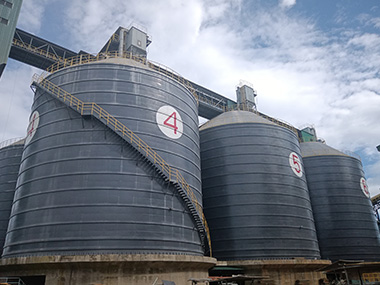

Silo Roof Inspection and Maintenance Engineering Guide
Silo roof failures don't announce themselves. They start as a 2mm crack above a manhole, a pinhole in a membrane, or a loose bolt ring that nobody tightens. This guide covers the inspection protocols, defect categories, and maintenance strategies we've refined across 30+ countries — because a roof leak in a cement silo isn't an inconvenience, it's a production killer.
1. Why Silo Roofs Fail Before the Shell Does
The shell gets all the attention. Thickness checks, hoop stress calculations, buckling analysis. But the roof? It's exposed to everything — UV, thermal cycling, condensation, wind uplift, chemical attack from vented dust — and it's the part most plants ignore until water's dripping onto their product.
1.1 Thermal Cycling and Fatigue Cracking
A steel roof deck in a desert plant sees surface temperatures swing from 12°C at 4am to 62°C by 2pm. That's a 50°C differential across a 15m diameter plate. The expansion works out to roughly 9mm of radial movement at the perimeter. Every single day. Over five years, that's 1,825 cycles of the roof trying to push its bolts sideways.
We inspected a clinker silo in UAE where the roof-to-wall connection had sheared 14 of 36 anchor bolts. The remaining ones were carrying double the load. Nobody had checked them in three years. The plant manager told us they'd "never had a problem." They had a problem — they just hadn't noticed it yet.
1.2 Condensation-Induced Corrosion
Here's what actually kills steel roofs: not rain from outside, but condensation from inside. Warm, moist air rises through the silo, hits the underside of the roof deck, and condenses. In a cement silo, that condensate picks up CO₂ and forms carbonic acid. pH drops to 4.5–5.0. At that rate, a 6mm carbon steel roof deck loses about 0.3mm of thickness per year on the underside.
The top side looks fine. You walk on it, it feels solid. Flip it over and you've got pitting corrosion that's eaten through 40% of the cross-section. I've seen this in Vietnam, Indonesia, and Colombia — always in humid climates, always on silos storing powder with moisture content above 0.5%.
1.3 Wind Uplift and Negative Pressure Events
When a silo discharges rapidly — say, a 2,000-tonne cement silo emptying at 300 tonnes/hour — the air displacement creates negative pressure inside. If the vent filter clogs or undersizes, that pressure drops fast. We've measured transient negative pressures of -2.5 kPa during emergency discharge events. The roof, designed for a dead load of maybe 1.2 kPa, suddenly has to resist uplift.
EN 1991-1-4 gives you the wind load calculations, but it doesn't account for the combined effect of wind uplift plus internal negative pressure during discharge. That's a load case most designers miss. We've added it to our standard design basis after seeing a roof panel pop off a slag silo in Poland during a winter storm. The panel landed 40m away. Nobody was hurt, but it could've been different.
2. Inspection Protocols That Actually Work
Walk the roof once a year. That's what most plants do. It's not enough. Here's the protocol we specify for our EPC projects — tiered by frequency and method.
2.1 Visual Inspection (Quarterly)
Quarterly walk-throughs. You're looking for:
- Standing water — any ponding deeper than 10mm after 48 hours of dry weather means the drainage is compromised
- Coating failures — blistering, peeling, or rust spots on the roof deck and structural members
- Seal condition at all penetrations — manholes, vent ports, level sensor entries, explosion vent frames
- Loose or missing fasteners — especially at the roof-to-wall connection ring
- Deflection — sight along the roof ribs; any visible sag between supports warrants measurement
Bring a camera. Photograph every penetration, every weld seam, every drain outlet. Compare to the previous quarter's photos. You're not looking for catastrophic damage — you're looking for the 5% change that tells you something's moving.
2.2 Detailed Structural Inspection (Annually)
Once a year, get a structural engineer on the roof. This isn't a walk-around — it's a measured survey:
- Thickness testing: Ultrasonic thickness gauges on the roof deck at a grid of no fewer than 20 points per 100m². Compare to original design thickness. If you're below 85% of nominal thickness, you've got a problem.
- Bolt torque verification: Check 20% of all accessible fasteners with a calibrated torque wrench. For M20 high-strength bolts at the roof-to-wall connection, you're looking for a minimum preload of 145 kN (per EN 1993-1-8). If more than 15% of checked bolts are below 80% of specified torque, retighten the full set.
- Weld inspection: Visual plus magnetic particle testing on primary structural welds — roof beam-to-column connections, hanger brackets, and the compression ring. Any crack indication over 3mm gets documented and monitored.
- Drainage test: Pour 20 litres of water at each drain point. It should clear within 5 minutes. If it doesn't, the outlet is partially blocked or the slope has deformed.
2.3 Drone and Remote Inspection (Semi-Annually)
For silos taller than 30m, sending a crew onto the roof every quarter gets expensive and risky. We've been using drones with 20MP cameras and thermal imaging for the past four years. A drone survey of a 45m-diameter silo roof takes about 90 minutes and captures imagery at 2mm resolution.
Thermal imaging is particularly useful. A wet insulation patch under a membrane roof shows up as a cold spot during daytime heating. We found a 3m² delamination on a fly ash silo in Malaysia this way — invisible to the naked eye, but a 4°C temperature differential on the thermal image. That patch would've become a leak within six months.
3. Common Defects and What They Tell You
Not every defect is equal. Some are cosmetic. Some are warnings. Some mean you need to shut down this week. Here's how we categorize them.
3.1 Category A — Immediate Action Required
These defects can lead to structural failure or contamination of stored material:
- Cracked or sheared anchor bolts at the roof-to-wall connection (more than 10% of bolts affected)
- Roof deck thickness below 70% of nominal — the structure is compromised
- Open cracks in primary structural welds (roof beams, columns, compression ring)
- Explosion vent frame distortion or seal failure — this is a life safety issue per EN 14491
- Roof deflection exceeding span/200 — the structure is approaching yield
If you find any of these, restrict access under the silo and engage a structural engineer within 48 hours. I'm not being dramatic. A roof collapse doesn't give you a warning.
3.2 Category B — Planned Repair Within 30 Days
These won't cause immediate failure, but they'll get worse fast:
- Localized corrosion with thickness between 70% and 85% of nominal
- Failed sealant at penetrations — water ingress risk
- Blocked or partially blocked roof drains
- Coating failure on structural members with visible rust scaling
- Loose fasteners (below 80% torque) affecting 5–15% of the connection
Schedule the repair during your next planned outage. Don't wait for the annual turnaround — 30 days is the window.
3.3 Category C — Monitor and Maintain
Document these and track them over time:
- Surface rust on non-structural elements (handrails, walkway grating)
- Minor coating chalking or fading
- Isolated fastener below torque (less than 5% of connection)
- Small areas of standing water (less than 10mm depth)
These go on your maintenance log. Re-inspect at the next quarterly walk-through. If they've progressed to Category B, act accordingly.
4. Maintenance Strategies and Repair Methods
Maintenance isn't just fixing what's broken. It's preventing the failure modes you know are coming.
4.1 Protective Coating Systems
The roof coating is your first line of defense. For carbon steel roofs in industrial environments, we specify a minimum system of:
- Zinc-rich primer: 75µm DFT (dry film thickness) — inorganic zinc silicate per ISO 12944 C5-M classification
- Epoxy intermediate coat: 125µm DFT
- Polyurethane topcoat: 75µm DFT
- Total system: 275µm DFT minimum
This system gives you 15–20 years of service life in a moderate industrial environment. In coastal or high-humidity locations, we bump the total to 350µm and add a third epoxy layer. The cost difference is about $8/m². The service life extension is worth ten times that.
Surface preparation matters more than the coating itself. We specify Sa 2.5 blast cleaning per ISO 8501-1. If you're coating over an existing system, feather the edges of intact coating by at least 50mm and ensure adhesion exceeds 5MPa pull-off strength per ASTM D4541. I've seen coatings fail at the interface because somebody skipped the feathering step. The whole sheet peeled off in one piece — like opening a tin can.
4.2 Drainage System Maintenance
Roof drains fail more often than any other roof component. Debris, dust, and frozen water block them. A blocked drain on a 20m-diameter roof can hold 3,000 litres of water after a moderate rain. That's 1.5 kPa of additional load — on a roof designed for 1.2 kPa.
Install debris baskets at every drain outlet. Clean them monthly. In cold climates, heat-trace the drain lines to 5°C minimum. We specify heat tracing at 15W/m for drain lines up to 50mm diameter. It costs about $35/m to install and $120/year in electricity per silo. Compare that to the cost of a collapsed roof.
4.3 Seal Replacement at Penetrations
Every penetration is a leak waiting to happen. Manholes, vent ports, cable entries, sensor mounts — each one is a discontinuity in the roof membrane. We use EPDM rubber gaskets for static seals and silicone-based sealants for joints subject to movement.
Replace all penetration seals every 5 years as a scheduled maintenance item. Don't wait for them to fail. EPDM loses about 15% of its compression set per year in UV exposure. After 5 years, it's lost its ability to seal. The cost to replace a manhole seal is about $200 in materials. The cost of water damage to 500 tonnes of cement? $50,000 and a week of lost production.
5. Safety and Access Considerations
You can't inspect or maintain a roof you can't safely access. And if you're sending people onto a silo roof, you need to think about fall protection, confined space entry, and structural capacity.
5.1 Fall Protection Systems
Any roof where the edge is more than 2m above the next level requires permanent fall protection. We install horizontal lifeline systems on all our EPC silo roofs — stainless steel cable, 8mm diameter, spanning the roof perimeter with intermediate supports every 6m. The system is designed per EN 795 for a maximum arresting force of 6kN.
Anchor points are welded to the structural steel, not the roof deck. We've seen plants install eyebolts through the deck membrane. That's a leak point. Every penetration through the deck is a future failure. Anchor to the structure, not the cladding.
5.2 Roof Load Capacity for Maintenance
When you send a crew onto the roof with tools, equipment, and coating materials, you're adding load. A typical maintenance crew of four with equipment weighs about 600kg concentrated in a small area. That's 6kN over maybe 4m² — 1.5 kPa point load.
Check the roof design load before planning any maintenance activity. If the roof was designed for 1.5 kPa uniform load, a concentrated crew load can exceed the local bending capacity of the deck. Use spreader boards or temporary mats to distribute the load. We specify a minimum distribution area of 2m² per person for maintenance operations.
5.3 Confined Space Entry
If your inspection requires entering the silo through the roof manhole, you're in a confined space. Full stop. That means atmospheric monitoring (O₂, CO, H₂S, LEL), standby rescue personnel, and a permit system per your local regulations. In China, that's GB 30871. In the EU, it's the Confined Spaces Directive. In the US, it's OSHA 1910.146.
We've had a near-miss on this. A crew in Indonesia entered a cement silo through the roof to inspect the interior lining. The silo had been empty for two weeks, but residual CO from the calcination process had accumulated in the lower section. The first worker felt dizzy at the 8m level. His partner pulled him out. They hadn't tested the atmosphere. They were lucky.
6. Documentation and Compliance
If you didn't write it down, it didn't happen. That's not just a maintenance philosophy — it's a legal requirement in most jurisdictions.
6.1 Inspection Records
Every inspection gets a report. Minimum content:
- Date, inspector name, and qualification
- Weather conditions (temperature, wind, recent rainfall)
- Defect log with location, category (A/B/C), and photograph reference
- Thickness measurements with grid reference
- Torque test results with bolt identification
- Recommended actions with priority and deadline
Keep these records for the life of the silo. When a failure occurs — and eventually, something will — your inspection history is your defense. It shows you knew about the defect, you prioritized it correctly, and you acted within a reasonable timeframe.
6.2 Design Basis Documentation
Maintain the original design documents: structural calculations, material specifications, coating system data sheets, and as-built drawings. When you're evaluating a defect, you need to know what the original specification was. A 5mm deck might be fine for a sand silo but inadequate for a cement silo with a central discharge cone adding 40 tonnes of concentrated load.
We provide all EPC clients with a digital twin of the silo — 3D model, material certificates, weld maps, and coating inspection reports. It's stored in a cloud-accessible format so the plant engineer can pull it up on a tablet while standing on the roof. That's not a luxury. It's how you make informed decisions in the field.
Case Study: Fly Ash Silo Roof Rehabilitation — Power Plant, India
Background: A 3,500-tonne fly ash silo, 18m diameter × 22m height, commissioned in 2011. The plant reported intermittent water leakage into the silo during monsoon season. Fly ash contamination required manual cleaning of 200 tonnes of wet material twice in one year.
Inspection Findings: Our team conducted a detailed survey in October 2022. The roof deck showed an average thickness loss of 1.2mm (original 6mm, measured average 4.8mm — 80% remaining). The EPDM seals at four penetration points had hardened and cracked. Two of six roof drains were completely blocked with hardened ash. The coating on the structural steel had failed across 60% of the surface area, with rust scaling up to 2mm deep.
Repair Scope: We replaced the roof deck panels in the worst-affected quadrant (approximately 25m²), installed new EPDM seals at all penetrations, cleared and heat-traced all drain lines, and applied a full coating system (275µm DFT) to all structural members. Total downtime: 9 days. Total cost: $47,000.
Result: No leakage reported in the following two monsoon seasons. The plant's maintenance team adopted our quarterly inspection protocol. Estimated annual savings from avoided contamination: $35,000.
Frequently Asked Questions
- How often should I inspect my silo roof?
- Quarterly visual inspections, annual detailed structural inspection with thickness testing and bolt torque verification, and semi-annual drone survey for silos over 30m tall. In harsh environments — coastal, high-humidity, or extreme temperature cycling — increase the detailed inspection frequency to every six months.
- What's the typical service life of a steel silo roof?
- With proper coating maintenance and scheduled seal replacement, a carbon steel roof in a moderate industrial environment lasts 20–25 years before major rehabilitation is needed. In aggressive environments (coastal, chemical exposure, high humidity), expect 12–15 years. Stainless steel roofs (304 or 316) can exceed 30 years with minimal maintenance, but the upfront cost is 3–4 times higher.
- Can I repair a corroded roof deck without replacing it?
- Yes, if the remaining thickness is above 70% of nominal. We use structural steel reinforcement — welding additional stiffeners or doubler plates to the underside — to restore load capacity. Below 70%, replacement is the only safe option. We've reinforced decks in the field using this method on silos in Brazil and Turkey, extending service life by 8–10 years at roughly 30% of replacement cost.
Need a professional silo roof inspection or rehabilitation?
Manxing provides EPC silo services across cement, fly ash, coal, slag, and aggregate plants in 30+ countries. Our engineers have inspected and repaired over 200 silo roofs in the field.