
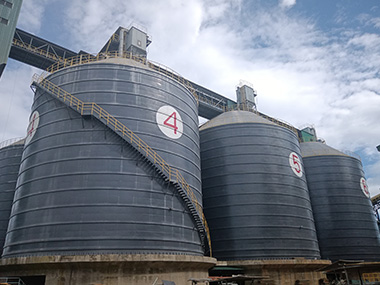

Industrial Silo Explosion Vent Inspection and Certification: A Field Engineer's Guide
How often do you need to inspect your explosion vents? Every six months, minimum. What standard governs the certification? EN 14491. If you can't answer both questions off the top of your head, your silo is a ticking time bomb. I've stood next to a 5,000-tonne coal silo when a vent failed to pop. The pressure wave buckled the roof. Don't let paperwork gaps kill your crew.
1. The Physics of Silo Explosions and Vent Sizing
You can't inspect what you don't understand. An explosion vent isn't a generic hole in the roof. It's a precisely engineered weak point designed to fail before the silo shell does. If you get the sizing wrong, the vent is just decorative.
1.1 Understanding Pmax and KSt Values
Every bulk solid has a dust explosion severity index. We call it KSt. For coal, it's typically 100 to 150 bar·m/s. For aluminum powder, it's over 300. The maximum explosion pressure (Pmax) usually sits between 7 and 9 bar for most industrial powders. Your vent sizing calculation depends entirely on these two numbers. If your process switches from storing cement (KSt < 150) to storing fly ash with high carbon content (KSt > 200), your existing vents are undersized. Full stop.
1.2 Vent Area Calculations and EN 14491
The cubic root law governs vent area. You're not calculating a linear ratio; you're calculating a volume-to-area relationship. For a 1,000 m³ silo handling St1 dust (KSt < 200), you might need 10 m² of vent area. But if that same silo handles St2 dust (KSt 200–300), you might need 18 m². EN 14491 gives you the exact formula, but you must input the correct KSt value. I've seen plants use the KSt value for the raw material instead of the processed dust. The processed dust is usually finer, meaning a higher KSt. That's a fatal math error.
2. Pre-Inspection Protocols and Documentation
Before you climb a ladder, you need to do your homework. Walking onto a silo roof without the right documentation is like performing surgery without an X-ray. You're guessing.
2.1 Gathering Design Specs and DExRA
You need the original Dust Explosion Risk Assessment (DExRA). This document dictates the required vent area, the static activation pressure (Pstat), and the reduced explosion pressure (Pred). If you don't have the DExRA, you're inspecting blind. I've been on sites where the DExRA was lost during a plant manager transition. We had to reverse-engineer the vent sizing from scratch. It cost them three days of downtime. Find the file. Read it. Verify the KSt value matches what you're actually storing today.
2.2 Isolation and Lockout Procedures
You cannot inspect a live silo. If the silo is under positive pressure from pneumatic conveying, the vent might pop the moment you touch it. Isolate the silo. Lock out the feeders, the blowers, and the aeration fans. Verify 0% LEL with a calibrated gas detector before you step onto the roof. I've seen guys try to inspect a vent while the silo is being filled. The aeration fans create a positive pressure. The vent pops, and they get a face full of cement. Lock it out. Every time.
3. Physical Inspection: What to Look For
Up on the roof, you're looking for three things: structural integrity, membrane condition, and mechanical freedom. If any of these fail, the vent fails.
3.1 Membrane and Seal Integrity
The composite membrane is the heart of the vent. It's usually fiberglass and silicone. Check for hairline cracks, UV degradation, and delamination. Run your hand along the surface. If it feels powdery, the silicone is gone. Check the gasket seating surface. If the gasket is compressed beyond 30% of its original thickness, it won't seal. Moisture gets in, corrodes the frame, and the vent rusts shut.
I was in Vietnam, inspecting a fly ash silo. The vent looked perfect from the ground. Climbed up, touched the membrane. It crumbled like a potato chip. UV had destroyed it. It wouldn't have opened at 0.1 bar. It would have held until 0.5 bar, which is too late for the silo shell. We replaced it that day.
3.2 Hinge and Latch Mechanisms
The vent door needs to swing freely. Coal dust acts like cement on hinges. Check for lateral play. More than 2 mm of lateral play means the pin is worn. Check the torque on the hinge bolts. We spec 120 Nm for M16 bolts on our standard vents. If they're loose, the door rattles, fatigues the membrane, and eventually tears. Lubricate the hinges with a dry graphite spray. Never use oil. Oil attracts dust, and dust seizes hinges.
Before you climb, check the vacuum break. If your silo has a vacuum relief valve, make sure it's not stuck. A stuck vacuum break means the silo can't equalize pressure during emptying. The vent won't open at the set pressure because the vacuum is holding it shut. Tap the vacuum break with a rubber mallet. If it doesn't rattle, clean it.
4. Certification and Compliance Testing
Inspection is visual. Certification is proof. You need both to satisfy an insurer or a regulatory body. If you can't produce a certificate, the vent doesn't exist in the eyes of the law.
4.1 Burst Pressure Testing and Factory Reports
Every vent leaves the factory with a Factory Test Report (FTR). This proves the membrane burst at the specified Pstat, usually 0.1 bar ± 10%. You can't easily field-test a burst pressure without destroying the vent. What you can do is verify the serial number on the vent matches the FTR. I've seen plants swap vents between silos during maintenance. A coal vent on a grain silo is a disaster waiting to happen. The burst pressures are different. Traceability is non-negotiable.
4.2 Documentation and ISO 15012 Compliance
ISO 15012 requires a documented dust explosion prevention and protection system. Your inspection records must include the date, the inspector's name, the vent serial number, and the findings. A clipboard in the control room gets lost. Use a digital tag. We put QR codes on our vents. Scan it, and you get the full history: installation date, last inspection, next inspection due, and the FTR. If an auditor shows up, you hand them a tablet, not a dusty folder.
5. Common Failure Modes and Field Fixes
Vents don't fail in a vacuum. They fail because of environment, neglect, or bad installation. Here's what I see most often in the field.
5.1 Corrosion and Chemical Attack
Coal absorbs moisture. It forms sulfuric acid. That acid eats through 3 mm steel in 18 months. If you're in a humid environment, you need 316L stainless steel frames, not carbon steel with a paint job. Paint chips. Acid doesn't care about paint. We spec 316L for all coal and slag applications. It costs 40% more upfront, but it lasts 10 years instead of 2.
5.2 Pest and Debris Obstruction
Pigeons love the warm roof of a cement silo. They build nests on the vent roof. A nest blocks 50% of the vent area. That means you need 100% more vent area to compensate. You don't have it. The silo explodes. Install bird spikes. Check for spilled product on the vent roof. If the vent is buried under 200 mm of fly ash, it can't open. Keep the roof clear.
6. Maintenance Schedules and Record Keeping
Set a schedule. Stick to it. If you wait until something breaks, you're not doing maintenance. You're doing emergency response.
6.1 The 6-Month Rule
Visual inspection every six months. Functional test annually. The functional test means manually tripping the vent door to verify it swings freely. Replace the membrane every five years, regardless of condition. UV and thermal cycling degrade the silicone. It might look fine, but it won't burst at 0.1 bar. It'll burst at 0.3 bar. That's the difference between a damaged silo and a totaled silo.
6.2 Digital Logs vs. Clipboards
Clipboards get lost. Digital logs don't. We use a cloud-based system for all our EPC projects. When an inspector scans the vent, the system logs the GPS coordinates, the timestamp, and the inspector's ID. If an inspection is missed, the system alerts the plant manager. It removes human error from the compliance chain.
Case Study: The Clinker Silo in Indonesia
We got a call from a plant in East Java. Their 3,000-tonne clinker silo had a vent that didn't open during a transfer. The pressure hit 0.3 bar before the roof ripped. The repair cost $450,000. We went out to inspect. The hinge pins were seized with clinker dust. The dust had mixed with rainwater and hardened like concrete. The vent door couldn't move. We replaced the hinges, installed dust shields on the vent frame, and implemented a quarterly hinge lubrication schedule. The total cost of the fix was $2,400. The math works.
Frequently Asked Questions
Q: Can I certify an explosion vent without a DExRA?
No. EN 14491 mandates a Dust Explosion Risk Assessment before you can size or certify a vent. The DExRA defines the KSt, Pmax, and Pred. Without it, you're guessing. If an insurer asks for your DExRA and you don't have it, they'll deny your claim after an incident.
Q: What happens if a vent opens accidentally during normal operation?
You have a process upset. The vent opened because the pressure exceeded the Pstat. Check your inlet temperatures. Hot clinker (over 80°C) can cause pressure spikes. Check your aeration system. If the aeration air volume exceeds the dust collection capacity, pressure builds. An accidental vent opening is a symptom, not the disease. Fix the process.
Q: How do I calculate the required vent area for a new silo?
Use the EN 14491 cubic root formula: A = K × V^(2/3). A is the vent area, V is the silo volume, and K is a factor derived from the KSt and Pred. Don't do this by hand. Use the EN 14491 spreadsheet or hire an EPC contractor. A 10% error in vent area can be the difference between a controlled vent and a catastrophic failure.
Protect Your Silo with Manxing
At Manxing, we don't just build silos. We engineer the entire bulk material storage system, including explosion protection. We handle the DExRA, the vent sizing, the installation, and the certification. We've commissioned silos in 30+ countries, and we've seen what happens when corners are cut. Don't let a $2,000 vent failure cost you $450,000 in damages. Contact our engineering team today for a site assessment and vent inspection protocol tailored to your plant.