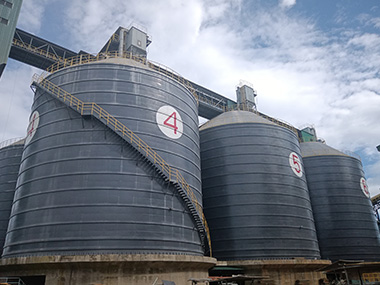
Plastic Resin Pellet Storage: Hygroscopic Material Handling
Plastic resin pellets such as PET, PA, PC, and ABS are highly hygroscopic, meaning they absorb ambient moisture rapidly—PET can gain 0.3–0.5% weight in 24 hours at 23 °C/50% RH. To prevent hydrolysis, silver streaks, and IV loss, pellets must be stored in sealed silos under dry-air conditions (dew point ≤ −40 °C) and kept at 50–80 °C until processing.
Different resins absorb moisture at dramatically different rates. Polyamide 6 (PA6) can reach 2.5% equilibrium moisture content at 23 °C/50% RH, while polycarbonate (PC) absorbs only 0.13% under the same conditions. Polyethylene terephthalate (PET) sits at 0.25% equilibrium but suffers irreversible hydrolysis above 0.005% moisture during melt processing. ABS resin absorbs 0.3–0.6% moisture, sufficient to cause surface splay and internal voids in molded parts. Understanding these thresholds is the foundation of any storage system design.
1.2 Consequences of Improper Storage
Excess moisture in hygroscopic resins triggers hydrolysis during extrusion or injection molding, breaking polymer chains and reducing intrinsic viscosity (IV). In PET, every 0.01% moisture increase above 0.005% can drop IV by 0.02–0.03 dl/g, rendering bottle-grade resin unusable. PA6 with >0.2% moisture produces parts with 15–25% lower tensile strength and visible silver streaks. Surface defects, reduced impact resistance, and batch rejection rates exceeding 5% are common outcomes when storage conditions are not controlled.
1.3 Critical Moisture Thresholds for Processing
Industry standards define strict moisture limits: PET bottle-grade ≤ 0.005% (50 ppm), PA6/PA66 ≤ 0.15–0.20%, PC ≤ 0.02%, and ABS ≤ 0.10%. Achieving these levels requires not only proper storage but also integrated drying systems that reduce pellet moisture from ambient equilibrium down to processing-safe levels within 2–4 hours before melt processing.
2. Silo Design for Hygroscopic Resin Storage
2.1 Sealed Silo Construction and Materials
Storage silos for hygroscopic resins must be fully sealed with all-welded carbon steel or stainless steel construction, designed to maintain positive dry-air pressure of 50–100 Pa inside the vessel. Wall thickness ranges from 4–8 mm depending on silo diameter (typically 3–12 m). All flanges, manholes, and discharge connections use double-gasket seals. Internal surfaces are polished to Ra ≤ 3.2 μm to prevent material hang-up and cross-contamination between resin grades.
2.2 Dry-Air Blanketing Systems
A dedicated desiccant dryer unit supplies continuous dry air (dew point −40 °C to −60 °C) into the silo headspace and bottom aeration zones. Airflow rates of 0.5–1.0 m³/h per ton of stored resin maintain a moisture-free environment. Twin-tower desiccant dryers with automatic regeneration cycles ensure uninterrupted supply. Dew-point sensors at the silo inlet and outlet provide real-time monitoring, with alarms triggered if dew point rises above −35 °C.
2.3 Temperature Control and Insulation
For resins requiring warm storage (e.g., PET pre-crystallized at 160–180 °C), silos are equipped with external heating jackets or internal coil systems maintaining 50–80 °C. Insulation thickness of 75–100 mm rock wool with aluminum cladding limits heat loss to ≤ 5 W/m². Temperature sensors at three vertical levels (top, middle, bottom) detect stratification and trigger recirculation fans to maintain uniformity within ±3 °C.
Engineering Tip: Always size silo discharge cones at 60–70° wall angle with fluidization pads for hygroscopic resins. Steeper angles prevent bridging caused by moisture-induced pellet agglomeration, ensuring mass-flow discharge without dead zones.
3. Material Handling and Conveying Integration
3.1 Pneumatic Conveying Under Dry Air
Resin transfer from storage to processing machines uses closed-loop pneumatic conveying with dry-air carrier gas (dew point ≤ −40 °C). Dilute-phase systems operate at 0.3–0.5 bar(g) with conveying velocities of 20–25 m/s. Pipeline materials are 304 stainless steel with electro-polished interiors (Ra ≤ 1.6 μm) to minimize friction and prevent fines generation. Each conveying cycle includes a pre-purge phase that flushes residual moisture from the line.
3.2 Dosing and Drying Integration
Automated dosing systems deliver resin from the storage silo to portable drying hoppers positioned at each processing machine. Drying hoppers hold 2–4 hours of material at 160–180 °C (for PET) or 80–120 °C (for PA), reducing moisture from storage-level (0.1–0.3%) to processing-safe levels (≤ 0.005%). Load-cell-based dosing accuracy of ±0.1% ensures consistent batch-to-batch quality. Centralized drying reduces energy consumption by 20–30% compared to individual machine-mounted dryers.
3.3 Contamination Prevention Protocols
Multi-grade facilities use dedicated silos, conveying lines, and filters for each resin type. Color-coded pipeline labeling, RFID-tagged transfer connections, and automated valve interlocks prevent cross-contamination. Silo changeover procedures include a 30-minute dry-air purge cycle and residual material sampling. Facilities handling food-grade or medical-grade resins implement HEPA-filtered air intake and positive-pressure clean room environments around discharge stations.
4. Monitoring, Automation, and Quality Assurance
4.1 Real-Time Moisture and Temperature Monitoring
Each silo is instrumented with capacitive moisture sensors at multiple levels, PT100 temperature probes, and differential pressure transmitters for level detection. Data is logged every 30 seconds via PLC and displayed on SCADA dashboards. Trend analysis algorithms detect moisture ingress patterns (e.g., slow dew-point rise indicating seal degradation) and trigger preventive maintenance alerts before material quality is compromised.
4.2 Batch Traceability and Quality Documentation
Automated batch management systems record every fill event, including supplier lot number, fill timestamp, dry-air dew point, and silo temperature profile. When material is discharged to processing, a digital certificate of conformance is generated showing complete storage history. This traceability is essential for ISO 9001 and automotive IATF 16949 compliance, where resin storage conditions must be documented for every production lot.
4.3 Energy Optimization Strategies
Modern hygroscopic resin storage systems incorporate heat recovery from drying exhaust air, reducing energy consumption by 15–25%. Variable-frequency drives on dry-air blowers adjust airflow based on real-time moisture sensor readings rather than running at constant maximum capacity. Insulated silos with thermal bridging elimination cut heating energy by 30–40% compared to uninsulated designs. Annual energy costs for a 500-ton PET storage system can be reduced from approximately $45,000 to $32,000 through these integrated optimizations.
5. Case Study: PET Bottle-Grade Resin Storage System
A beverage packaging manufacturer in Southeast Asia required storage and handling for 2,000 tons of PET bottle-grade resin (IV 0.80–0.84 dl/g) across 8 production lines. The existing open-silo system resulted in 3.2% batch rejection due to moisture-related IV drops and silver streak defects.
The implemented solution included eight 250-ton sealed stainless-steel silos with −50 °C dew-point dry-air blanketing, external heating jackets maintaining 65 ± 3 °C, and a centralized twin-tower desiccant drying system. Closed-loop pneumatic conveying with 304 SS electro-polished pipelines connected all silos to 16 processing machines. Integrated SCADA monitoring tracked moisture, temperature, and flow rates in real time.
After commissioning, batch rejection dropped from 3.2% to 0.4%, IV consistency improved to ±0.01 dl/g, and annual energy costs decreased by 22%. The system paid back its investment within 14 months through reduced scrap, lower energy consumption, and eliminated rework costs.
6. Frequently Asked Questions
Q1: What is the maximum allowable moisture content for PET resin before processing?
PET bottle-grade resin must contain no more than 0.005% (50 ppm) moisture before entering the injection or blow-molding machine. At moisture levels above 0.02%, hydrolysis during melt processing causes measurable IV loss, and above 0.05% the resin becomes unsuitable for bottle applications due to hazing and reduced mechanical properties.
Q2: How often should dry-air desiccant beds be regenerated?
Desiccant beds in twin-tower dryers typically regenerate every 4–8 hours depending on inlet air humidity and throughput. Automatic regeneration based on dew-point monitoring (rather than fixed timers) extends desiccant life by 30–40% and ensures consistent outlet quality. Molecular sieve desiccant should be replaced every 3–5 years under normal operating conditions.
Q3: Can hygroscopic resins be stored in outdoor silos in tropical climates?
Yes, but outdoor installations in tropical climates (ambient RH 70–90%) require additional engineering: double-wall silo construction with 100 mm insulation, weather-shrouded roof structures, heated discharge hoppers, and oversized dry-air systems (1.5× capacity factor). Condensation on silo walls is the primary risk, addressed by maintaining internal air temperature 5–10 °C above ambient dew point at all times.
Partner with Manxing for Your Hygroscopic Resin Storage Project
Manxing delivers complete EPC solutions for plastic resin pellet storage, from process design and silo fabrication to dry-air system integration and automation commissioning. Our engineering team has designed over 300 hygroscopic material storage systems across 40+ countries, handling resins from PET and PA to engineering-grade PC and PBT.
Contact Manxing today to discuss your resin storage requirements and receive a customized technical proposal with energy analysis, 3D layout, and ROI projection. Visit manxingstorage.com or email our project engineering team directly.