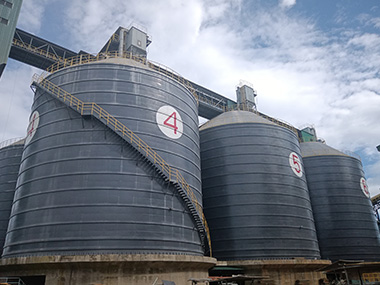
Sugar Storage: Anti-Caking Engineering for Refined Sugar Silos
Refined sugar caking in silos is primarily caused by moisture migration and temperature fluctuations that dissolve surface sucrose crystals, which then re-solidify into hard agglomerates. The most effective anti-caking engineering combines controlled humidity storage (below 55% RH), aeration systems maintaining 25–30°C uniform temperature, and fluidized bottom designs that eliminate dead zones. This article details the structural, mechanical, and operational strategies that prevent sugar bridging and ensure consistent discharge from bulk storage silos.
1. The Mechanism of Sugar Caking: Understanding the Root Cause
Figure 1Figure 2Figure 3
Before designing anti-caking solutions, engineers must understand how refined white sugar deteriorates during bulk storage. Sugar caking is not a single phenomenon but a cascade of physical and chemical reactions driven by environmental conditions.
1.1 Moisture Absorption and Surface Dissolution
Refined sucrose has a critical relative humidity (CRH) of approximately 85% at 20°C. However, even at lower ambient humidity, sugar particles absorb moisture on their surface micro-roughness. A thin film of sucrose solution forms, bridging adjacent crystals. When humidity drops, this film recrystallizes, creating solid bridges between particles. A storage silo experiencing daily humidity swings between 40% and 70% can see surface moisture content rise from 0.02% to 0.06% within 48 hours—sufficient to initiate caking.
1.2 Temperature Gradient-Induced Migration
Temperature differentials between the silo wall and the sugar core drive moisture migration. In a 30-meter-tall silo, a 10°C wall-to-core gradient can cause moisture to migrate inward at rates of 0.3–0.5% per week. The center zone accumulates moisture while the wall-adjacent zone dries and hardens, creating a crust that blocks discharge gates. Seasonal variations amplify this effect, with summer-to-winter transitions producing the most severe caking episodes.
1.3 Crystal Fines and Static Charge Effects
Sugar handling generates fine particles below 100 μm, which have higher surface-area-to-volume ratios and absorb moisture 3–5 times faster than standard crystals. Additionally, pneumatic conveying systems can impart static charges of 2–5 kV, causing fine particles to agglomerate electrostatically. These pre-agglomerated fines serve as nucleation sites for larger caking structures.
2. Silo Structural Design for Anti-Caking Performance
The geometry and internal configuration of a sugar storage silo directly influence caking severity. Proper structural engineering eliminates the physical conditions that promote moisture accumulation and bridging.
2.1 Hopper Geometry and Wall Friction Management
Mass flow hoppers with angles of 65–70° from horizontal ensure all sugar remains in motion during discharge, preventing stagnant zones where caking initiates. Wall friction coefficients must be below 0.35 (sugar-to-surface) to guarantee mass flow. Stainless steel 304L with electropolished finish (Ra ≤ 0.8 μm) achieves friction coefficients of 0.28–0.32, while carbon steel with epoxy coatings typically measures 0.40–0.55, promoting funnel flow and wall buildup.
2.2 Silo Diameter-to-Height Ratio Optimization
Higher column pressures increase inter-particle contact forces and accelerate crystal bridge formation. For refined sugar (bulk density 850–900 kg/m³), the optimal diameter-to-height ratio is 1:2.5 to 1:3.5. A 40-meter-tall silo storing 5,000 metric tons should have a minimum diameter of 14 meters. Exceeding 1:4 ratios without internal pressure-relief structures results in compaction zones below 15 meters depth where unassisted discharge becomes impossible.
2.3 Thermal Insulation and Jacket Design
External insulation with 100–150 mm polyurethane foam (thermal conductivity 0.022 W/m·K) limits wall temperature fluctuations to ±2°C annually. For tropical climates, insulated silos with internal temperature monitoring at three heights (top, middle, bottom) maintain core temperatures within ±3°C of the setpoint. Double-wall jacket designs with air gaps of 50 mm further reduce condensation risk on the inner wall surface.
3. Active Anti-Caking Systems and Equipment
Passive structural design alone cannot eliminate caking in long-term storage. Active systems provide continuous environmental control and mechanical disruption of forming agglomerates.
3.1 Forced Aeration and Dehumidification Loops
Low-pressure aeration systems (200–500 Pa) distribute conditioned air through perforated floor panels or radial diffusers at flow rates of 0.5–1.0 m³/h per metric ton of stored sugar. The air is dehumidified to 30–40% RH using silica gel rotary desiccant systems, reducing sugar moisture content to a stable 0.02–0.04%. Aeration cycles of 2 hours on / 4 hours off maintain uniformity without excessive energy consumption, typically consuming 0.8–1.2 kWh per metric ton per month.
3.2 Fluidized Bed Bottoms and Air-Assist Discharge
Fluidized bottom silos use porous ceramic tiles or sintered polymer panels covering 15–25% of the hopper floor area. Compressed air at 100–200 kPa fluidizes the sugar mass, reducing its apparent density from 880 kg/m³ to 650–700 kg/m³ and eliminating bridging. For existing silos retrofitted with flat bottoms, air cannons (0.5–1.0 m³ capacity, 6–8 bar) mounted at 1.5-meter intervals provide pulsed discharge assistance, breaking bridges up to 2 meters in diameter.
3.3 Anti-Caking Agent Dosing Systems
Calcium stearate or silicon dioxide (food-grade, 0.1–0.3% by weight) can be applied at the silo inlet via precision screw feeders. These agents coat sucrose crystals with hydrophobic layers, reducing moisture absorption by 40–60%. Automated dosing synchronized with the conveyor belt speed ensures uniform application at 1–3 kg per metric ton of sugar, maintaining product purity within food-grade specifications (FDA 21 CFR 172.480).
Engineering Tip: Install temperature and humidity sensors at 5 vertical levels (every 8 meters in a 40m silo) with wireless data logging at 15-minute intervals. A differential exceeding 4°C between any two adjacent sensors indicates active moisture migration requiring immediate aeration intervention. This early-warning system reduces caking incidents by over 70% in year-round monitoring programs.
4. Operational Protocols for Long-Term Sugar Storage
Even optimally designed silos require disciplined operational procedures. Human factors and scheduling decisions significantly impact caking outcomes.
4.1 First-In-First-Out (FIFO) Rotation Schedules
Refined sugar stored beyond 90 days shows measurable caking progression even under controlled conditions. FIFO rotation limits maximum residence time to 60–75 days. For silos with multiple compartments, alternating filling and discharge cycles every 14 days ensures no sugar mass remains undisturbed beyond the critical window. Inventory management systems with RFID batch tracking automate rotation scheduling.
4.2 Pre-Storage Conditioning and Quality Checks
Sugar entering the silo should be preconditioned to moisture content below 0.04% and temperature within ±5°C of the silo ambient. Incoming batches exceeding 0.06% moisture require flash drying or blending with drier stock before storage. Portable near-infrared (NIR) moisture analyzers at the silo inlet provide real-time readings with ±0.01% accuracy, enabling immediate rejection of non-conforming batches.
4.3 Seasonal Operation Adjustments
During monsoon or high-humidity seasons (ambient RH > 75%), aeration systems should run continuously rather than on intermittent cycles. Dehumidifier capacity must be sized for peak moisture load—typically 1.5× the base design capacity. In winter, heating elements in the aeration loop prevent cold-wall condensation, maintaining supply air at 28–32°C regardless of ambient conditions.
Case Study: 8,000-Ton Refined Sugar Terminal Silo — Southeast Asia
Challenge: A port terminal storing 8,000 metric tons of refined sugar experienced 12 bridging incidents per year, each requiring 2–3 days of manual intervention with pneumatic hammers and resulting in $45,000–$80,000 per incident in lost throughput and labor costs.
Solution: Engineering retrofit included: (1) electropolished stainless steel liner installation in the lower 8 meters of the silo wall, reducing friction coefficient from 0.48 to 0.30; (2) fluidized bottom retrofit with 22% floor coverage using sintered alumina tiles; (3) 500 kg/h desiccant dehumidification system supplying 35% RH aeration air; (4) 15 wireless temperature/humidity sensors with automated alarm thresholds.
Results: After 18 months of operation, zero bridging incidents were recorded. Sugar moisture content remained stable at 0.025–0.035%. Discharge rate increased from 180 t/h to 280 t/h due to consistent mass flow. Total project ROI was achieved in 14 months through eliminated downtime and increased throughput.
Frequently Asked Questions
Q1: What is the maximum safe storage duration for refined sugar in a standard silo?
Under controlled conditions (humidity below 55% RH, temperature 25–30°C ±3°C), refined sugar can be stored for 90–120 days without significant caking. Beyond this period, crystal bridge strength increases exponentially, and discharge difficulty rises. With active aeration and anti-caking agents, storage can extend to 180 days, but FIFO rotation within 75 days remains the recommended best practice.
Q2: Can existing concrete silos be retrofitted for anti-caking performance?
Yes. Concrete silos can be upgraded with internal stainless steel liners (2–3 mm thickness, welded seam), fluidized bottom inserts, and external insulation jackets.