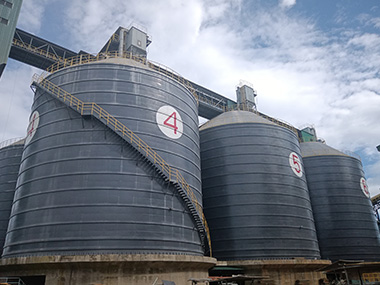
Wheat Flour Storage: Sanitary Design and Contamination Prevention
Sanitary wheat flour storage design integrates food-grade materials, sealed structural geometries, and controlled atmospheric conditions to eliminate pathogen harboring, pest entry, and cross-contamination. Contamination is prevented through a combination of hygienic surface finishes (Ra ≤ 0.8 μm), positive-pressure aeration systems, and integrated pest management protocols that maintain flour quality from intake to discharge. This article examines the engineering standards, material specifications, and operational procedures that define modern sanitary flour silo systems.
Wheat flour is a low-moisture food (typically 12–14% water activity), which inhibits bacterial growth but does not eliminate risk entirely. Salmonella spp. can survive in dry flour environments for over 12 months, and outbreaks have been traced directly to contaminated silo systems. Fungal contamination—particularly Aspergillus, Penicillium, and Fusarium species—thrives when localized moisture pockets form due to condensation or inadequate ventilation. Mold growth initiates at relative humidity levels above 70% and temperatures between 20–35°C, producing mycotoxins such as deoxynivalenol (DON) and aflatoxin B1 that exceed regulatory limits (EU limit: 1.75 μg/kg total aflatoxin for processed cereal products). Residual flour deposits on silo walls and internal structures serve as nutrient substrates for microbial colonization, creating persistent contamination sources that re-infect subsequent batches.
1.2 Chemical and Physical Hazard Sources
Chemical contamination arises from lubricant migration, cleaning agent residues, and fumigant retention. Pest control treatments using phosphine (PH₃) require minimum aeration periods of 72 hours before flour can be safely dispatched, with residual limits set at 0.01 ppm by FDA regulations. Physical contaminants include metal fragments from worn conveyor components, gasket material degradation, and welding slag from maintenance operations. Foreign body detection systems (magnetic separators, sieves with ≤1.0 mm aperture, and optical sorters) must be installed at both intake and discharge points. Silo construction materials themselves can introduce chemical hazards if non-food-grade coatings leach bisphenol A, heavy metals, or volatile organic compounds into stored flour.
1.3 Cross-Contamination Vectors in Shared Facilities
Multi-product facilities storing wheat flour alongside other grains (corn, rye, barley) face elevated cross-contamination risks. Allergen transfer—particularly gluten cross-contact for facilities handling gluten-free products—requires physical separation of silos, dedicated conveying lines, or validated flush protocols using 50–100 kg of sacrificial flour between product changeovers. Airborne flour dust migration between compartments occurs when differential pressure management fails; maintaining negative pressure in non-flour zones and positive pressure in flour storage areas prevents particulate drift. Personnel movement patterns, shared equipment (ladders, inspection platforms), and return air ducting must be designed to prevent biological and allergen transfer.
2. Sanitary Design Principles for Flour Silos
2.1 Material Selection and Surface Finish
Food-grade stainless steel (AISI 304 or AISI 316L for high-chloride environments) is the standard material for flour-contact surfaces. AISI 316L provides superior corrosion resistance in coastal or high-humidity environments, with a molybdenum content of 2–3% reducing pitting corrosion rates by 40–60% compared to 304 grades. Internal surface roughness must not exceed Ra 0.8 μm (32 μin) to prevent flour adhesion and facilitate cleaning; electropolished finishes achieve Ra 0.3–0.5 μm. Galvanized carbon steel silos are acceptable for dry flour storage when internal coatings meet FDA 21 CFR 175.300 requirements, with epoxy-based powder coatings applied at 80–120 μm thickness and cured at 180–200°C. All coatings must pass migration testing (total migration limit: 10 mg/dm² per EU Regulation 10/2011).
2.2 Structural Geometry for Self-Cleaning
Silo hopper angles must exceed the angle of repose for wheat flour (typically 45–50° from horizontal) to ensure mass flow discharge and prevent material stagnation. Conical hoppers require minimum 60° wall angles; for rectangular silos, chute angles of 65–70° eliminate bridging. Internal surfaces must be free of ledges, bolts, crevices, or dead spaces where flour can accumulate. Flush-mounted manways with clamp closures (instead of bolted flanges) reduce harborage points by 80%. Discharge cones should incorporate fluidizing pads or vibrators rated for food-zone use, operating at 0.3–0.5 bar air pressure. Roof designs with a minimum 30° pitch prevent dust accumulation, and all external stiffeners should be mounted outside the flour contact zone.
2.3 Sealing and Access Control
Complete silo sealing prevents pest ingress and moisture penetration. All joints, seams, and penetrations must be continuously welded or sealed with FDA-approved silicone gaskets (compliant with 21 CFR 177.2600). Pressure/vacuum relief valves should include 20-micron filtration to exclude insect entry during breathing cycles. Manway openings require double-gasket designs with interspace monitoring capability. Pest-proof screening on ventilation openings uses stainless steel mesh with ≤0.6 mm aperture (excludes adult Sitophilus granarius, the granary weevil, which measures 0.8–1.2 mm). Automated sealing systems on discharge valves prevent environmental exposure during non-operating periods.
💡 Critical Design Tip: Specify a minimum internal surface slope of 65° for all flour-contact hopper sections. Combined with electropolished stainless steel (Ra ≤ 0.5 μm), this geometry achieves 99.8% self-evacuation efficiency, eliminating residual deposits that serve as contamination incubators. For facilities with limited headroom, consider wedge-shaped hoppers with equivalent discharge performance.
3. Environmental Control Systems
3.1 Temperature and Humidity Management
Maintaining flour temperature within 15–25°C and relative humidity below 65% prevents condensation, mold growth, and insect activity. Grain cooling systems using ambient air aeration reduce silo core temperatures by 5–8°C per pass when external air is at least 5°C below product temperature. Automated aeration controllers activate fans (typically 0.1–0.3 m³/min per ton of stored flour) based on temperature differential sensors placed at 1-meter intervals along the silo height. Moisture migration driven by thermal gradients can increase local moisture content by 1–2% at the silo wall interface, necessitating continuous monitoring with capacitive humidity sensors (±2% RH accuracy). In tropical climates, insulated silo walls (50–80 mm polyurethane foam, U-value ≤ 0.4 W/m²K) prevent external condensation during nighttime temperature drops.
3.2 Aeration and Ventilation Strategies
Positive-pressure aeration systems force filtered ambient air through the flour mass, creating a slight overpressure (50–200 Pa) that prevents unfiltered air infiltration through silo openings. Air filtration must meet minimum efficiency reporting value MERV 14 (95% efficiency for 0.3–1.0 μm particles) to exclude airborne spores and dust. Aeration ducting uses perforated stainless steel floors with 30–40% open area, distributing air uniformly across the silo cross-section. Dedicated exhaust systems remove fine dust during filling operations, maintaining dust concentrations below the lower explosive limit (50 g/m³ for wheat flour, with OSHA PEL at 15 mg/m³ total dust). Cyclone dust collectors with rotary airlocks recover 99% of entrained flour particles.
3.3 Inert Atmosphere Options
For long-term storage exceeding 6 months, nitrogen-generating systems reduce oxygen concentration below 5%, eliminating insect metabolic activity and oxidative rancidity. Membrane-based nitrogen generators produce 95–99% N₂ purity at flow rates of 1–5 Nm³/hr per 100-ton silo capacity. Oxygen monitoring probes with electrochemical sensors (detection limit: 0.1% O₂) maintain target levels automatically. Modified atmosphere storage extends flour shelf life by 40–60% compared to ambient storage, with peroxide value increases limited to <2 meq O₂/kg fat over 12 months (vs. 5–8 meq O₂/kg under ambient conditions). This approach eliminates chemical fumigation requirements entirely.
4. Integrated Pest Management (IPM) Protocols
4.1 External Perimeter Defense
Physical barriers form the first line of defense: sealed concrete foundations extending 300 mm beyond the silo footprint prevent rodent burrowing; external bait stations spaced at 15-meter intervals around the facility perimeter use tamper-resistant stations with non-toxic monitoring baits; and vegetation-free zones of 1 meter width along silo walls eliminate insect harborage. Loading docks and truck bays employ rapid-roll doors (opening speed >1.0 m/s) with brush seals to minimize open-door time below 30 seconds during vehicle entry. External lighting uses sodium vapor lamps (wavelength 589 nm) positioned 10 meters from building entrances, as these attract 60% fewer flying insects than mercury vapor alternatives.
4.2 Internal Monitoring and Detection
Pheromone-baited traps for Tribolium castaneum (red flour beetle) and Ephestia kuehniella (Mediterranean flour moth) are placed at 20-meter intervals within storage areas, with weekly inspection protocols. Pitfall traps along silo perimeters detect rodent activity with infrared-triggered cameras providing 24/7 monitoring. Acoustic emission sensors mounted on silo walls detect insect feeding activity (larvae of Plodia interpunctella produce characteristic sounds at 2–4 kHz) at infestation levels as low as 1 larva per kg of flour. Data from all monitoring points feeds into centralized pest management software with trend analysis and automated alert thresholds.
4.3 Elimination Methods Without Chemical Residues
Heat treatment at 50–55°C for 24–48 hours achieves 100% mortality across all insect life stages (egg, larva, pupa