```html
Iron Ore Storage: Heavy Material Handling and Foundation Loads | Manxing
Iron Ore Storage: Heavy Material Handling and Foundation Loads
Iron ore storage presents two defining engineering challenges: managing extreme material weight that demands robust handling systems, and transferring enormous foundation loads safely into the ground. This article addresses both directly—explaining how bulk densities of 2.4–3.2 t/m³ require specialized silo structural designs, and how total loads exceeding 50,000 kN per silo necessitate rigorous geotechnical analysis and foundation engineering. For EPC contractors and plant operators, understanding these parameters is essential for safe, cost-effective iron ore storage facilities.
1. Iron Ore Properties and Their Impact on Storage Design
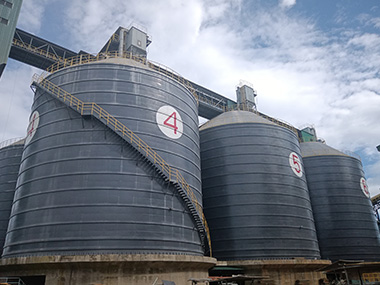
Figure 1Figure 2Figure 3
1.1 Bulk Density and Angle of Repose
Iron ore exhibits bulk densities ranging from 2.4 t/m³ for crushed ore up to 3.2 t/m³ for dense hematite and magnetite concentrates. This is roughly 2.5 to 3 times the weight of grain or cement stored in comparable silo volumes. The angle of repose typically falls between 35° and 42°, depending on particle shape and moisture content. Lump ore with angular particles tends toward the higher range, while pellets and concentrates settle closer to 35°. These values directly determine silo geometry—steeper hopper bottoms are required to ensure mass flow discharge, and wall pressures increase proportionally with bulk density.
1.2 Moisture Content and Flow Characteristics
Moisture content in stored iron ore varies from below 1% for dried concentrates to 8–12% for natural porous ores. Elevated moisture dramatically increases cohesive strength, promoting rat-holing and arching in hoppers. At moisture levels above 6%, iron ore fines can develop unconfined compressive strengths exceeding 5 kPa, which significantly raises the risk of flow obstruction. Storage design must incorporate flow-promoting hopper geometries—typically with outlet dimensions calculated using shear test data and flow factor analyses per established bulk solids engineering standards.
1.3 Abrasion and Wear Factors
Iron ore ranks among the most abrasive bulk materials in industrial handling. During loading and discharge, ore particles generate intense wear on silo walls, hoppers, and liners. Abrasion rates can exceed 2–4 mm of steel loss per year in high-velocity discharge zones. Engineering solutions include wear-resistant steel liners (Hardox 450 or equivalent), ceramic tile liners in hopper throats, and controlled-flow chutes that minimize direct impact on structural surfaces.
2. Structural Design for Heavy-Duty Iron Ore Silos
2.1 Wall Thickness and Reinforcement Strategy
Silo wall design for iron ore must account for both static and dynamic loads. Horizontal wall pressures calculated using bulk solids engineering theories can reach 80–150 kPa at the hopper transition for large-diameter silos storing dense ore. For a 25-meter-diameter silo storing magnetite concentrate (bulk density 3.0 t/m³) to a height of 30 meters, total vertical loads on the wall can exceed 45,000 kN. Wall thicknesses typically range from 16 mm to 30 mm for welded steel silos, with horizontal stiffeners spaced at 1.5–2.5 meter intervals. Concrete silo walls require equivalent reinforcement ratios of 0.5–0.8% to manage hoop tension.
2.2 Hopper Design and Flow Pattern Selection
Hoppers for iron ore storage must be designed for mass flow to eliminate dead storage and ensure complete discharge. Hopper half-angles for mass flow with iron ore fines typically range from 25° to 35° from vertical, depending on wall friction angles measured on actual ore samples. The critical arching dimension for a cohesive iron ore with 6% moisture can be 800–1,200 mm, dictating minimum outlet sizes. Funnel flow hoppers are generally avoided for iron ore due to segregation and flow reliability concerns, though they may be acceptable for coarse lump ore with low moisture.
3. Foundation Engineering and Load Management
3.1 Soil Bearing Capacity Requirements
A single large iron ore silo (25 m diameter, 30 m height, storing ore at 2