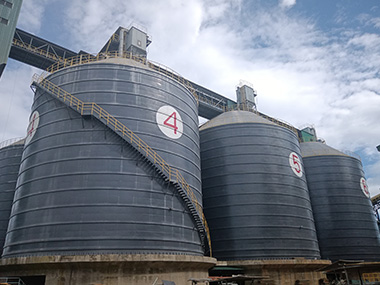
Salt Storage: Hygroscopic Material Handling Engineering
Salt storage requires specialized engineering due to salt's extreme hygroscopic nature, which causes rapid moisture absorption above 75% relative humidity. Proper silo design must incorporate sealed structures, dehumidification systems, and corrosion-resistant materials to prevent caking, bridging, and structural degradation. This article examines the critical engineering principles for safe, long-term salt storage across industrial applications.
Sodium chloride exhibits pronounced hygroscopic behavior, with deliquescence occurring at 75.3% relative humidity (RH) at 25°C. Below this threshold, salt remains stable; above it, surface dissolution begins, creating brine films that accelerate moisture migration. The equilibrium moisture content (EMC) of refined salt at 80% RH reaches 0.5–1.2% by weight within 24 hours of exposure. Temperature fluctuations compound this issue—a 10°C drop can cause condensation on silo walls even at ambient RH levels below the deliquescence point.
Critical Humidity Thresholds by Salt Type
Different salt grades exhibit varying hygroscopic thresholds. Vacuum-refined salt deliquesces at 75% RH, while rock salt with magnesium chloride impurities absorbs moisture at 65% RH due to MgCl₂'s lower critical humidity. Solar salt, containing calcium sulfate, demonstrates intermediate sensitivity at 72% RH. Engineers must specify dehumidification systems targeting 40–50% RH internal silo atmosphere to maintain a 25–35% safety margin below the most sensitive contaminant threshold.
Silo Design Considerations for Salt
Material Selection and Corrosion Resistance
Standard carbon steel corrodes at rates exceeding 0.5 mm/year in salt-rich atmospheres. Engineering specifications require hot-dip galvanized steel (minimum 85 μm zinc coating) or fiber-reinforced polymer (FRP) construction for silo shells. Internal surfaces require epoxy phenolic coatings rated for continuous immersion in 26% brine solution. Bolted seam designs outperform welded joints in salt environments, as weld zones develop micro-pitting that accelerates localized corrosion by 3–5× compared to base metal.
Aeration and Ventilation Systems
Silo aeration systems must maintain air velocity of 0.02–0.05 m/s through the salt bed to prevent moisture accumulation without causing dust generation. Ventilation capacity should achieve 4–6 air changes per hour, with intake air processed through desiccant dehumidifiers maintaining outlet dew points below -20°C. Hopper bottom silos require aeration pads at 300 mm intervals across the cone section, with air distribution manifolds designed for ±10% flow uniformity to prevent channeling.
Handling and Conveying Systems
Preventing Moisture Contamination During Transfer
Enclosed conveyor systems with inflatable gasket seals reduce moisture ingress by 98% compared to open belt configurations. Bucket elevators for salt service require NEMA 4X enclosures with continuous dry air purge at 0.5 m³/min per head section. Transfer points must incorporate dust collection systems operating at 80–100 mm water column negative pressure, with filter media selected for hydrophobic properties to prevent blinding from salt mist.
Flow Aid Technologies
Bin activators with 3–5 Hz vibration frequencies effectively break salt bridges without compaction. Fluidization cones using 0.3–0.5 bar compressed air at 1.5 Nm³/min per m² of cone area ensure mass flow discharge. For silos exceeding 15 m diameter, multiple discharge assist points spaced at 0.6× silo diameter intervals prevent rat-holing. Pneumatic flow aids outperform mechanical vibrators in salt applications, as vibration can increase bulk density by 8–12%, exacerbating compaction.
Environmental Control Strategies
Dehumidification Requirements
Desiccant rotor dehumidifiers with silica gel or lithium chloride rotors achieve outlet dew points of -40°C, consuming 0.8–1.2 kWh per kg of moisture removed. For a 5,000-ton salt silo with 300 m² surface area, a 500 kg/h moisture removal capacity system maintains target humidity with 15% safety margin. Rotary valve airlocks on silo vents, rated for 50 Pa pressure differential, prevent ambient air infiltration during thermal cycling.
Temperature Management
Internal silo temperature must remain 5°C above ambient dew point to prevent condensation. Insulated silo walls with 100 mm polyurethane foam (U-value ≤ 0.35 W/m²·K) eliminate thermal bridging. In cold climates, trace heating on hopper sections maintains 10–15°C surface temperature, consuming 15–25 W/m². Temperature sensors at 1 m vertical intervals provide real-time monitoring with ±0.5°C accuracy.
Engineering Tip: Always design salt silos with a minimum 30° hopper angle and surface roughness Ra ≤ 3.2 μm to ensure mass flow. Ratholing occurs when hopper angles fall below 25° or surface roughness exceeds Ra 6.3 μm, as salt-wall friction coefficients increase from 0.35 to 0.55 under these conditions.
Case Study: 10,000-Ton Refined Salt Silo Project
A chemical processing facility required storage for 10,000 tons of vacuum-refined salt (NaCl ≥ 99.5%) with maximum 0.3% moisture gain over 6-month storage cycles. The engineering solution featured a 32 m diameter × 18 m high carbon steel silo with 85 μm galvanized coating and internal epoxy phenolic lining. A 600 kg/h desiccant dehumidification system maintained internal RH at 45% ± 5%. The 60° hopper incorporated four fluidization cones and a bin activator. After 18 months of operation, moisture content remained at 0.18% (well below the 0.3% threshold), with zero bridging incidents and corrosion rates measured at 0.02 mm/year—96% below unprotected steel benchmarks.
Frequently Asked Questions
What is the maximum safe storage duration for bulk salt in sealed silos?
With proper dehumidification maintaining RH below 50%, refined salt can be stored indefinitely without quality degradation. Field data shows moisture content remains stable at 0.1–0.2% over 24-month periods when dew points are controlled below -15°C. Without climate control, caking begins within 2–4 weeks at ambient RH above 70%.
How does silo diameter affect salt storage performance?
Larger diameters increase the wall-area-to-volume ratio, reducing moisture infiltration per ton of stored salt. However, diameters exceeding 20 m require enhanced flow aid systems due to increased arching potential. The optimal economic diameter for salt silos ranges from 12–18 m, balancing construction costs against flow reliability and moisture control efficiency.
What maintenance intervals apply to salt silo dehumidification systems?
Desiccant rotors require inspection every 2,000 hours, with replacement at 15,000–20,000 hours depending on airborne salt particulate loading. Pre-filters on dehumidifier intakes need monthly replacement in salt storage applications. Annual calibration of humidity sensors (±2% RH accuracy) ensures control system reliability.
Engineer Your Salt Storage Solution with Manxing
As a leading EPC silo contractor, Manxing delivers turnkey salt storage systems engineered for hygroscopic material challenges—from corrosion-resistant construction to integrated dehumidification. Our projects span 500 to 50,000-ton capacities across 30+ countries.