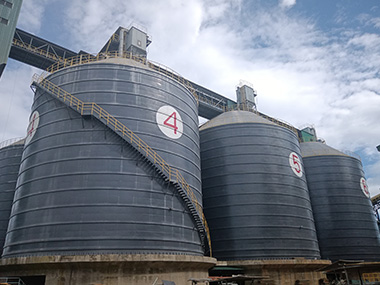
Biomass pellet storage facilities face significant dust explosion risks due to the combustible nature of wood and agricultural dust. This article examines the engineering controls, silo design parameters, and safety management systems required to mitigate explosion hazards in pellet storage operations. We address critical questions about minimum ignition energy thresholds, deflagration venting requirements, and the structural design standards that protect personnel and infrastructure from catastrophic dust explosions.
A dust explosion requires five simultaneous conditions: combustible dust, dispersion in air at sufficient concentration, confinement, an ignition source, and oxygen. Biomass pellets generate fine particulate matter during handling, with dust concentrations reaching 30–60 g/m³ in poorly ventilated silos. Eliminating any single element prevents explosion propagation. Engineering controls typically target dust concentration reduction and ignition source elimination as the most reliable intervention points.
Minimum Ignition Energy and Temperature Thresholds
Wood dust exhibits a minimum ignition energy (MIE) of 10–30 millijoules, making it susceptible to electrostatic discharge, mechanical sparks, and hot surface ignition. The layer ignition temperature for biomass dust ranges from 250–300°C, while cloud ignition occurs at 400–500°C. Pellet storage silos must maintain all surface temperatures below 70% of the cloud ignition threshold, requiring thermal monitoring systems with alarms set at 280°C for early warning intervention.
Deflagration Index (Kst) and Severity Classification
Biomass dust typically registers Kst values between 80–150 bar·m/s, classifying it as St1 (weak to moderate explosion severity). However, fine dust fractions below 200 μm can reach Kst values exceeding 200 bar·m/s, elevating classification to St2. Silo design must account for worst-case Kst scenarios, as deflagration pressure rise rates directly determine venting area requirements and structural reinforcement specifications.
Biomass Pellet Properties and Hazard Classification
Particle Size Distribution and Dust Generation Rates
Standard biomass pellets measure 6–8 mm in diameter with lengths of 10–30 mm. Mechanical degradation during conveying generates fines at rates of 0.5–2.0% per transfer point. A 5,000-ton storage facility with 12 transfer points accumulates approximately 300–1,200 kg of respirable dust monthly. Dust accumulation exceeding 1/32 inch (0.8 mm) on horizontal surfaces creates secondary explosion fuel loads that amplify primary event severity by factors of 3–10.
Moisture Content and Self-Heating Risks
Biomass pellets stored at moisture contents above 12% undergo exothermic biological degradation, with internal temperature rises of 1–3°C per day in poorly ventilated zones. Self-heating can progress to smoldering at 150–200°C within 2–6 weeks, creating persistent ignition sources. Storage silos require temperature monitoring cables spaced at 3-meter vertical intervals, with automated aeration systems activating when core temperatures exceed 60°C.
Volatile Organic Compound Emissions
Fresh biomass pellets emit terpenes, aldehydes, and organic acids during the first 4–8 weeks of storage. These volatile compounds lower the effective MIE by 15–25% and create flammable vapor-air mixtures in silo headspaces. Gas monitoring systems should detect VOC concentrations below 25% of the lower explosive limit, with forced ventilation maintaining headspace concentrations below 10% LEL during the initial storage period.
Silo Design Engineering for Explosion Prevention
Deflagration Venting Area Calculations
Venting area requirements follow the cubic root law: A = C × V^(2/3) / √P_red, where A is vent area (m²), V is silo volume (m³), P_red is reduced explosion pressure (bar), and C is a dust-specific constant. For a 3,000 m³ silo storing St1 biomass dust with P_red = 0.5 bar, minimum vent area calculates to approximately 4.2 m². Vent panels must open at static activation pressures below 0.1 bar and discharge to safe exterior locations minimum 5 meters from personnel areas.
Structural Reinforcement for Explosion Pressure Resistance
Silo shells must withstand maximum explosion pressures (P_max) of 8–10 bar for biomass dust. Cylindrical steel silos require wall thickness calculations per EN 14491, with typical specifications calling for 6–10 mm shell plates and circumferential stiffeners at 1.5-meter vertical spacing. Hopper sections experience 40–60% higher pressure loads due to flame acceleration, requiring additional reinforcement rings and thicker plate sections at transition zones.
Isolation and Flame Arrestor Systems
Explosion isolation prevents flame propagation between connected equipment. Mechanical rotary valves must achieve minimum closing times of 50 ms, with flame front arrestors rated for 150 bar·m/s Kst values. Pneumatic conveying lines require chemical isolation barriers that detect pressure waves within 5 ms and discharge suppressant within 15 ms. All isolation devices must be interlocked with silo access doors to prevent personnel entry during active explosion risk periods.
Operational Safety Management Systems
Housekeeping Protocols and Dust Control
Effective housekeeping reduces secondary explosion risk by maintaining dust layer thickness below 0.8 mm on all surfaces. Industrial vacuum systems with HEPA filtration (99.97% efficiency at 0.3 μm) should operate on scheduled cycles: daily for transfer points, weekly for structural members, and monthly for ceiling areas. Compressed air cleaning is prohibited in silo interiors due to dust cloud generation risks. Wet cleaning methods using biodegradable surfactants provide safer alternatives for enclosed spaces.
Ignition Source Control and Hot Work Management
All electrical equipment within Zone 22 dust atmospheres must meet ATEX II 3D certification with temperature classes T4 (135°C) or higher. Bearing temperature monitoring on conveyors and bucket elevators triggers automatic shutdown at 80°C. Hot work permits require atmospheric testing confirming dust concentrations below 10% of the minimum explosible concentration (MEC), with continuous monitoring throughout operations. Static dissipation systems maintain surface resistance below 10⁶ ohms, with grounding verification conducted quarterly.
Emergency Response and Suppression Systems
Active explosion suppression systems detect pressure rises within 1–3 ms and inject sodium bicarbonate suppressant at 3–5 kg/m³ within 10–20 ms. System design requires minimum suppressant concentrations of 100 g/m³ for biomass dust, with storage vessels sized for 3 consecutive discharge events. Emergency response plans must include silo evacuation procedures, isolation valve activation sequences, and coordination protocols with local fire departments trained in combustible dust firefighting techniques.
Engineering Tip: Install continuous oxygen monitoring in silo headspaces. Maintaining O₂ levels below 12% through nitrogen inerting reduces explosion probability by 85% while preserving pellet quality. This approach is particularly effective for long-term storage exceeding 90 days.
Case Study: 10,000-Ton Wood Pellet Terminal
A Scandinavian biomass terminal experienced a dust explosion in a 4,500 m³ steel silo during pellet discharge operations. Investigation revealed dust accumulation of 3–5 mm on internal structural members and a failed bearing on the bottom conveyor reaching 340°C. The explosion generated peak pressures of 6.2 bar, rupturing the silo roof and propagating through connected conveyor galleries. Post-incident engineering redesign included: installation of 8.5 m² deflagration vents, implementation of automated bearing temperature monitoring with 70°C alarm thresholds, deployment of robotic cleaning systems reducing dust layers to below 0.5 mm, and addition of chemical isolation barriers on all connecting ducts. The facility resumed operations 14 months later with zero dust-related incidents over subsequent 36 months of continuous operation.
Frequently Asked Questions
What is the minimum explosible concentration for biomass dust?
The minimum explosible concentration (MEC) for wood biomass dust ranges from 30–60 g/m³ depending on particle size, moisture content, and volatile compound levels. Dust clouds below this concentration cannot propagate flame. Engineering controls should maintain airborne dust concentrations below 25% of MEC (approximately 10–15 g/m³) as a safety margin.
How often should silo explosion protection systems be inspected?
Deflagration vent panels require monthly visual inspection for corrosion, obstruction, and seal integrity. Pressure-rated rupture disks need annual replacement regardless of condition. Explosion suppression systems demand quarterly functional testing with full discharge verification every 24 months. All inspection records must be maintained per NFPA 652 documentation requirements for minimum 5-year retention periods.
Can existing silos be retrofitted with explosion protection?
Yes, existing silos can be retrofitted through structural analysis and engineering modification. Typical retrofits include cutting vent openings with reinforcement frames, installing flameless vent devices for indoor applications, adding explosion isolation valves on connected ductwork, and implementing automated cleaning systems. Structural assessment must verify shell integrity can withstand predicted explosion pressures, with reinforcement added where P_max exceeds original design specifications by more than 20%.
Partner with Manxing for Engineered Biomass Storage Solutions
Manxing delivers turnkey EPC silo contracting for biomass pellet storage facilities worldwide. Our engineering team specializes in explosion-protected silo design compliant with EN 14491, NFPA 652, and ATEX directives. From hazard analysis and venting calculations to automated safety system integration, we provide complete solutions that protect your personnel, equipment, and operational continuity. Contact Manxing today to discuss your biomass storage project requirements and receive a comprehensive engineering assessment tailored to your specific material characteristics and regulatory environment.