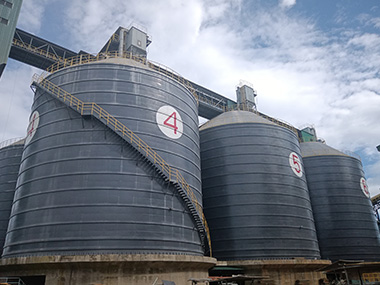
Lime Powder Storage: Cohesive Material Aeration Engineering
Lime powder storage presents unique challenges due to fine particle size (typically 1–50 μm), high cohesion, and moisture sensitivity, which cause rat-holing, bridging, and erratic discharge. Proper aeration engineering solves these issues by introducing controlled low-pressure air to fluidize the powder mass, reducing wall friction and promoting mass flow discharge.Effective aeration systems typically operate at 0.1–0.3 bar with air volumes of 1–3 Nm³/min per aeration pad, depending on silo diameter and material bulk density (400–650 kg/m³ for hydrated lime).
Particle Size Distribution and Cohesion Mechanisms
Hydrated lime (Ca(OH)₂) and quicklime fines exhibit mean particle diameters between 2–30 μm, with d₅₀ values commonly at 8–15 μm. At this scale, van der Waals forces dominate over gravitational forces, producing unconfined yield strengths (UYS) of 2–8 kPa measured via Jenike shear testing. The flow function ratio (ffc = σ₁/σc) typically falls between 1.0–2.0, classifying lime as a cohesive-to-very-cohesive powder requiring active discharge assistance. Cohesion increases exponentially below 5 μm due to surface area-to-mass ratio effects, with specific surface areas reaching 15,000–25,000 cm²/g for fine hydrated lime grades.
Moisture Content Thresholds and Flow Pattern Deterioration
Critical moisture content for hydrated lime is 0.5–1.5% by weight. Above 1.5%, capillary liquid bridges form between particles, increasing UYS by 40–80%. Hygroscopic absorption from ambient air at >60% relative humidity can raise moisture by 0.3–0.8% per 48 hours in unsealed silos. This moisture uptake shifts flow patterns from mass flow to funnel flow, creating stagnant zones where material ages and carbonates, reducing Ca(OH)₂ content by 5–15% over 30-day storage periods.
Aeration System Design Principles for Cohesive Powder Silos
Fluidization Velocity and Air Distribution Requirements
Minimum fluidization velocity (Umf) for lime powder ranges from 0.002–0.008 m/s depending on particle size and moisture. Design air velocity through aeration media should achieve 1.5–3× Umf to ensure uniform fluidization without channeling. For a 10m-diameter silo, total aeration air requirement is approximately 8–15 Nm³/h per aeration zone. Air distribution must maintain ±10% pressure uniformity across all pads to prevent preferential flow paths. Compressed air dew point should be ≤−40°C to prevent moisture introduction at the aeration interface.
Pad Arrangement Geometry and Coverage Ratios
Aeration pads should cover 15–25% of the hopper bottom area for cohesive powders, compared to 5–10% for free-flowing materials. Pad spacing follows the formula: S = 0.5 × D × tan(θf), where D is silo diameter and θf is the material's effective angle of internal friction (typically 35–50° for lime). Standard pad configurations include radial arrangements (6–12 pads for diameters 6–15m) and concentric ring layouts for larger silos (>15m). Each pad serves an effective fluidization radius of 1.5–2.5m, verified by pressure drop measurements across the material bed.
Silo Geometry and Discharge Enhancement Engineering
Hopper Slope Angles and Wall Friction Considerations
For mass flow lime silos, hopper slope angles must exceed the wall friction angle by ≥5°. Measured wall friction angles for lime against carbon steel range from 18–28° (polished) and 25–35° (rough/uncoated). Conical hoppers require slopes of 55–70° from horizontal for reliable mass flow. Wall surface finishes of Ra ≤3.2 μm (ground/polished) reduce friction by 15–25% compared to as-welded surfaces (Ra 12.5 μm). Stainless steel 304/316 liners or epoxy-based low-friction coatings (coefficient of friction μ ≤0.35) are recommended for high-moisture applications.
Mass Flow vs. Funnel Flow Design Implications
Mass flow design ensures first-in-first-out discharge, preventing material stagnation and quality degradation. Funnel flow silos for lime create a central flow channel with surrounding stagnant zones occupying 30–50% of total volume. These stagnant zones experience compaction pressures 2–3× higher than design predictions, leading to arching with span strengths of 15–40 kPa. Mass flow hoppers require steeper slopes and smoother walls but eliminate rat-holing and reduce aeration energy consumption by 30–50% due to more uniform material conditioning.
Operational Parameters and Control Systems
Air Pressure, Volume, and Timing Sequences
Intermittent aeration cycles are preferred over continuous operation to prevent over-fluidization and segregation. Typical cycle parameters: aeration ON for 5–15 seconds, OFF for 60–180 seconds, with air pressure at 0.15–0.25 bar at the pad inlet. Sequential zone activation (bottom-up) prevents air channeling upward through compacted material. Pulse aeration at 0.3–0.5 bar for 0.5–2 seconds effectively breaks arches without disturbing settled material. Total compressed air consumption for a 500-ton lime silo averages 2–5 Nm³/h during discharge operations.
Integrated PLC-Based Aeration Control
Modern aeration systems integrate with plant PLC/DCS via Modbus TCP or Profinet protocols. Control logic includes: discharge rate feedback (from weigh feeders or flow meters), automatic pad sequencing based on material level, moisture-compensated air volume adjustment, and fault detection (pad blockage, air leakage). HMI displays show real-time pad pressure, air flow per zone, and cumulative air consumption. Alarm thresholds trigger at >20% deviation from baseline pad pressures, indicating blockage or media degradation.
Engineering Tip: Always conduct bench-scale lime powder flow property testing (Jenike shear testing per ASTM D6128) before finalizing aeration system design. UYS values can vary by 50–100% between lime suppliers due to calcination temperature differences and hydration completeness. Design for the worst-case UYS value plus a 20% safety margin to ensure reliable discharge under all operating conditions.
Safety and Maintenance Considerations
Dust Explosion Prevention and Pressure Relief
Lime powder has a low explosion severity (Kst = 50–100 bar·m/s, St1 classification), but dust clouds at 200–500 g/m³ concentration present deflagration risk. Aeration systems must be grounded with resistance <10Ω to prevent static accumulation. Silo pressure relief panels should be sized per EN 14491, with vent area ≥0.05 m² per 10 m³ of silo volume. Inerting with nitrogen (O₂ <8%) is recommended for silos with potential ignition sources. Aeration air must be oil-free (Class 1 per ISO 8573-1) to prevent hydrocarbon contamination.
Aeration Pad Maintenance and Replacement Protocols
Porous aeration media (sintered polyethylene or ceramic) require inspection every 6 months. Pressure drop across pads should remain within ±15% of baseline (typically 20–50 mbar at design flow). Media replacement is indicated when: pressure drop exceeds 2× baseline (clogging), visible powder leakage occurs, or air distribution uniformity falls below 85%. Pad lifespan is 3–7 years for sintered PE and 5–10 years for ceramic media. Annual calibration of air flow measurement devices (±5% accuracy) ensures consistent aeration performance.
Case Study: 1,200-Ton Hydrated Lime Silo Aeration Retrofit
A cement plant's 1,200-ton hydrated lime silo (diameter 8.5m, height 22m) experienced chronic bridging at the hopper outlet (60° cone), requiring manual intervention 3–4 times per shift. Material moisture averaged 1.8% due to inadequate sealing. The retrofit included: installation of 8 sintered PE aeration pads (200mm diameter) in a radial hopper arrangement at 22% coverage ratio, polished stainless steel liner in the hopper (Ra 1.6 μm), PLC-controlled pulse aeration (0.2 bar, 10s ON/120s OFF), and desiccant dryer for aeration air (dew point −40°C). Post-commissioning results: zero bridging incidents over 18 months, discharge rate increased from 45 to 85 tons/hour, air consumption reduced by 40% compared to previous continuous aeration, and lime quality variation (Ca(OH)₂ content) decreased from ±8% to ±2%.
Frequently Asked Questions
What is the optimal aeration air pressure for lime powder silos?
Optimal aeration pressure ranges from 0.1–0.3 bar at the pad inlet. Higher pressures (>0.4 bar) cause air channeling through the powder bed, reducing fluidization effectiveness and potentially disturbing settled material. The exact pressure depends on material bed height above the pad—for a 10m bed of hydrated lime (bulk density 550 kg/m³), the theoretical fluidization pressure is approximately 0.15 bar. Always verify with pilot-scale testing.
How often should aeration pads be replaced in lime storage applications?
Sintered polyethylene pads typically last 3–5 years; ceramic pads last 5–8 years in lime service. Replacement indicators include: pressure drop increase >100% from baseline, visible powder leakage through the pad, or air distribution uniformity below 80%. Annual pressure drop measurements across each pad provide early warning of degradation. Proactive replacement at year 4–5 for PE pads avoids unplanned shutdowns.