
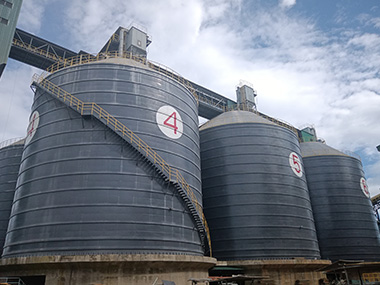

A bulk storage silo is a large structure designed to store bulk materials such as grain, cement, coal, fly ash, and other powders or granular materials. Silos are typically cylindrical with a conical or flat bottom and can be made from steel or concrete. They are essential in industries including agriculture, mining, cement production, and power generation.
Silos can store a wide variety of bulk materials including:
- Grains (wheat, corn, rice, soybeans)
- Cement and fly ash
- Coal and minerals
- Plastic pellets and chemicals
- Food products (flour, sugar, salt)
- Agricultural products (feed, fertilizer)
Material properties determine the appropriate silo design and features.
We follow international design standards including:
- Eurocode 3 Part 4-1: European standard for steel silos
- Eurocode 1 Part 4: Actions on silos (filling and discharge loads)
- ACI 313-97: American standard for silo design
- GB 50009: Chinese load code for structures
- ASME BPVC: For pressurized silo applications
All designs are verified by qualified structural engineers.
Silo wall thickness is calculated based on:
- Hoop tension: From internal material pressure using Janssen or Reimbert theory
- Wind loads: Circumferential bending from wind pressure
- Seismic loads: Dynamic forces from earthquake events
- Thermal loads: Expansion and contraction from temperature changes
- Buckling: Stability under external pressure and wind
Safety factors are applied per applicable design codes.
Erection time depends on silo size and type:
- Small bolted silos (50-200 tons): 1-2 weeks
- Medium welded silos (200-1000 tons): 3-6 weeks
- Large welded silos (1000-5000 tons): 2-3 months
- Very large silos (5000+ tons): 3-6 months
Foundation construction typically adds 4-8 weeks before erection begins.
Site preparation includes:
- Site survey: Topographic and geotechnical investigation
- Access roads: For construction equipment and material delivery
- Foundation construction: Concrete foundation with embedded anchor bolts
- Utilities: Power and water for construction activities
- Assembly area: Space for staging silo components
Recommended inspection schedule:
- Visual inspection: Monthly by operations staff
- Detailed inspection: Annually by qualified inspector
- Comprehensive assessment: Every 5 years
- Post-event inspection: After earthquakes, storms, or overfilling
Inspection should cover shell condition, foundations, roof, and accessories.
Common problems include:
- Bridging: Material arching over outlet - solved with aeration or vibrators
- Ratholing: Material sticking to walls - solved with wall liners or air cannons
- Corrosion: Wall thinning - solved with coating repair or plate replacement
- Leakage: At seams or penetrations - solved with resealing
- Foundation settlement: Differential settlement - solved with underpinning
Silo costs vary widely based on size and features:
- Small silos (50-200 tons): $15,000 - $50,000
- Medium silos (200-1000 tons): $50,000 - $200,000
- Large silos (1000-5000 tons): $200,000 - $800,000
- Very large silos (5000+ tons): $800,000+
Costs include structure, foundation, and basic accessories. Special features (heating, insulation, advanced aeration) add to the price.
Key cost factors include:
- Capacity: Larger silos cost more but have lower cost per ton Material: Steel vs concrete, grade selection
- Height: Taller silos require thicker walls
- Location: Transportation and labor costs vary
- Features: Aeration, insulation, special coatings
- Site conditions: Foundation requirements
- Seismic/wind loads: Higher loads require stronger structures
Essential safety features include:
- Pressure/vacuum relief valves: Prevent over-pressurization
- Level indicators: Prevent overfilling
- Temperature monitoring: Detect material heating
- Explosion vents: For combustible dust applications
- Access platforms and ladders: Safe access for inspection
- Lightning protection: For tall structures
- Earthing/bonding: Static electricity protection
Dust explosion prevention measures:
- Inerting: Reduce oxygen concentration with nitrogen
- Explosion venting: Safely relieve pressure if ignition occurs Suppression systems: Detect and suppress explosions early
- Housekeeping: Control dust accumulations
- Ignition source control: Eliminate sparks and hot surfaces
- Bonding and grounding: Prevent static discharge
Risk assessment per NFPA 654 is recommended for combustible materials.