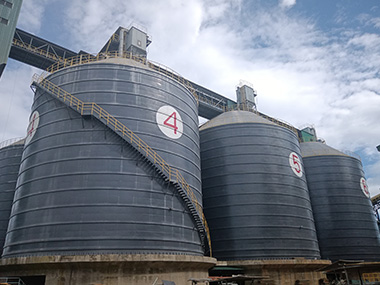
The initial silo filling process is the most structurally critical phase in a silo's operational life. This article details the pre-fill inspections, material conditioning, and rate-controlled loading protocols that prevent wall deformation and foundation settlement. Proper first-load procedures reduce structural risk by up to 80% compared to uncontrolled filling and ensure compliance with Eurocode and ACI 313 standards. Learn how to protect your investment from the very first ton of material.
Before any material enters the silo, a comprehensive verification sequence must confirm structural readiness. Skipping these steps risks catastrophic failure under unexpected load conditions.
1.1 Structural Integrity Documentation
Review all as-built drawings, weld inspection reports, and bolt torque records. Verify that wall panel connections achieve the specified preload — typically 70% of the bolt's proof load for ASTM A325 fasteners. Confirm that foundation concrete has reached at least 90% of its 28-day compressive strength, generally 30 MPa or higher for large-diameter silos.
1.2 Foundation Settlement Baseline
Establish survey benchmarks at minimum four equidistant points around the foundation perimeter. Record initial elevation readings with a precision level (±0.5 mm accuracy). These baselines serve as the reference for all future settlement monitoring. Differential settlement exceeding 1/500 of the silo diameter warrants immediate investigation.
1.3 Instrumentation Verification
Test all load cells, pressure sensors, and strain gauges connected to the SCADA system. Calibrate load cells to ±0.5% accuracy. Confirm that wall-mounted pressure sensors (typically piezoelectric, range 0–50 kPa) respond correctly to simulated inputs. Document all calibration certificates for compliance records.
2. Material Conditioning Requirements
The physical properties of the first-fill material directly influence flow patterns, wall pressure distribution, and potential segregation. Material that deviates from design assumptions introduces unpredictable loading scenarios.
2.1 Moisture Content Control
Measure moisture content of the incoming material batch. For cement, maintain below 0.5% to prevent caking and erratic flow. For fly ash, target 2–4% to control dusting without causing bridging. For grains such as corn or wheat, adhere to safe storage moisture thresholds — typically below 14% for cereal grains at ambient temperature. Excess moisture promotes internal condensation and wall adhesion, increasing localized wall pressure by 15–25%.
2.2 Temperature Equalization
Allow bulk material to reach thermal equilibrium with the silo environment. A temperature differential exceeding 15°C between material and shell induces differential thermal expansion. For steel silos, this creates hoop stress variations of up to 8 MPa. Store material in a covered staging area for a minimum of 12 hours before filling.
2.3 Pre-Blending and Homogenization
If the material is a blend (e.g., raw mix for cement production), ensure uniform composition before entry into the silo. Segregated material creates asymmetric density distribution, generating eccentric wall loading. Use a pre-blending hopper or gravity homogenization tower to achieve a coefficient of variation below 5% for the target component.
3. Filling Rate Control Protocols
Controlled filling rates allow the structure and foundation to adapt gradually to increasing loads. Rapid filling generates dynamic pressure surges that can exceed static design pressures by 30–50%.
3.1 Phased Loading Sequence
Divide the filling operation into defined phases. Phase 1: Fill to 20% capacity at a rate not exceeding 50% of the design throughput. Hold for 2 hours to monitor initial settlement. Phase 2: Fill to 50% capacity at 75% throughput. Hold for 4 hours. Phase 3: Fill to 100% at full design rate. Each phase transition requires sign-off from the structural engineer.
3.2 Differential Pressure Monitoring
During eccentric or concentric filling, monitor wall pressure differentials. The maximum allowable differential pressure across any 90° sector is 10 kPa for thin-walled steel silos. If readings exceed this threshold, immediately halt filling and redirect the feed point. Use multiple inlet points or a rotating distributor to maintain concentric loading.
3.3 Flow Pattern Management
Ensure mass flow or controlled funnel flow as designed. For funnel flow silos, maintain a minimum material head of 2 meters above the hopper transition to stabilize the flow channel. For mass flow silos, verify that the hopper slope angle exceeds the wall friction angle by at least 5° — typically requiring 30–35° from horizontal for polished steel surfaces handling cement.
Critical Tip: Never exceed 60% of the design fill rate during the initial fill of a newly commissioned silo. The first load permanently sets the foundation settlement profile. A conservative approach during this phase prevents irreversible differential settlement that cannot be corrected without emptying the silo.
4. Structural Monitoring During Filling
Continuous monitoring transforms the filling operation from a blind process into a data-driven engineering activity. Real-time feedback enables immediate corrective action.
4.1 Wall Displacement Tracking
Install dial gauges or LVDTs at 90° intervals around the shell circumference, positioned at mid-height. Record readings at 10% capacity increments. Maximum permissible radial deflection is H/300, where H is the silo height. For a 30-meter silo, this equals 100 mm. Any reading approaching 70% of this limit triggers a mandatory hold.
4.2 Foundation Settlement Logging
Take elevation readings at each benchmark after every 100 tons of material added. Plot settlement curves in real time. Uniform settlement up to 50 mm is acceptable for rigid ring foundations. Differential settlement must remain below 25 mm across the foundation diameter. If the settlement rate exceeds 5 mm per hour, pause filling and reassess.
4.3 Bolt Torque Re-Check
After reaching 50% capacity, re-torque all wall panel bolts in the lower third of the silo. Settlement and wall deflection can loosen connections. Apply the original specified torque plus 10% to account for relaxation. Document all re-torque values for the commissioning report.
5. Post-Fill Verification and Documentation
Completion of filling does not conclude the commissioning process. Post-fill verification confirms that the structure performed within design parameters and establishes the baseline for future operations.
5.1 Final Settlement Survey
Conduct a comprehensive survey 24 hours after reaching full capacity. Compare all benchmark readings to the baselines. Calculate total and differential settlement. Prepare a settlement contour map for the foundation. If differential settlement exceeds 1/500, implement corrective grouting under the foundation ring before declaring the silo operational.
5.2 Wall Geometry Inspection
Perform a full shell survey using a total station. Check for bulges, dents, or out-of-roundness. Maximum permissible out-of-roundness is D/500, where D is the silo diameter. For a 20-meter diameter silo, this equals 40 mm. Photograph any anomalies and measure with precision calipers.
5.3 Commissioning Report Compilation
Assemble all monitoring data, calibration certificates, inspection records, and photographic evidence into a formal commissioning report. Include as-built deviations, settlement curves, and pressure logs. This document becomes the legal and engineering baseline for warranty claims and future structural assessments.
Case Study: 30,000-Ton Cement Silo First Fill — Southeast Asia
A Chinese EPC contractor commissioned a 35-meter diameter, 30,000-ton capacity cement silo for a new grinding plant. The silo featured a reinforced concrete foundation ring and a thin-walled steel shell (12 mm lower rings, tapering to 6 mm upper rings). The initial fill was executed over 72 hours using a phased protocol: Phase 1 (0–20%) at 80 t/h, Phase 2 (20–50%) at 150 t/h, Phase 3 (50–100%) at the full 250 t/h design rate.
During Phase 2, differential settlement of 18 mm was detected between benchmarks at 90° and 270°. The team immediately reduced the fill rate to 100 t/h and redirected the feed to the opposite side. After 4 hours, differential settlement stabilized at 12 mm. Final survey at full capacity showed maximum settlement of 38 mm and differential of 14 mm — both within acceptable limits. Wall deflection peaked at 62 mm against a 100 mm allowable. The silo passed all verification criteria and entered full production without structural modification.
Frequently Asked Questions
Q1: Why is the initial silo fill more critical than routine refilling?
The first load permanently establishes the foundation settlement profile and sets residual stresses in the shell. Routine refilling operates within an already-settled system. Errors during initial fill — such as excessive differential settlement or localized overpressure — create permanent structural conditions that cannot be reversed without major intervention. The first fill essentially defines the silo's structural baseline for its entire service life.
Q2: What is the maximum recommended fill rate for a new silo?
As a general rule, do not exceed 50–60% of the design throughput during the initial fill. For a silo designed for 200 t/h, limit the initial fill to 100–120 t/h. The exact rate depends on foundation type, soil conditions, and silo geometry. Always follow the structural engineer's site-specific protocol, which accounts for local geotechnical data and the specific silo design.
Q3: What happens if pre-fill inspections are skipped?
Skipping pre-fill inspections risks undetected deficiencies — loose bolts, uncured concrete, or malfunctioning sensors — going unnoticed until the structure is under full load. This can lead to wall panel separation, foundation cracking, or sensor failure during a critical monitoring period. Documented inspections also provide legal protection and warranty validation. The cost of a thorough pre-fill inspection is negligible compared to the cost of structural remediation.
Ensure Your Silo's Structural Integrity from Day One
Manxing provides end-to-end EPC silo contracting with rigorous commissioning protocols backed by decades of engineering experience. Our first-load procedures follow international standards and are tailored to your site-specific conditions. From foundation design through post-fill verification, our engineers ensure every sil