
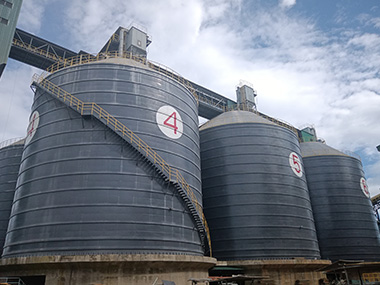

Corrosion Prevention and Repair for Industrial Steel Silos: A Field Engineer's Guide
How do you stop a steel silo from rusting? You control the environment and apply the right coatings. How do you fix it when it's already rusting? You cut out the bad steel and rebuild the protection system. I've spent 15 years fighting corrosion on silos across 30 countries. Here's what actually works.
Understanding the Enemy: Why Industrial Steel Silos Corrode
Corrosion isn't just surface rust. It's an electrochemical reaction that eats away at your structural integrity. You've got an anode, a cathode, and an electrolyte. In a bulk storage silo, the steel is both the anode and the cathode. The electrolyte? It's the moisture that condenses on your walls every single night. Once that reaction starts, it doesn't stop until you intervene.
Chemical Attack from Bulk Materials
Storing cement or clinker? The alkalinity is brutal. Cement dust has a pH between 12 and 13. When that alkaline dust settles on your steel and absorbs moisture, it creates a highly caustic electrolyte. It accelerates the corrosion rate exponentially compared to plain water. I remember a project in Malaysia where a coal silo lost 2mm of wall thickness in just 18 months. The sulfur content in the coal was 4%, and the ambient humidity hovered around 85%. The sulfur reacted with condensation to form sulfuric acid. The steel just dissolved.
Slag and fly ash are equally aggressive. They hold moisture against the steel surface, creating a continuous electrolytic bath. If you're storing alumina or gypsum, the hygroscopic nature of the material pulls moisture right out of the air and traps it against the silo wall. You can't just assume the material is dry. It never is.
Atmospheric and Condensation Cycles
Here's the thing about condensation: it's invisible until the damage is done. In regions with high diurnal temperature swings—think the Middle East or Central Asia—you'll see 40°C days and 20°C nights. The steel silo radiates heat quickly after sunset. By 3am, the wall temperature drops below the dew point. Water forms on the inside of the silo, dripping down and pooling at the boot. I've walked into silos in Saudi Arabia where the walls were literally weeping. The rust scale was 3mm thick. You could scrape it off with a screwdriver.
Coastal environments add salt to the equation. Salt aerosols penetrate microscopic coating defects and create a highly conductive electrolyte. A silo 500 meters from the coast will corrode twice as fast as one 10 kilometers inland. If you're near the coast, your design has to account for this from day one.
Prevention by Design: Building Corrosion Out from Day One
You can't paint your way out of a bad design. If the silo traps moisture, no coating system will last. Prevention starts with how you engineer the structure and manage the internal climate.
Material Selection and Galvanizing
For bolted steel silos, hot-dip galvanizing is the minimum standard. We specify a minimum zinc coating thickness of 85 microns per ASTM A123. That gives you a solid barrier against atmospheric corrosion. Electro-galvanizing? Don't bother. It only gives you 10 to 15 microns. It'll scratch off during bolt tightening.
Some engineers swear by Corten steel for silos. I don't. Corten forms a protective patina, but it requires wet and dry cycles to stabilize. Inside a silo, the environment is constantly wet. The patina never stabilizes, and the steel corrodes just as fast as mild steel. Save Corten for structural frames that are exposed to open air, not for silo walls holding damp slag.
Ventilation and Moisture Management
Condensation is a physics problem. You solve it by managing the dew point. The goal is to keep the internal air temperature above the dew point, or to remove the moisture entirely. We design aeration systems that push ambient air through the material at a rate of 0.1 to 0.2 CFM per square foot of wall area. This airflow strips the moisture off the steel before it can form an electrolyte.
Roof ventilation is equally critical. A silo is a giant chimney. Hot air rises and hits the roof. If you don't provide adequate venting—typically 1 square foot of vent area per 1,000 cubic feet of silo volume—that moisture condenses on the underside of the roof and drips back down. I've seen roof panels rusted through in 3 years because the vent was undersized. The rest of the silo was fine. The roof was scrap.
Protective Coatings: The First Line of Defense
If you're building a welded steel silo, or if you need extra protection on a galvanized bolted silo, coatings are your primary defense. But a coating is only as good as the surface prep underneath it. 80% of coating failures trace back to poor surface preparation. If you skip the blast, you're wasting your money on paint.
Surface Preparation Standards
You have to remove all mill scale, rust, and contaminants. We specify abrasive blasting to ISO 8501-1 Sa 2.5, which is near-white metal. The surface profile—the anchor pattern—needs to be between 50 and 75 microns. If the profile is too shallow, the coating won't adhere. If it's too sharp, you get pinpoint rusting at the peaks. I've watched contractors skip the blast and just wire-wheel the steel. The coating peeled off in sheets within 18 months. We had to re-blast the entire 5,000-tonne silo in the rain. It cost them $45,000 in downtime.
Coating Systems for Extreme Environments
For cement and clinker silos, we use a three-coat system. First, a zinc-rich epoxy primer with 80% zinc by weight in the dry film. This provides cathodic protection—if the coating is scratched, the zinc sacrifices itself to protect the steel. Second, a high-build epoxy intermediate coat at 125 microns DFT (dry film thickness). This is your barrier against chemical attack. Third, a polyurethane topcoat at 50 microns DFT for UV resistance. Total DFT: 200 to 250 microns. We test for holidays—pinhole voids—using a spark tester at 100 volts per 25 microns of coating thickness. Every single square meter gets tested.
For highly abrasive materials like slag or sand, we add a ceramic epoxy lining. It's a two-component epoxy filled with alumina particles. We apply it at 1,000 to 1,500 microns DFT. It handles the abrasion and the chemical attack. It's expensive—around $80 per square meter installed—but it lasts 15 years instead of 5.
Repair Strategies When Corrosion Takes Hold
You can't ignore wall loss. A silo is a pressure vessel. It handles vertical compression, hoop tension, and wind loads. If you lose 40% of your wall thickness, the structural integrity is compromised. You have to assess, decide, and repair.
Assessing Structural Integrity
We use Ultrasonic Thickness Testing (UTT) to measure wall loss. You can't eyeball it. Rust scale is deceptive—it's 10 times thicker than the steel it came from. You have to remove the rust, then measure the remaining steel with a dual-element transducer. We map the silo in a grid pattern, taking readings every 500mm. If the wall thickness drops below 60% of the original design thickness, we don't patch it. We replace the panel. Eurocode 3 (EN 1993-1-1) dictates the minimum thickness for structural stability. You can't just weld a doubler plate over a thin wall and call it fixed. The base metal is fatigued.
Patching, Welding, and Panel Replacement
For localized pitting—say, a 100mm diameter hole from a corrosion pit—we can weld a patch. But you have to follow strict procedures. Pre-heat the base metal to 150°C to prevent hydrogen-induced cracking. Use low-hydrogen electrodes, specifically E7018. And you absolutely cannot weld on a silo containing combustible dust. ISO 15012 requires a full gas monitoring protocol. The oxygen level must be below the LOC (Limiting Oxygen Concentration), typically 8% for coal dust. I've seen contractors weld on a half-empty coal silo. The explosion blew the roof off. Nobody died, but only because the operator was outside getting coffee.
For bolted silos, panel replacement is safer and faster. We unbolt the damaged ring, crane out the old panels, and bolt in new ones. We use 8.8 grade high-strength bolts torqued to 400 Nm. The new panels come pre-coated from the factory. Field coating the seams is the weak point—we use a brush-applied zinc-rich epoxy at 75 microns DFT, but it's never as good as the factory coat. That's why we design the silo with a 2mm corrosion allowance on the wall thickness. It buys you 10 years of grace before you hit the structural limit.
Maintenance Protocols That Actually Work
A silo isn't a set-and-forget asset. You have to inspect it. But most inspection checklists are useless. They say "check for rust." That tells you nothing. You need a protocol that catches corrosion before it becomes structural.
Inspection Schedules and Checkpoints
Quarterly visual inspections. Look at the roof seals first. If the seal is leaking, rainwater hits the material, increases the moisture content, and accelerates internal corrosion. Check the boot area. That's where the moisture pools. Look for rust streaks running down the wall from the boot—that's a telltale sign of internal condensation. Annual UTT on the lower three rings of the silo. That's where the hoop stress is highest, and where the wall loss is usually worst. We've found 3mm of wall loss in a 6mm panel during a routine inspection. The silo was 4 years old. The coating had failed at the bolt holes where the installer overtightened the nuts and cracked the paint.
Cathodic Protection for Ground-Level Threats
The base of the silo is vulnerable to groundwater and soil-borne corrosion. We install Impressed Current Cathodic Protection (ICCP) systems on the foundation ring. A transformer-rectifier forces a DC current through the steel, making it the cathode. The anode—usually a mixed metal oxide grid—is buried in the ground. It sacrifices itself instead of the steel. We monitor the potential with a copper-copper sulfate reference electrode. If the reading is more negative than -850 mV, the steel is protected. It's a cheap system—around $5,000 for a 10,000-tonne silo—and it adds 20 years to the foundation's life.
Case Study: Coastal Cement Silo Rehabilitation
A cement plant in Vietnam had a 5,000-tonne welded steel silo built in 2015. It was 800 meters from the coast. The original coating was a single coat of epoxy primer at 75 microns DFT. No topcoat. By 2019, the UV had degraded the epoxy, and the salt spray had penetrated to the base metal. The lower rings showed 2mm of rust scale. UTT revealed wall loss down to 3.5mm on a 6mm panel.
We couldn't just paint over it. We abrasive blasted the entire exterior to Sa 2.5, removing 1,200 square meters of failed coating. We applied a new system: 75 microns zinc-rich epoxy primer, 150 microns high-build epoxy intermediate, and 50 microns polyurethane topcoat. Total DFT: 250 microns. We also installed a forced ventilation system on the roof, adding four 1.5kW exhaust fans to pull moist air out. The project cost $45,000. The alternative was replacing the lower rings, which would have cost $200,000 and required 3 weeks of downtime. The plant manager told me the silo looked better than it did when it was new. That's the goal.
Frequently Asked Questions
How often should I inspect my silo for corrosion?
Quarterly visual inspections for the roof, boot, and exterior coatings. Annual Ultrasonic Thickness Testing (UTT) on the lower rings and any areas showing visible rust. If you're in a coastal or high-humidity environment, bump the UTT to every 6 months. It takes a crew of two about 4 hours to map a 5,000-tonne silo. The math works—it's cheap insurance against a catastrophic failure.
Can I paint over existing rust?
No. Rust is iron oxide. It's porous and holds moisture. If you paint over it, the corrosion continues underneath the paint, and the coating delaminates. You have to remove the rust down to bare metal. For spot repairs, use a needle scaler or a rotary disc to get to ISO 8501-1 St 3 (power tool clean) at minimum. For full recoating, abrasive blast to Sa 2.5. There's no shortcut. I've seen contractors use rust converters. They turn the iron oxide into iron phosphate, but they don't remove the chloride contamination from the salt. The rust comes back in 6 months.
What is the typical lifespan of a properly coated steel silo?
With a 250-micron DFT epoxy/polyurethane system applied over a Sa 2.5 blast profile, you'll get 15 to 20 years of service before you need to recoat. The zinc-rich primer provides sacrificial protection, so minor scratches won't rust immediately. In a benign environment—dry, inland, low humidity—you might get 25 years. In a coastal or chemical environment, expect 10 to 12 years. Budget for a major recoating at year 15. It's a lot cheaper than replacing the steel.
Need a Corrosion Assessment for Your Silo?
Manxing has designed and maintained steel silos for cement, clinker, fly ash, and coal plants across 30 countries. We don't just build silos—we engineer them to survive the environments you put them in. Contact our engineering team for a site-specific corrosion prevention plan or a structural integrity assessment. We'll give you the numbers, not the sales pitch.
Visit Manxing Storage