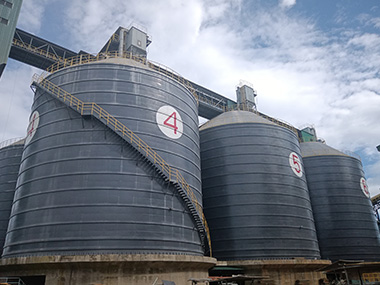
Limestone Powder Storage: Cohesive Material Handling Challenges
Limestone Powder Storage: Cohesive Material Handling Challenges
Limestone powder storage presents unique engineering challenges because fine limestone particles (typically under 200 mesh, ~74 µm) exhibit strong cohesive behavior that resists gravity flow, leading to arching, rat-holing, and unpredictable discharge. The primary solutions involve designing silos with steep, smooth hopper walls (≥60° from horizontal), integrating active flow-promotion devices such as aeration pads or vibratory dischargers, and controlling moisture content below 0.5% to minimize inter-particle adhesion forces that cause flow obstruction.
Limestone powder used in flue gas desulfurization (FGD), cement manufacturing, and mineral processing typically has a particle size distribution of 90% passing 200 mesh (74 µm) and 50% below 325 mesh (44 µm). At this fineness level, the powder's cohesion index ranges from 1.8 to 3.2 kPa depending on source geology, classifying it as a cohesive to very cohesive powder under Jenike flowability classification. Bulk density varies between 0.8 and 1.2 t/m³ in aerated conditions and 1.3 to 1.6 t/m³ when compacted. The Carr Compressibility Index typically falls between 25% and 38%, confirming poor flow characteristics that demand engineered discharge solutions rather than simple gravity reliance.
Moisture Absorption Characteristics
Calcium carbonate (CaCO₃), the primary component of limestone powder (≥95% purity in most industrial grades), is hygroscopic and absorbs ambient moisture readily. When relative humidity exceeds 60%, surface moisture adsorption increases sharply, raising the powder's unconfined yield strength from approximately 1.5 kPa to over 5 kPa within 48 hours. This moisture-induced strength increase directly causes flow channel collapse. Critical moisture threshold for limestone powder storage is 0.3–0.5% by weight; exceeding this range requires climate-controlled storage environments or nitrogen blanketing systems to maintain flowability.
Angle of Repose and Wall Friction
The drained angle of repose for dry limestone powder measures 38°–45°, while the dynamic angle of repose during discharge reaches 50°–55° due to air entrainment. Wall friction coefficients against carbon steel range from 0.55 to 0.70 (wall friction angle 29°–35°), and against stainless steel 304 from 0.45 to 0.60. These values are critical for hopper design: the hopper half-angle must be at least 15°–20° less than the wall friction angle to ensure mass flow. For cohesive limestone powders, polished stainless steel or specialized lining materials (Ra ≤ 1.6 µm surface finish) are recommended to reduce wall friction and prevent adhesion build-up.
Common Storage Problems in Limestone Silos
Arching and Rat-holing
Arching occurs when cohesive limestone powder forms a stable bridge across the hopper outlet, blocking discharge entirely. The critical arching diameter for limestone powder with a cohesive strength of 2.5 kPa and bulk density of 1.0 t/m³ calculates to approximately 180–220 mm using Jenike's arching theory. Rat-holing (piping) is equally problematic: a narrow flow channel develops along the silo wall while stagnant material around it remains stationary. In silos taller than 12 meters storing limestone powder, rat-holing is the dominant failure mode because the material's cohesive strength exceeds the stress imposed by the overlying material column.
Segregation and Flooding
Limestone powder is prone to both particle segregation and flooding (silo discharge surge). During filling, fine particles segregate toward the silo center while coarser fractions migrate to walls, creating uneven density distribution. More critically, partially aerated limestone powder can transition from controlled mass flow to uncontrolled fluidized discharge. Flooding occurs when aerated powder with a bulk density below 0.6 t/m³ enters the hopper section, causing discharge rates to spike to 5–10 times the designed capacity. This surge overwhelms downstream conveyors and feeders, creating operational hazards and material spillage.
Wall Build-up and Corrosion
Limestone powder accumulates on silo walls over time, particularly at weld seams, bolt heads, and surface irregularities. Build-up rates of 2–5 mm per month are common in high-humidity environments. This accumulation narrows the effective silo diameter, promotes bridging, and creates dead zones where material degrades chemically. Additionally, limestone powder's mildly alkaline nature (pH 8.5–9.5 when wet) accelerates corrosion on carbon steel surfaces, especially where moisture condensation occurs on silo roofs and upper walls during temperature cycling.
Silo Design Solutions for Cohesive Limestone Powder
Hopper Geometry and Discharge Aids
For cohesive limestone powder, mass flow silo design is strongly preferred over funnel flow. The hopper half-angle should not exceed 25°–30° from vertical for conical hoppers, and the outlet diameter must exceed the critical arching dimension by a safety factor of 1.5–2.0, yielding minimum outlets of 300–450 mm. Live bottom dischargers with rotating augers or flexible hopper walls with external vibrators provide reliable discharge promotion. For large-capacity silos (≥500 m³), the inverted cone design with a central discharge chute and annular aeration zones ensures consistent flow across the full cross-section.
Aeration and Fluidization Systems
Controlled aeration is one of the most effective methods for promoting limestone powder discharge. Aeration pads installed on hopper walls introduce low-pressure air (0.1–0.3 bar) at 2–5 air-to-powder ratios by volume, reducing the powder's effective cohesion by 40%–60%. Fluidization should be applied in timed pulses (3–5 seconds on, 10–15 seconds off) rather than continuously, to prevent over-aeration and flooding. Air distribution must be uniform: pad spacing should not exceed 300 mm in the critical flow zone, and air velocity through the pad surface should remain below 3 m/s to avoid channeling.
Material Selection and Surface Treatment
Silo construction materials significantly impact limestone powder flow performance. Stainless steel 316L offers superior corrosion resistance and lower wall friction compared to carbon steel. For carbon steel silos, internal coating with epoxy-based flow-promoting liners (dry film thickness 250–400 µm) reduces wall friction angle by 8°–12°. Electropolished surfaces (Ra ≤ 0.8 µm) provide the best flow performance but are cost-prohibitive for large silos. A practical compromise is shot-blasted carbon steel with a thin PTFE-impregnated coating in the hopper zone only, where flow resistance is highest.
Operational Best Practices
Inventory Management and Rotation
Implementing first-in-first-out (FIFO) inventory rotation is essential for limestone powder storage. Material residence time should not exceed 30 days in humid climates or 90 days in arid conditions to prevent moisture-induced hardening. Silo level monitoring using radar or weight-based systems enables operators to maintain inventory between 30% and 85% of total capacity. Operating below 30% fill level reduces the consolidating pressure that compacts powder into hard deposits, while staying below 85% prevents overfilling and uncontrolled discharge surges.
Monitoring and Automation
Modern limestone silos benefit from integrated monitoring systems that track powder temperature (alarm threshold: 10°C above ambient, indicating moisture migration), silo weight trends (detecting wall build-up when weight exceeds theoretical capacity by 5%–10%), and discharge flow rate consistency. Automated aeration control using programmable logic controllers adjusts air injection based on real-time discharge rate feedback, optimizing energy consumption while maintaining reliable flow. Dust monitoring at the silo vent outlet ensures filtration systems handle the increased dust load during aerated discharge.
Maintenance Protocols
Preventive maintenance for limestone powder silos should include quarterly internal inspections of hopper walls and outlet regions using borescope cameras, semi-annual calibration of level and weight sensors, and annual replacement of aeration pad membranes. Wall build-up removal using pneumatic knockers or manual chipping should be scheduled when build-up exceeds 10 mm thickness. All maintenance activities must follow confined space entry procedures, as limestone powder silos present engulfment hazards and potential oxygen deficiency from powder displacement.
💡 Engineering Tip: When designing a new limestone powder silo, always conduct bench-scale flow property testing (per ASTM D6128 or D6773) on representative samples from your specific quarry source. Limestone from different geological formations can vary in cohesion by up to 40%, and using generic design assumptions leads to costly retrofit projects. Jenike shear testing provides the unconfined yield strength and flow function data required for reliable hopper geometry calculations.
Case Study: FGD Limestone Silo Retrofit
A 1,200-tonne limestone powder silo at a coal-fired power plant experienced chronic rat-holing and unplanned shutdowns averaging 3–4 events per month. The original design featured a carbon steel conical hopper with a 35° half-angle and a 250 mm outlet, with no active flow promotion devices. After shear testing confirmed the powder's unconfined yield strength at 3.8 kPa (due to 0.7% moisture content), the engineering team implemented a three-stage retrofit: (1) installation of a stainless steel 316L live-bottom discharger with a 500 mm outlet, (2) addition of 12 aeration pads in the lower hopper zone with pulsed air injection at 0.15 bar, and (3) application of epoxy flow-promoting coating to the upper hopper walls. Post-retrofit monitoring over 18 months showed zero flow obstruction events, discharge rate improved from 45 t/h to 85 t/h, and maintenance costs decreased by 65%.
Frequently Asked Questions
What is the ideal moisture content for limestone powder storage?
Limestone powder should be stored at moisture content below 0.3% by weight to maintain free-flowing characteristics. Between 0.3% and 0.5%, flowability decreases measurably and aeration systems become necessary. Above 0.5%, active discharge promotion devices (live bottoms, vibratory dischargers) are required to prevent arching and rat-holing. Silos in coastal or tropical environments should include dehumidification or nitrogen blanketing to maintain this threshold.