Alumina hydration follows the reaction Al₂O₃ + 3H₂O → Al₂O₃·3H₂M, with reaction rates doubling for every 10°C temperature increase above 40°C. Gamma-phase alumina exhibits 15-20 times higher reactivity than alpha-phase due to surface hydroxyl density of 8-12 OH/nm² versus 2-4 OH/nm². Critical humidity thresholds begin at 45% RH, with accelerated conversion occurring above 65% RH at 25°C storage conditions.
Impact on Metallurgical Grade Quality
Hydration reduces available alumina content from 99.5% to below 98.7% within 72 hours under uncontrolled humidity. Loss on ignition (LOI) increases by 0.3-0.8% per 1% moisture absorption, directly affecting aluminum smelting current efficiency by 0.5-1.2% reduction. Particle agglomeration from hydration increases d50 diameter by 15-40 μm, disrupting fluoride bath dissolution rates in Hall-Héroult cells.
Silo Structural Design for Moisture Exclusion
Sealed Shell Construction Standards
Alumina storage silos require welding seam integrity achieving ≤0.1 m³/h·m² air permeability at 250 Pa pressure differential. Bolted connections must use EPDM gaskets with 30-40 Shore A hardness rated for -30°C to +120°C operating range. Roof-to-wall joints incorporate double labyrinth seals with 50mm overlap, maintaining positive internal pressure of 50-100 Pa above ambient to prevent humid air infiltration.
Conical Discharge and Flow Channel Engineering
Mass flow hopper angles of 65-70° from horizontal prevent material stagnation zones where moisture accumulation occurs. Fluidization cone systems use 0.5-1.0 mm sintered polyethylene pads at 200-400 mm spacing, delivering dry air at 0.5-1.5 Nm³/h·m². Discharge isolator valves must achieve Class V leakage rating per FCI 70-2 standards, with soft seat seals rated for 100,000 cycles minimum.
Thermal Insulation Integration
External wall insulation with 100-150 mm mineral wool (density 100 kg/m³) maintains shell surface temperature within 3°C of internal material temperature, preventing condensation during nighttime temperature drops. Heat tracing systems on hopper sections provide 10-20 W/m² to maintain 5-10°C above ambient dew point during shutdown periods.
Atmosphere Control and Drying Systems
Nitrogen Purging Configuration
Blanketing systems maintain oxygen content below 5% and dew point at -40°C using 99.999% purity nitrogen. Purge rates of 0.5-1.0 silo volume per hour during initial filling reduce to 0.1-0.2 volume/hour during steady-state storage. Bottom injection through ring manifolds with 5mm orifice nozzles ensures uniform gas distribution across the 15-30m silo diameter.
Compressed Air Drying Units
Desiccant twin-tower dryers with activated alumina or molecular sieve beds deliver -40°C pressure dew point at 7 bar operating pressure. Regeneration cycles of 4-6 hours with 15-18% purge air consumption maintain consistent outlet quality. Refrigerated backup dryers provide +3°C dew point for non-critical pneumatic conveying, reducing energy consumption by 30-40% compared to full desiccant operation.
Vent Filtration and Pressure Relief
Dust collector vent filters use PTFE membrane cartridges with 0.3 μm absolute filtration efficiency, sized for 2-5 air changes per day during filling operations. Vacuum relief valves crack at -250 Pa to prevent shell collapse, while pressure relief opens at +500 Pa. Filter differential pressure transmitters trigger pulse-jet cleaning at 1000 Pa, with high-level alarms at 1500 Pa.
Material Selection and Surface Treatment
Silo Interior Coating Systems
Food-grade epoxy coatings (200-300 μm DFT) with 98% solids content provide chemical resistance to alkaline alumina dust (pH 9-11). Surface anchor profiles of 50-75 μm ensure adhesion strength exceeding 10 MPa per ASTM D4541. For abrasive alumina grades, polyurethane liners with 85 Shore A hardness and 6-8 mm thickness extend service life to 15+ years versus 5-7 years for unlined carbon steel.
Aluminum Alloy Component Compatibility
Discharge valve bodies in 6061-T6 aluminum resist pitting corrosion in chloride-containing environments up to 500 ppm. Stainless steel 316L (1.4404) is specified for moisture probe housings and instrumentation connections, with surface finish Ra ≤0.8 μm to prevent dust adhesion. Galvanic isolation gaskets between dissimilar metals prevent crevice corrosion at flange joints.
Wear Protection in High-Flow Zones
Impact zones at 30-45° from vertical receive 10 mm thick alumina ceramic tiles (92% Al₂O₃) with 250 kg/cm² compressive strength. Bends in pneumatic conveying lines use cast basalt linings with 6 Mohs hardness, reducing wall thickness loss to <0.1mm/year versus 2-3mm/year for unprotected steel.
Instrumentation and Automated Control
Multi-Level Moisture Monitoring
Capacitance-type moisture sensors at three elevations (top 20%, middle 50%, bottom 30%) measure 0-5% moisture content with ±0.1% accuracy. TDR (Time Domain Reflectometry) probes provide continuous profiling along 3-5m insertion lengths. Data logging at 1-minute intervals with 4-20 mA output to PLC systems enables trend analysis and early warning detection.
Temperature Profiling Arrays
Thermocouple strings with 2-3 vertical measurement points detect exothermic hydration reactions showing 5-15°C temperature rise. RTD sensors (Pt100 Class A) achieve ±0.15°C accuracy, critical for detecting moisture ingress before visible quality degradation. Wireless mesh networks reduce cabling costs by 40% in large silo farms.
Integrated SCADA Architecture
PLC-based control systems with redundant CPU modules manage purge valve sequencing, dryer regeneration, and alarm interlocks. HMI displays show real-time moisture trends, nitrogen consumption rates, and filter differential pressures. OPC UA connectivity enables integration with plant MES systems for batch traceability and quality documentation per ISO 9001:2015 requirements.
Engineering Tip: Install moisture sensors at the silo wall-to-material interface rather than centerline. Hydration initiates at boundary layers where temperature differentials create condensation. Offset probes at 0.3-0.5m from wall surface detect moisture 12-24 hours earlier than center-mounted instruments, enabling preventive nitrogen purge activation before bulk material quality is affected.
Case Study: 10,000-Ton Alumina Silo Project
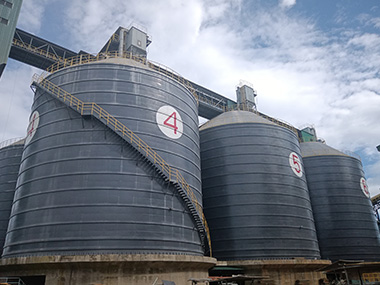
A Middle Eastern smelter required storage for 10,000 tons of metallurgical-grade alumina with <0.3% moisture guarantee over 90-day retention. Manxing engineered a 32m diameter × 22m high steel silo with the following specifications: 150 mm rock wool insulation with aluminum jacketing, twin-tower desiccant dryers rated 40 Nm³/min at -40°C dew point, nitrogen blanketing system with 200 Nm³/h capacity, and 9-point moisture monitoring array.
Performance results after 18 months operation: moisture content maintained at 0.18-0.22% (well below 0.3% target), LOI variation <0.05% across full storage duration, nitrogen consumption averaged 85 Nm³/h (57% below design capacity), zero hydration-related quality rejections. Total project delivery time was 14 weeks from fabrication start to mechanical completion, with 3-week commissioning period achieving guaranteed performance on first attempt.
Frequently Asked Questions
What is the maximum allowable moisture content for smelting-grade alumina?
Industry specifications require moisture content below 0.3% LOI (Loss on Ignition) for premium grade. Moisture above 0.5% causes visible hydration, while levels exceeding 1.0% result in material rejection by smelters. Continuous storage above 0.4% triggers accelerated hydration kinetics that cannot be reversed through drying.
How often should nitrogen purge systems operate in alumina silos?
During initial filling, continuous purging at 0.5-1.0 silo volumes per hour is required for 24-48 hours. Steady-state storage maintains intermittent purging at 0.1-0.2 volumes per hour, triggered by moisture sensors exceeding 0.25% setpoint. Automated systems with oxygen and dew point feedback reduce nitrogen consumption by 40-60% compared to timer-based operation.
What maintenance intervals ensure long-term hydration prevention?
Desiccant replacement every 2-3 years (or 10,000 operating hours), moisture sensor calibration every 6 months, gasket inspection annually, and coating integrity assessment every 3 years using holiday detection at 25V/μm. Preventive maintenance contracts with quarterly performance audits maintain system reliability above 98% availability.
Partner with Manxing for Engineered Alumina Storage Solutions
Manxing delivers turnkey EPC silo projects with guaranteed moisture performance, backed by 15+ years of material storage engineering experience. Our integrated design-manufacture-commissioning approach ensures your alumina maintains metallurgical-grade quality from receipt through extended storage periods.
Contact our engineering team for site-specific hydration prevention analysis and customized silo design proposals. Visit manxingstorage.com to request technical consultation and project feasibility assessment.