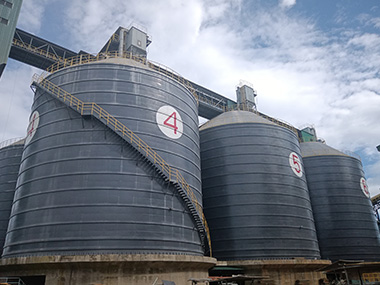
Insulation and Cladding Installation for Temperature-Sensitive Silos
Insulation and cladding installation for temperature-sensitive silos involves applying thermal barrier layers (typically 50–150 mm thick) to silo walls and roofs, then securing weather-resistant metal cladding over the insulation to maintain internal temperatures within ±2°C of target values. This dual-layer system prevents condensation, thermal bridging, and material spoilage in facilities storing cement, fly ash, grain, chemicals, or other moisture- and temperature-sensitive bulk solids.
1. Why Temperature Control Matters in Silo Storage
Figure 1Figure 2Figure 3
Condensation and Moisture Intrusion Risks
When ambient temperature fluctuates by more than 15°C relative to stored material temperature, interstitial condensation forms inside uninsulated steel walls. A 5000 m³ cement silo operating at 25°C internal temperature in a 5°C external environment can generate up to 12 liters of condensate per day on bare steel surfaces. This moisture causes material caking, accelerated corrosion (up to 0.5 mm/year wall loss), and structural degradation at weld seams.
Material Degradation Thresholds
Fly ash loses flowability when moisture content exceeds 3%. Grain storage requires maintaining temperatures below 15°C to prevent insect activity and mycotoxin growth. Chemical powders such as sodium carbonate experience caking at relative humidity above 45%. Insulation systems must maintain wall surface temperatures above the dew point at all times, which typically requires a minimum thermal resistance of R-3.5 (m²·K/W) in temperate climates and R-5.0 or higher in tropical or arctic zones.
2. Insulation Material Selection for Silo Applications
Mineral Wool vs. Polyurethane Foam
Mineral wool (density 100–150 kg/m³, thermal conductivity 0.035–0.040 W/m·K) offers non-combustible performance (Class A1 fire rating) and acoustic damping, making it suitable for silos located near residential areas or handling combustible dusts. Polyurethane foam panels (thermal conductivity 0.022–0.028 W/m·K) deliver 30–40% better thermal performance per millimeter but require fire-retardant treatment and are limited to 130°C maximum service temperature. For silos storing hot materials (up to 80°C), mineral wool is the standard choice.
R-Value Requirements by Climate Zone
In Köppen climate zone Cfa (humid subtropical), a minimum insulation thickness of 75 mm mineral wool (R-2.1) is required. In Dfb (humid continental) zones, 100 mm (R-2.9) is the baseline. Arctic ET zones demand 150 mm or greater (R-4.3+). The insulation thickness calculation must account for wind speed at silo height—a 30-meter silo in a 15 m/s wind zone experiences 20% higher convective heat loss than ground-level projections suggest.
3. Cladding System Design and Weather Protection
Profiled Steel Cladding Specifications
External cladding typically uses 0.50–0.70 mm thick pre-galvanized or pre-coated steel sheets with a trapezoidal profile (rib height 25–35 mm). Coating systems of 25 μm polyester (standard), 50 μm PVDF (coastal/chemical environments), or 100 μm PVC (high-corrosion) are selected based on the C1–C5 corrosivity category per ISO 12944. Panel lengths are optimized to minimize horizontal joints—single panels up to 13 meters long are standard for large-diameter silos.
Vapor Barrier and Drainage Integration
A 0.2 mm polyethylene vapor barrier is installed on the warm side (interior face) of the insulation to prevent moisture migration into the thermal layer. At the base of the silo wall, a drainage channel integrated into the cladding support system directs any condensate or rainwater penetration outward. Capillary breaks using EPDM gaskets are placed at all horizontal panel overlaps to prevent wicking.
Pro Tip: Always install insulation boards in a staggered, multi-layer pattern with offset joints. A single-layer installation with aligned joints creates linear thermal bridges that reduce overall system efficiency by up to 18%. Use mechanical fasteners with thermal break washers (nylon or phenolic) to prevent metal-to-metal conduction through the cladding support system.
4. Installation Best Practices for Vertical Surfaces
Fastener Spacing and Load Calculations
Insulation boards are secured using spiral fasteners at a density of 6–8 fasteners per m² for silos up to 20 meters tall, increasing to 10–12 per m² above 25 meters due to higher wind suction loads. Cladding panels are attached to Z-purlins or horizontal sub-girts spaced at 1.5–2.0 meter vertical intervals. Self-drilling screws with EPDM washers are placed at every corrugation valley, with spacing not exceeding 350 mm on the shell surface.
Seam Sealing and Thermal Break Details
Vertical cladding joints use a 10 mm open-joint rain screen design or a sealed butt joint with continuous butyl tape, depending on the local driving rain index. At the silo roof-to-wall junction, a preformed transition flashing with 200 mm overlap on both surfaces eliminates the most common thermal weak point. All penetrations (access hatches, level indicator ports, aeration inlets) receive custom-fabricated insulated collars to maintain thermal continuity.
5. Case Study: 8000-Ton Fly Ash Silo in Southeast Asia
A cement plant in Vietnam required insulation and cladding for a 12-meter-diameter, 38-meter-tall fly ash silo storing material at 40°C in a 32°C ambient, 85% RH environment. The design team specified 100 mm mineral wool (120 kg/m³) with a vapor barrier and 0.63 mm PVDF-coated trapezoidal cladding. Installation was completed in 18 days using a suspended platform system. Post-installation thermal imaging confirmed uniform surface temperatures with no bridging detected. Internal wall condensation was eliminated entirely, and the fly ash moisture content stabilized at 1.2%, well below the 3% caking threshold. The system achieved a measured U-value of 0.34 W/m²·K, matching design calculations within 3%.
6. Quality Control and Long-Term Performance
Thermal Imaging Inspection Protocols
After installation, a full-surface infrared thermographic survey is conducted under conditions of at least 8°C temperature differential between interior and exterior. Anomalies exceeding ±10% of the average surface temperature indicate missing insulation, compressed boards, or thermal bridging at fasteners. Repairs are documented and re-inspected within 48 hours.
Maintenance Intervals and Resealing Schedules
Cladding sealant joints should be inspected annually and resealed every 5–7 years. Fastener integrity checks (torque verification on 5% of fasteners) are recommended at year 3 and year 6. Insulation systems with proper installation and maintenance deliver 20–25 years of service life before major refurbishment is required.
Frequently Asked Questions
Q1: Can insulation be added to an existing silo without emptying it?
Yes. External insulation and cladding installation does not require silo discharge. Work proceeds from the outside using suspended platforms or rope access. Internal temperatures remain unaffected during installation, though material discharge may be needed if internal liner repair is also planned.
Q2: What is the typical cost range for silo insulation and cladding?
Installed costs range from $18–$45 per m² of shell surface area, depending on insulation thickness, cladding material grade, silo height, and regional labor rates. A 15-meter-diameter, 30-meter-tall silo typically incurs total insulation and cladding costs between $35,000 and $85,000.
Q3: How does cladding color affect silo temperature performance?
Light-colored cladding (solar reflectance index above 78) can reduce external surface temperatures by 15–25°C compared to dark colors under direct sun. For heat-sensitive materials, white or light-gray PVDF coatings are recommended to minimize solar heat gain and reduce the insulation thickness requirement by up to 20%.
Need Expert Silo Insulation & Cladding Solutions?
Manxing provides turnkey EPC silo contracting services including thermal design, material procurement, and professional installation for temperature-sensitive storage projects worldwide. Our engineering team calculates insulation thickness, selects optimal cladding systems, and delivers fully documented installations with thermal performance guarantees.