Cement Bulk Density and Angle of Repose Engineering Reference
Cement bulk density is the mass of cement powder per unit volume, typically ranging from 1,000 to 1,600 kg/m³ depending on compaction and moisture. The angle of repose is the maximum angle at which a granular material can rest on a slope without collapsing, usually between 25° and 40° for cement. Both parameters are essential inputs for silo capacity calculation, hopper geometry design, and structural load analysis in cement storage engineering.
1. Cement Bulk Density Fundamentals
Figure 1Figure 2Figure 3
1.1 Definition and Measurement Principles
Bulk density represents the total mass of cement particles divided by the total volume they occupy, including inter-particle voids. The standard measurement method involves filling a calibrated container of known volume (typically 1 L or 10 L) under controlled conditions and weighing the contents. Loose bulk density is measured by free-filling the container without vibration, while tapped bulk density is determined after mechanical compaction to simulate long-term settling. The ratio between tapped and loose bulk density, known as the Hausner ratio, indicates flowability—values above 1.4 suggest cohesive behavior that may cause bridging in silos.
1.2 Factors Affecting Bulk Density
Multiple variables influence cement bulk density. Finer cement particles (Blaine surface area above 400 m²/kg) exhibit lower bulk density due to increased air entrapment. Moisture content above 0.5% significantly increases bulk density initially but promotes caking above 2%. Storage time causes natural compaction, increasing loose density by 5–15% over 30 days. Temperature variations between 20°C and 80°C cause density fluctuations of approximately 2–4% due to thermal expansion of entrapped air within the powder matrix.
1.3 Typical Density Values by Cement Type
Portland cement (OPC) has a loose bulk density of 1,100–1,300 kg/m³ and tapped density of 1,400–1,600 kg/m³. Fly ash blended cements range from 900–1,200 kg/m³ loose. Slag cements typically measure 1,000–1,250 kg/m³. White cement exhibits slightly lower values at 1,000–1,150 kg/m³ due to different particle morphology. For silo structural design, engineers commonly use 1,200–1,400 kg/m³ as the reference bulk density for OPC, with safety factors applied based on actual material testing.
2. Angle of Repose and Flow Characteristics
2.1 Static and Dynamic Angle of Repose
The static angle of repose is measured after the material has come to rest following free-fall deposition, while the dynamic angle is measured during controlled discharge. For Portland cement, static angles typically range from 30° to 38°, and dynamic angles from 25° to 32°. The difference between these values indicates material cohesion—a larger delta suggests higher cohesive strength and potential flow problems. Pneumatic cement from aeration systems shows lower dynamic angles (22°–28%) due to fluidization effects.
2.2 Flowability Classification
Based on angle of repose measurements combined with shear testing, cement flowability is classified into four categories. Free-flowing materials have angles below 25° with Carr indices above 85. Moderate-flowing materials range from 25° to 35° with Carr indices of 70–85. Cohesive materials exhibit angles from 35° to 45° with Carr indices of 55–70. Highly cohesive materials exceed 45° with Carr indices below 55, requiring special hopper designs with large outlet diameters and flow aids. Most fresh OPC falls into the moderate-flowing category.
2.3 Relationship to Silo Flow Patterns
The angle of repose directly determines whether a silo operates in mass flow or funnel flow mode. Mass flow hoppers require wall friction angles below the material's angle of repose, typically achieved with wall friction angles under 20°. Funnel flow occurs when hopper walls are too rough or insufficiently steep, creating a stable central channel. The critical hopper half-angle for mass flow is calculated as (90° − angle of repose) minus a safety margin of 5°–10°. For cement with a 35° angle of repose, this yields a maximum hopper half-angle of 45°–50°.
3. Engineering Implications for Silo Design
3.1 Wall Pressure Calculations
Janssen's equation for vertical wall pressure requires bulk density as a primary input parameter. The horizontal pressure at depth h is calculated as p = (ρgD/4μK)(1−e^(−4μKh/D)), where ρ is bulk density, D is silo diameter, μ is wall friction coefficient, and K is the lateral pressure ratio. Using 1,200 kg/m³ for OPC versus 1,400 kg/m³ for compacted material can produce a 15–20% difference in predicted wall loads. Underestimating bulk density leads to structural inadequacy, while overestimation wastes steel and concrete.
3.2 Hopper Geometry Optimization
The hopper outlet diameter must exceed the critical arching dimension to prevent bridging. For cement with a unconfined yield strength of 1.5–3.0 kPa, the minimum circular outlet diameter is calculated as d = 2σc/(ρg), yielding approximately 0.3–0.6 m. Conical hoppers require steeper angles than wedge hoppers for the same flow assurance. A typical cement silo uses a conical hopper with a 55°–60° included angle from horizontal, combined with a 600 mm minimum outlet and air fluidization systems to reduce effective angle of repose during discharge.
3.3 Structural Load Considerations
Cement silos must account for eccentric discharge loads that increase wall pressures by 30–50% above symmetric predictions. The dynamic amplification factor during rapid discharge (above 200 tonnes/hour) adds 10–15% to static loads. Thermal loads from cement at 60–80°C during storage create circumferential stresses requiring reinforcement. Seismic design in zones above PGA 0.2g requires additional consideration of bulk material sloshing effects, which can increase horizontal forces by 25% during earthquake events.
Engineering Tip: Always conduct material-specific bulk density and angle of repose testing before finalizing silo design. Generic handbook values can vary by ±15% from actual material properties, potentially causing structural overdesign or flow failures. Request suppliers to provide certified test reports with Blaine fineness, moisture content, and particle size distribution data alongside density measurements.
4. Testing Methods and Standards
4.1 Standardized Bulk Density Testing
ASTM C188 specifies the standard test method for density of hydraulic cement using a Le Chatelier flask, though this measures absolute density rather than bulk density. For bulk density, ISO 679 and EN 196-1 provide procedures using standardized containers. The loose bulk density test fills the container from a fixed height of 50 mm without mechanical intervention. Tapped bulk density requires 100 taps from a height of 12.5 mm using a mechanical jolting apparatus. Results must be reported with temperature and humidity conditions, as 10°C variation can shift readings by 1–2%.
4.2 Angle of Repose Measurement Methods
The poured cone method creates a heap on a flat surface and measures the slope angle with a protractor or digital inclinimeter. The drained angle method measures the residual slope after material flows from a container base. The rotating drum method provides dynamic measurements at controlled shear rates. For cement, the poured cone method yields the most reproducible results with standard deviations of ±2° when performed by trained operators. At least five replicate measurements are required, with the mean value used for engineering calculations.
4.3 Shear Testing for Flow Properties
Jenike shear testing provides the most reliable data for silo design, measuring unconfined yield strength, internal friction angle, and wall friction. The test applies normal stresses from 1 to 20 kPa and records shear stress at failure. Flow function values (ff = σ1/σc) above 10 indicate free-flowing behavior, while values below 1 indicate no flow without mechanical assistance. Wall friction tests on steel, concrete, and lining materials determine hopper angles for mass flow. Complete testing typically requires 2–3 kg of representative material and 1–2 days of laboratory work.
5. Case Study: Cement Terminal Silo Design
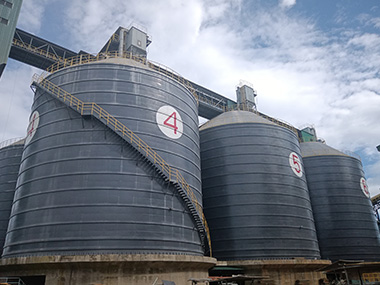
A cement terminal in Southeast Asia required two 10,000-tonne capacity silos for OPC storage. Initial design used generic handbook values of 1,200 kg/m³ bulk density and 35° angle of repose. Material testing revealed actual values of 1,350 kg/m³ (tapped) and 32° static angle of repose with a 28° dynamic angle. The higher density increased wall loads by 12%, requiring additional hoop reinforcement in the lower silo section. The lower dynamic angle allowed a steeper hopper design (52° half-angle versus original 48°), reducing silo height by 1.2 meters and saving 45 tonnes of structural steel. Wall friction testing on epoxy-coated steel showed a friction angle of 18°, confirming mass flow was achievable without additional flow aids. The project achieved 98% design capacity with first-fill discharge rates of 350 tonnes/hour, validating the material-specific engineering approach.
6. Frequently Asked Questions
Q: What is the difference between bulk density and specific gravity for cement?
Bulk density measures the mass per total volume including voids between particles (typically 1,100–1,300 kg/m³ for OPC). Specific gravity (or absolute density) measures the mass per volume of solid particles only, typically 3,100–3,200 kg/m³ for Portland cement. Bulk density is used for silo capacity and structural calculations, while specific gravity is used for mix design and quality control. The ratio between them indicates void content—approximately 55–65% voids in loose cement.
Q: How does moisture content affect cement bulk density and flowability?
Moisture below 0.5% has minimal effect on bulk density. Between 0.5% and 2%, density increases slightly (2–5%) due to particle lubrication, but flowability decreases as capillary bridges form. Above 2% moisture, cement begins to cake, bulk density becomes unpredictable, and angle of repose increases dramatically (often above 45°). Silos should maintain cement moisture below 1% through sealed storage and desiccant air systems. Moisture-induced caking is the leading cause of flow obstruction in cement silos.
Q: Can the angle of repose be reduced to improve silo discharge?
Yes, several methods reduce effective angle of repose. Air fluidization systems inject low-pressure air (0.1–0.3 bar) through porous pads, reducing the angle to 15–20° during discharge. Mechanical vibrators and air cannons break stable arches but do not change the fundamental angle. Internal hopper coatings