
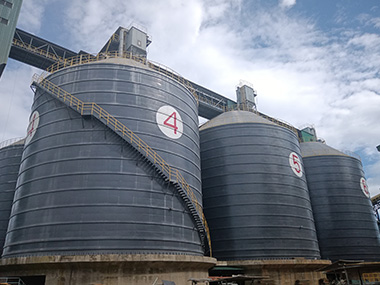

Carbon Steel vs Stainless Steel for Industrial Silo Construction: A Field Engineer's Comparison
Carbon steel wins on upfront cost — typically 60–75% cheaper per tonne of fabricated shell. Stainless steel wins on lifecycle cost when you're storing hygroscopic, corrosive, or high-purity materials in aggressive environments. The right choice depends on what you're storing, where the site is, and how long you need the silo to last without a major overhaul. I've specified both across 30+ countries. Here's what actually happens in service.
1. Material Properties That Actually Matter in Silo Service
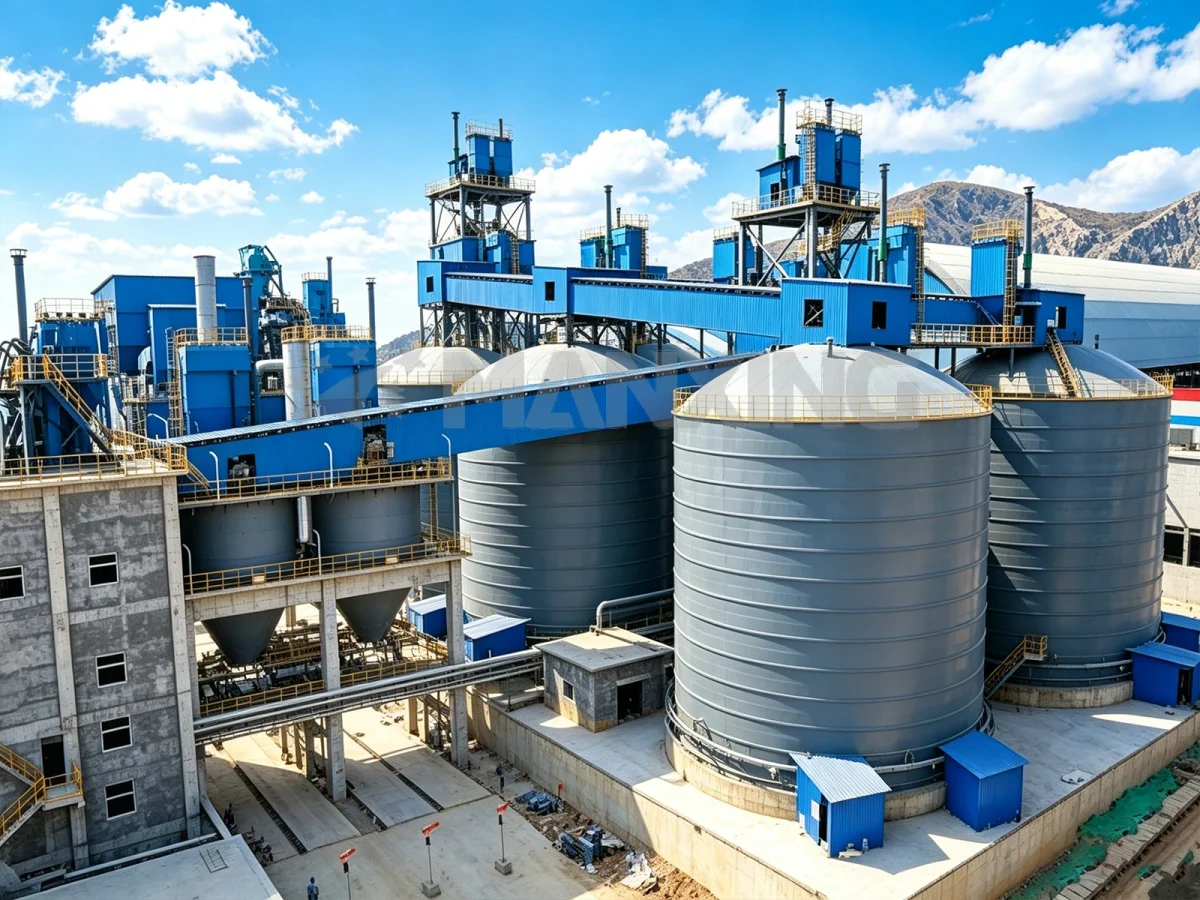
1.1 Yield Strength and Wall Thickness
Structural carbon steel — S235JR per EN 10025 or Q235B under GB/T 700 — gives you a minimum yield of 235 MPa. Step up to S355 and you're at 355 MPa. That matters because silo wall thickness is driven by hoop tension from stored material pressure, not just structural self-weight. A 30-metre-diameter cement silo holding 10,000 tonnes sees hoop stresses that'll push 6mm carbon steel past its limit. You'll be at 8mm or 10mm minimum for the lower rings, per EN 1993-4-1 (Eurocode 3, Part 4-1 for silos).
Stainless steel 304 (EN 10088-2, grade 1.4301) yields around 215 MPa minimum. 316L (1.4404) is similar — roughly 240 MPa. So for the same pressure loading, a stainless shell needs to be slightly thicker than an equivalent carbon steel shell in the lower rings. Not dramatically — maybe 10–15% more — but it's there. Where stainless compensates is that you don't need corrosion allowance on top of that. Carbon steel designs typically add 1–3 mm of corrosion allowance depending on the internal environment. That allowance disappears with stainless.
1.2 Corrosion Mechanisms in Bulk Solids Storage
Here's what most spec sheets won't tell you: the corrosion inside a silo isn't uniform. It's driven by condensation cycles. Every time you fill a silo with warm material — say, clinker at 80–120°C discharged from a cooler — the air inside heats up, picks up moisture, then hits the cooler upper shell and condenses. That condensation film is where carbon steel loses its paint system first. I've seen epoxy coatings fail at the 3-metre level on a clinker silo in Vietnam within 18 months. The coating looked perfect everywhere else. But that condensation band was rusting through.
Stainless steel handles condensation differently. 304 resists condensation corrosion in most bulk solids applications. 316L adds molybdenum — 2–3% — which buys you resistance to chlorides. If your site is coastal or you're storing salt-laden materials like sea-dredged sand or certain industrial byproducts, 316L isn't optional. It's the minimum. I specified 304 for a fly ash silo in Malaysia once. The ash had absorbed SO₂ from the coal stream. Condensation turned it mildly acidic. Six years later, pitting on the 304 shell was measurable. We should have gone 316L.
1.3 Temperature Behavior
Carbon steel's ductile-to-brittle transition sits around -20°C for most structural grades. If your silo is in northern China, Siberia, or anywhere that sees -30°C winters, you need to specify impact-tested grades — S235J2 or S355J2 per EN 10025-2. That adds cost, but it prevents brittle fracture. Stainless steel austenitic grades (304, 316L) don't have a ductile-to-brittle transition. They stay ductile down to cryogenic temperatures. For hot material storage — say, 200°C+ — carbon steel holds its strength fine up to about 350°C. Stainless 304 starts losing meaningful strength above 500°C, but sensitization (chromium carbide precipitation) becomes a risk in the 425–850°C range if you're welding without proper procedures. For normal bulk solids — cement, coal, slag, sand — temperature is rarely the deciding factor. Corrosion is.
2. Cost Analysis: First Cost vs Total Ownership
2.1 Purchase Price Differential
As of 2024, fabricated carbon steel silo shell plate runs roughly $1,200–1,800 per tonne installed, depending on diameter, thickness, and site location. Stainless steel 304 shell plate? $4,500–6,500 per tonne. 316L pushes to $5,500–8,000. That's a 3–5x multiplier on the shell material alone. For a 5,000-tonne cement silo with about 80 tonnes of shell plate, you're looking at a $240,000–$400,000 difference in shell material cost. On a $2–3 million total EPC project, that's significant but not necessarily decisive.
What changes the math is the coating system. A proper internal coating for carbon steel — surface preparation to Sa 2.5 per ISO 8501-1, epoxy primer at 75 microns, epoxy intermediate at 150 microns, polyurethane topcoat at 50 microns — runs $25–40 per square metre applied. On a 30m-diameter, 20m-tall silo with roughly 2,200 m² of internal surface, that's $55,000–$88,000. And it needs recoating every 8–15 years depending on the environment. Over a 30-year service life, you'll recoat twice. That's $110,000–$264,000 in today's money, not counting downtime.
2.2 Downtime Is the Hidden Cost
Recoating a silo means emptying it, ventilating it, sending crews inside with blast equipment, and losing storage capacity for 4–8 weeks. At a cement plant producing 3,000 tonnes per day, four weeks of lost silo capacity means you're either curtailing production or trucking product in from elsewhere. I watched a plant in Indonesia lose $180,000 in margin during a recoating shutdown because they couldn't store enough finished cement to keep the kiln running at full rate. The recoating itself cost $95,000. The real cost was the production loss.
Stainless steel doesn't need that recoating cycle. You might do a passivation check every 5–7 years, but that's a day of inspection, not a month of downtime. Over 30 years, the total cost of ownership for stainless can actually be lower than carbon steel in aggressive environments. I've run the numbers for clients. The crossover point is usually around year 18–22 for coastal or high-humidity sites storing hygroscopic materials.
3. When Carbon Steel Is the Right Call
3.1 Dry, Non-Hygroscopic Materials
If you're storing dry limestone, aggregate, gravel, or coal with low sulfur content in an inland location, carbon steel with a proper coating system is the right choice. Full stop. The material doesn't absorb moisture from the air, so condensation on the shell doesn't create an aggressive electrolyte. I've got carbon steel aggregate silos in central China — Henan, Shanxi — that are 15 years old with original coatings still intact. The internal environment is essentially inert. The coating system specified was a zinc-rich epoxy primer at 60 microns plus a micaceous iron oxide epoxy at 200 microns. Total DFT 260 microns. ISO 12944-5 calls for C3–C4 environment protection, and that system delivers it.
3.2 Large-Diameter, Low-Corrosion-Risk Applications
For very large diameter silos — 40m and above — the shell plate tonnage gets significant. A 45m-diameter, 15,000-tonne capacity fly ash silo might need 150+ tonnes of shell plate. At a 3–5x material cost differential, the stainless premium becomes $3–4 million on shell alone. That's hard to justify when the material is dry fly ash stored at ambient temperature in an inland plant. Carbon steel with a 300-micron epoxy system and a 25-year recoating schedule is the economically rational choice. We've built silos like this across Shandong and Jiangsu provinces. They perform fine.
4. When You Need Stainless Steel
4.1 Hygroscopic and Corrosive Materials
Sodium chloride, calcium chloride, certain chemical powders, and some industrial slags are genuinely corrosive to carbon steel even at ambient temperature. If the material's pH when wetted falls below 5 or above 10, or if it contains chlorides above 500 ppm, I'm specifying stainless. No discussion. I had a project in Gujarat, India, storing a sodium-based industrial byproduct. The client wanted carbon steel to save money. We ran a wetted-pH test on the material: 11.4. At that pH with condensation, carbon steel loses 0.5–1.0 mm per year. A 6mm shell would be through in 6–12 years. We went with 316L. The client wasn't happy about the cost. But they'd have been a lot unhappier replacing a silo shell in year eight.
4.2 Coastal and High-Humidity Environments
Chloride-induced corrosion isn't just about the stored material. It's about the air. Within 5 km of a coastline, airborne chlorides deposit on every surface. On a carbon steel silo, that means the exterior coating system needs to be specified for C5-M (marine) per ISO 12944-2. That's a zinc-rich epoxy primer, epoxy intermediate, and polyurethane topcoat at a combined DFT of 320+ microns. It works, but it's expensive and maintenance-intensive. For the interior, if the material is even mildly hygroscopic, those airborne chlorides get absorbed into the condensation film and accelerate corrosion dramatically.
I built a clinker silo in UAE, 3 km from the Persian Gulf. Carbon steel exterior with a C5-M system. Within 6 weeks of commissioning, we had rust streaks at the bolt holes on the lower rings. The bolt holes — where the coating is thinnest because it's hard to spray into a hole — were the failure point. We ended up doing a full re-blast and recoat at month four. For the next project at the same site, we specified 316L for the lower 8 metres of shell and carbon steel with enhanced coating above. Hybrid approach. It worked.
4.3 Food-Grade and High-Purity Applications
If you're storing food-grade materials — sugar, starch, salt, certain food additives — carbon steel is usually a non-starter. Not because of corrosion, but because of contamination. Carbon steel can shed rust particles into the product. Stainless 304 with a No. 4 finish (Ra ≤ 0.8 μm) is the minimum for most food-grade applications. Some clients electropolish to Ra ≤ 0.4 μm. For pharmaceutical or high-purity chemical powders, 316L with electropolish is standard. The cost premium is irrelevant in these applications because the alternative — product contamination — is a regulatory and liability issue, not just a maintenance one.
5. Hybrid Approaches: Where Most Projects Actually Land
5.1 Carbon Steel Shell with Stainless Steel Lining
This is the compromise I recommend most often. Build the structural shell in carbon steel — it carries the loads, it's cheaper, it's faster to fabricate. Then line the lower section with stainless steel plate, either by welding a thin (2–3 mm) stainless liner to the carbon steel shell or by using a loose liner system. The liner handles the corrosion. The carbon steel handles the structural loads. For a cement silo, I typically line the bottom 6–8 metres — the zone below the material's natural angle of repose where abrasion and condensation are both worst. Above that, carbon steel with a good coating is fine.
The cost savings are real. On a 30m-diameter silo, lining 8 metres of height with 3mm 304 plate adds maybe $40,000–$60,000 to the project. Full stainless shell would add $300,000–$500,000. The liner approach gets you 80% of the corrosion protection at 15–20% of the cost. The catch: you need to detail the liner carefully. If moisture gets behind the liner — through a weld pinhole or a seam — you've created a trapped corrosion cell that's worse than bare carbon steel. We use continuous fillet welds on the liner seams and seal all penetrations with stainless-to-stainless welding. No carbon steel exposed behind the liner.
5.2 Zone-Specific Material Selection
Some projects benefit from splitting the silo into material zones. Bottom cone and lower rings in stainless. Mid-section in carbon steel with enhanced coating. Upper rings and roof in standard carbon steel with standard coating. This sounds complicated, but it's actually straightforward to detail. You transition at a bolted ring flange — carbon steel ring bolted to stainless ring, with a gasket between them to prevent galvanic contact. The flange is external, so it's accessible for inspection. I've used this approach on slag silos in South Korea and chemical powder silos in Thailand. It works because the corrosion risk genuinely varies with height. The bottom of the silo sees the most material contact, the most abrasion, and the most condensation. The top sees almost none of those.
6. Common Mistakes We've Seen on Site
6.1 Specifying the Wrong Stainless Grade
304 is not 316L. I see specs that say "stainless steel" without a grade. That's not a spec — it's a wish. 304 costs less. 316L costs more. If you're in a chloride environment and someone gives you a price based on 304, you're being under-specified. The price difference between 304 and 316L plate is roughly 20–30%. On an 80-tonne shell, that's maybe $80,000–$120,000. It's not worth gambling $100,000 against a shell replacement in year ten. Specify the grade. Specify the standard — EN 10088-2 for European projects, ASTM A240 for American projects, GB/T 3280 for Chinese projects. And specify the surface finish if it matters for your material.
6.2 Ignoring Weld Corrosion
Stainless steel welds are the weak point. If you don't specify proper welding procedures — matching filler metal, backing gas for the root pass, post-weld cleaning and passivation — the heat-affected zone becomes susceptible to localized corrosion. I've seen 316L silos with perfect plate and corroded welds. The weld metal had lower chromium content than the base metal because the contractor used a dissimilar filler. EN 10088-2 and AWS D18.1 both specify filler metal requirements for sanitary and industrial stainless welding. Enforce them. Inspect the welds. Passivate after welding. It's not optional.
6.3 Underestimating Condensation Risk
The biggest mistake I see with carbon steel silos is assuming the material is "dry enough" that condensation won't be a problem. Almost every bulk solid absorbs some moisture from the air. Cement absorbs 0.5–1.0% moisture by weight in humid conditions. Fly ash absorbs 1–3%. Coal absorbs 2–5%. That moisture doesn't stay in the material — it migrates to the shell when the temperature cycles. I measured 85% relative humidity inside a "dry" coal silo in Indonesia at 3am during commissioning. The shell was sweating. The carbon steel had no chance without a coating system rated for immersion-level protection. We ended up applying an additional 100 microns of coal-tar epoxy to the lower rings. Emergency fix. Cost the project $35,000 and two weeks of schedule.
Case Study: Cement Silo for a 5,000 TPD Plant in Central Vietnam
We designed two 10,000-tonne capacity cement silos for a new clinker line 12 km from the coast. Ambient humidity averaged 82% year-round. The client initially specified carbon steel throughout with a standard epoxy system. We pushed back. The combination of coastal chlorides, high humidity, and cement's mild alkalinity (pH 12–13 when wetted) would attack a standard coating system aggressively.
Our proposal: S355J2 carbon steel shell per EN 10025-2 for structural integrity, with a hybrid lining approach. Bottom 10 metres of shell lined with 3 mm 316L stainless plate, continuously welded and seal-welded at all seams. Upper shell coated with a three-coat system: zinc silicate primer at 75 microns, epoxy intermediate at 250 microns, polyurethane topcoat at 50 microns — total DFT 375 microns, rated for C5-M per ISO 12944. Roof and upper rings in carbon steel with standard C4 coating at 240 microns DFT.
Result: the project came in 18% under the cost of a full stainless shell specification. At year seven of operation, the stainless liner shows zero measurable corrosion. The coated upper shell has two minor touch-up areas at bolt holes — expected and easily addressed during a planned maintenance window. The client's total coating maintenance cost over seven years has been under $12,000. A full carbon steel specification would have required one full internal recoat by now, at an estimated cost of $90,000 plus four weeks of downtime.
FAQ
Q: Can I use carbon steel for a cement silo near the coast?
Yes, but you need to specify for it. Use S355J2 for the shell (impact-tested for coastal wind loads), a C5-M coating system per ISO 12944 at 320+ microns DFT, and plan for recoating every 8–10 years instead of the 12–15 years you'd get inland. Budget $25–35 per square metre for each recoat cycle. If you want to avoid that cycle, line the bottom 8–10 metres with 3 mm 316L. The hybrid approach typically pays for itself by year 15.
Q: Is 304 stainless steel ever a mistake for bulk storage?
It's a mistake when chlorides are present — either in the stored material or in the surrounding air. Within 10 km of a coastline, or when storing salt-laden or chemically treated materials, 304 will develop pitting within 5–8 years. The pits are small — maybe 0.5 mm diameter — but they go deep fast. 316L with its 2–3% molybdenum content resists pitting in chloride environments up to about 2,000 ppm chloride concentration at ambient temperature. Above that, you're looking at duplex or super-duplex grades, which is a different conversation entirely.
Q: How do I decide between full carbon steel and a hybrid approach for a new project?
Run the numbers over 25 years, not at purchase. Get quotes for both options — full carbon steel with coating, and carbon steel with stainless lining in the lower section. Add recoating costs for the carbon steel option at 8–12 year intervals. Add downtime costs if the silo can't be taken offline without curtailing production. In my experience, the hybrid approach wins on total cost of ownership for any site within 15 km of a coast, any site with average humidity above 70%, and any application storing hygroscopic materials. For dry, inland, low-humidity applications, full carbon steel with a good coating is still the most economical choice.
Need a silo material recommendation for your specific project?
Manxing has designed and built over 2,000 bulk storage silos across cement, clinker, fly ash, coal, slag, and chemical applications in 30+ countries. We don't default to one material — we run the corrosion analysis, the cost-of-ownership calculation, and the site-specific risk assessment before we specify anything. Contact our engineering team with your material properties, site location, and required service life. We'll give you a recommendation with numbers, not a sales pitch.
Manxing — EPC silo contracting for industrial bulk storage. Designed by engineers who've been on site.