

Key Takeaways
- Foundations Carry 10,000-60,000 kN: A 5,000-ton cement silo generates enormous concentrated loads requiring careful foundation design.
- Soil Investigation Saves Money: A $10,000 geotechnical study can prevent $100,000+ in foundation failures.
- Three Main Foundation Types: Ring wall (economical), mat foundation (uniform settlement), piled (poor soil/high capacity).
- Differential Settlement is the Enemy: Edge-to-center settlement must be controlled to prevent silo distortion.
- Seismic Foundations Cost 30-50% More: Additional reinforcement and pile requirements significantly increase cost in seismic zones.
Table of Contents
The Hidden Cost of Silo Projects
After 20 years of silo engineering, I can tell you that foundations are where projects succeed or fail. I've seen a 3,000-ton grain silo in Argentina develop 150mm differential settlement because the foundation was underdesigned for the local clay soil. The silo had to be jacked up and re-leveled - a $280,000 repair that could have been prevented with proper soil investigation.
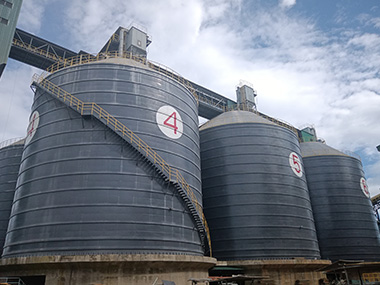
Foundation costs represent 10-25% of total silo project cost. A 5,000-ton cement silo generating 60,000+ kN requires engineering that matches the sophistication of the silo structure itself.
Understanding Your Loads
2.1 Vertical Loads
Dead load (steel shell, roof, equipment) + Live load (stored material) = Total vertical load. Apply partial factors: 1.35G + 1.5Q per Eurocode or 1.2D + 1.6L per ASME.
2.2 Horizontal and Moment Loads
Wind and seismic loads create overturning moments. For tall silos, wind moment Mw = w × H × H/2 can exceed seismic moment. Eccentric discharge adds horizontal forces that must be considered.
Soil Investigation: Don't Skip This Step
I cannot emphasize this enough: every silo project needs proper geotechnical investigation. On a project in Vietnam, we saved the client $80,000 by identifying a shallow rock layer that allowed shallow foundations instead of the originally assumed piled foundation.
Minimum investigation: 3 boreholes per silo, SPT at 1.5m intervals, laboratory testing (triaxial shear, consolidation, chemical analysis), and groundwater monitoring.
Foundation Types Compared
| Type | Best For | Typical Cost |
|---|---|---|
| Ring wall | Good soil, D < 20m | $15,000-30,000 |
| Circular mat | Moderate soil, 10-30m | $25,000-50,000 |
| Piled | Poor soil, high capacity | $50,000-150,000 |
Settlement Analysis
Immediate settlement occurs upon loading in granular soils. Consolidation settlement in cohesive soils can continue for years - total settlement of 50-100mm is not uncommon. Differential settlement (edge-to-center) must be controlled to prevent silo distortion.
Seismic Design Considerations
Seismic regions require: increased lateral load capacity (10-20% of vertical), liquefaction assessment, soil-structure interaction analysis, and overturning moment resistance. Seismic foundations typically cost 30-50% more than static designs.
Frequently Asked Questions
Q: How long does foundation construction take?
A: Typical timeline: 2-4 weeks for excavation and preparation, 1-2 weeks for reinforcement and anchor bolts, 1 day for concrete placement, 2-4 weeks curing before silo loading. Total: 5-8 weeks.
Q: Can I build on existing foundations?
A: Sometimes. We assess bearing capacity, settlement history, and structural integrity. Existing foundations may require strengthening or extension. We've successfully reused foundations on 30% of retrofit projects.
Q: What happens if soil conditions differ from investigation?
A: We design for uncertainty with conservative assumptions. If conditions are worse than expected, we modify design during construction (deeper foundations, additional piles). If better, we optimize to save costs.
Need foundation design for your silo? Manxing provides complete foundation engineering including soil investigation supervision, design, and construction drawings. Request a Foundation Assessment