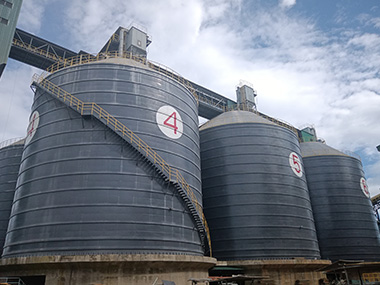
Silo Ladder and Platform Engineering per OSHA and ISO Standards
Silo ladder and platform engineering must comply with OSHA 29 CFR 1910 Subpart D for walking-working surfaces and ISO 14122 series for permanent means of access to machinery. These standards mandate minimum platform widths of 600 mm, guardrail heights of 1,100 mm, and ladder cage provisions for vertical climbs exceeding 6 meters. This article details the structural, material, and safety requirements that govern every access system on industrial storage silos.
OSHA Regulations for Silo Access Systems
Figure 1Figure 2Figure 3
29 CFR 1910 Subpart D – Walking-Working Surfaces
OSHA Subpart D establishes that every silo platform must support a minimum concentrated load of 2.2 kN (500 lb) applied over any 645 mm² area. Platforms must maintain a slip-resistant surface with static coefficient of friction ≥ 0.5. Access openings require self-closing gates or guardrails with equivalent protection. Stairways on silos with a pitch between 30° and 50° must have uniform riser heights (±3 mm) and tread depths ≥ 200 mm.
Fall Protection Requirements for Silo Platforms
Any platform or walkway positioned 1.2 meters (4 feet) or more above a lower level requires guardrail systems per 29 CFR 1910.29. Top rails must withstand 890 N (200 lbf) of force in any direction. When guardrails are impractical—such as at silo roof hatches—personal fall arrest systems anchored to structural members rated at 22.2 kN (5,000 lb) per worker are mandatory.
ISO Standards Governing Silo Structural Access
ISO 14122 Series – Permanent Means of Access
ISO 14122-1 through -4 provides the international framework for fixed access to silos and industrial structures. ISO 14122-2 specifies that ladder rung spacing must be uniform at 300 mm (±15 mm) center-to-center. Ladders exceeding 6,000 mm in vertical length require either a safety cage (internal diameter 650–800 mm) or a personal fall-arrest system compatible with ISO 14122-4. Platforms must be designed for load classes P (pedestrian only, 2.0 kN/m²) or S (maintenance with tools, 3.0 kN/m²).
Load Classification and Structural Design Criteria
ISO 14122-2 classifies access load scenarios. For silo platforms supporting maintenance equipment, engineers apply a dynamic amplification factor of 1.4 to static loads. Cantilevered platform brackets must be verified for fatigue under 2×10⁶ stress cycles at the design stress range. Bolted connections require preload to 70% of the bolt's proof load to prevent loosening under vibration from material discharge.
Ladder Engineering and Configuration
Cage vs. Rest Platform Design
Vertical silo ladders over 6,000 mm require intermediate rest platforms spaced at maximum 9,000 mm intervals. OSHA permits cages as an alternative, but ISO 14122-4 increasingly favors rest platforms because cages do not prevent falls—they only limit fall distance. Rest platforms must be 700 mm minimum width with 1,100 mm guardrails and 150 mm toe boards. Cage hoops are spaced at 1,200 mm vertical intervals with vertical bars at 300 mm maximum spacing.
Vertical Ladder Safety Factors
Silo ladder structural members are designed with a minimum safety factor of 3.0 against yield and 5.0 against ultimate tensile strength. Side rails are typically 50×10 mm flat bar steel or equivalent tubular sections. Rungs of 20–25 mm diameter round bar must resist a 1.5 kN point load at midspan with deflection under 2 mm. All ladder connections to the silo shell use through-bolts with backing plates to prevent local shell buckling.
Platform Design and Guardrail Engineering
Platform Load Requirements
Silo roof platforms and intermediate walkways are designed for a uniform live load of 3.0 kN/m² plus a concentrated maintenance load of 1.4 kN at the most unfavorable position. Grating panels (typically 30×5 mm bearing bars at 33 mm c/c) must not deflect more than L/200 under full load. Cantilevered platforms extending beyond the silo shell require torsional bracing to resist unbalanced loading during maintenance operations.
Guardrail and Toe Board Specifications
Guardrail systems consist of a top rail at 1,000–1,100 mm, an intermediate rail at 450–500 mm, and a toe board of minimum 100 mm height. Mesh or solid infill panels with openings no larger than 50 mm are required when tools or materials may fall. All guardrail-to-post connections must resist 1.5 kN/m applied at the top rail level. On silos storing combustible materials, guardrails incorporate static-dissipative coatings (surface resistivity 10⁶–10⁹ Ω).
Material Selection and Corrosion Protection
Steel Grade Selection
Structural carbon steel for silo ladders and platforms conforms to ASTM A36 (yield ≥ 250 MPa) or EN 10025 S235JR. In low-temperature environments (below −20°C), impact-tested grades such as ASTM A572 Grade 50 or S355J2 are required to prevent brittle fracture. All structural steel undergoes Charpy V-notch testing at the minimum service temperature with 27 J minimum absorbed energy.
Hot-Dip Galvanizing Standards
Per ISO 1461 and ASTM A153, hot-dip galvanizing provides 85–100 µm coating thickness for steel sections 6 mm or thicker. This delivers 50+ years of corrosion protection in rural industrial atmospheres (C2–C3 corrosivity categories per ISO 9223). For silos in coastal or chemical environments (C4–C5), duplex systems (galvanizing plus 120 µm polyurethane topcoat) extend service life to 25+ years before first maintenance.
Engineering Tip: Always design silo ladder and platform anchor points as part of the primary silo shell analysis. Post-installed anchors (expansion or adhesive) on thin-walled bolted silos (6 mm shell or less) require finite-element verification to confirm local shell stresses remain below 0.6× yield under combined wind and access loads.
Case Study: Cement Silo Access System Upgrade
A cement plant in Southeast Asia required full access engineering for four 60-meter-tall, 8,000-tonne capacity cement silos. The original 1990s-era ladders lacked cages and platforms exceeded 12-meter uninterrupted climbs.
Manxing's engineering team performed the following:
Designed OSHA/ISO-compliant vertical ladders with safety cages (700 mm internal diameter, 1,200 mm hoop spacing) and rest platforms at 8,000 mm intervals
Installed 1,200 mm-wide perimeter roof platforms with 1,100 mm guardrails, intermediate rails, and 150 mm toe boards
Applied hot-dip galvanizing (95 µm per ISO 1461) with a 100 µm epoxy topcoat for the C4 coastal environment
Verified all anchor connections on the 8 mm steel shell using FEA, adding 200×200×10 mm backing plates at each bracket
The project delivered 48 ladders, 32 rest platforms, 4 roof walkways, and 2 hopper-access stairways—all certified to OSHA 29 CFR 1910 and ISO 14122-2, with full structural calculation packages submitted to the client's third-party inspector.
Frequently Asked Questions
What is the maximum uninterrupted vertical climb allowed on a silo ladder without a cage or rest platform?
OSHA 29 CFR 1910.27 limits fixed ladder vertical runs to 6 meters (20 feet) before requiring either a ladder safety cage or a rest platform. ISO 14122-2 recommends rest platforms at 9-meter maximum intervals, but OSHA's 6-meter rule governs in jurisdictions where it applies.
What is the minimum width for a silo maintenance platform?
ISO 14122-2 specifies a minimum platform width of 600 mm for pedestrian-only access and 800 mm where maintenance tools or equipment must be carried. OSHA requires sufficient width to maintain a 500 mm clearance from any hazard when the platform is occupied.
How often should silo ladders and platforms be inspected?
OSHA recommends annual visual inspections of all fixed ladders and platforms. ISO 14122-4 adds that structural connections should be torque-verified every 3 years and full-load deflection testing conducted every 5 years for platforms supporting equipment. In corrosive environments, coating thickness surveys are recommended annually.