```html
Silo Anchoring Design: Bolted vs Welded Base Plate Engineering
Silo Anchoring Design: Bolted vs Welded Base Plate Engineering
Silo anchoring design determines structural stability under wind, seismic, and material loading. Bolted base plates allow field adjustability and easier maintenance, while welded base plates provide continuous load transfer and higher fatigue resistance. This article compares both methods across engineering parameters to guide specification decisions for industrial storage projects.
1. Base Plate Connection Fundamentals
Figure 1Figure 2Figure 3
1.1 Load Transfer Mechanisms
Base plates distribute silo wall loads to the concrete foundation. Bolted connections transfer forces through shear and tension in anchor rods, creating discrete load paths at each bolt location. Welded connections create a continuous bond between the steel plate and embedded elements, distributing loads uniformly around the full circumference. For a 30-meter-diameter cement silo storing 10,000 metric tons, base plate loads can exceed 15 MN radially and 40 MN vertically.
1.2 Design Code Requirements
International standards govern both connection types. EN 1993-4-1 (Eurocode 3) specifies silo structural requirements including anchorage design. AISC 360-22 Chapter J addresses base plate and anchor rod design in the United States. API 650 Appendix E provides additional guidance for large-diameter welded steel tanks. Seismic provisions in EN 1998-4 require anchorage systems to resist overturning moments calculated from silo height-to-diameter ratios exceeding 1.5.
1.3 Material Specifications
Base plates typically use S355 structural steel (yield strength 355 MPa minimum) with thicknesses ranging from 20 mm to 60 mm depending on silo diameter. Anchor rods for bolted connections use Grade 8.8 or 10.9 high-strength steel (yield strengths 640 MPa and 900 MPa respectively). Welded connections require compatible filler metals matching base plate chemistry, typically E7018 electrodes for S355 steel with minimum tensile strength of 480 MPa.
2. Bolted Base Plate Engineering
2.1 Anchor Rod Configuration
Bolted base plates use circular patterns of anchor rods embedded in the concrete foundation. Rod diameters range from M24 to M64, with typical embedment depths of 400 mm to 1200 mm. For a 20,000-ton grain silo with 24-meter diameter, designs commonly specify 48 M48 Grade 10.9 anchor rods arranged at 7.5-degree spacing. Each rod must develop full tensile capacity before concrete cone failure occurs, requiring minimum edge distances of 150 mm and spacing of 250 mm per EN 1992-4.
2.2 Grouting and Leveling Systems
Bolted installations require precision grouting beneath the base plate. Non-shrink cementitious grout with minimum compressive strength of 50 MPa at 28 days fills the 30 mm to 50 mm gap between plate underside and foundation top. Leveling nuts on each anchor rod permit plate elevation adjustment to ±1 mm tolerance before final grouting. Torquing sequences follow star patterns to prevent uneven loading, with final torquing reaching 80% of rod proof load—typically 380 kN for M48 Grade 10.9 rods.
2.3 Inspection and Replacement Advantages
Bolted connections permit non-destructive inspection using ultrasonic testing of individual anchor rods. Rod elongation measurements verify preload retention without disassembly. Replacement of individual rods requires only local concrete breakout and re-anchoring, typically completed in 4–8 hours per rod. This maintainability advantage makes bolted designs preferred for silos in corrosive environments or regions requiring periodic seismic recertification.
3. Welded Base Plate Engineering
3.1 Weld Joint Design
Welded base plates connect to embedded steel rings or anchor chairs through full-penetration groove welds or heavy fillet welds. Typical weld sizes range from 12 mm to 25 mm leg length for fillet welds, requiring 2 to 4 weld passes depending on plate thickness. For a 40 mm thick base plate on a 15,000-ton fly ash silo, the total weld length per silo exceeds 80 linear meters. Weld procedures must qualify per AWS D1.1 or EN ISO 15614-1, with qualified positions covering vertical and overhead orientations encountered during field welding.
3.2 Thermal Effects and Distortion Control
Welding introduces residual stresses reaching 50–70% of material yield strength in the heat-affected zone. For large-diameter silos exceeding 30 meters, cumulative weld shrinkage can cause 5 mm to 15 mm of base plate distortion. Controlled welding sequences—alternating between diametrically opposite segments—minimize distortion. Preheating to 100°C for plates over 35 mm thickness reduces thermal gradients and hydrogen-induced cracking risk. Post-weld heat treatment at 580°C ± 20°C may be specified for critical applications.
3.3 Fatigue Performance
Welded joints exhibit lower fatigue strength than bolted connections under cyclic loading. Detail Category 71 per EN 1993-1-9 applies to full-penetration butt welds, permitting 71 MPa stress range at 2 million cycles. Fillet-welded connections fall to Detail Category 45, limiting permissible stress ranges for silos experiencing frequent filling and discharging cycles exceeding 10,000 per year. Bolted connections avoid weld fatigue concerns entirely, as anchor rods experience primarily tensile stress without stress concentration at the joint.
Engineering Tip: For silos exceeding 25-meter diameter or storing abrasive materials with daily cycling, specify bolted base plates with hot-dip galvanized anchor rods (minimum 85 μm coating per ISO 1461). This combination provides 25+ year corrosion protection while maintaining field replaceability—critical for minimizing downtime in continuous-process facilities.
4. Comparative Engineering Analysis
4.1 Structural Performance Summary
Bolted connections achieve 85–92% of the continuous load capacity of welded joints due to discrete load transfer points. However, properly designed bolted systems with adequate rod counts meet all strength requirements for silos up to 50-meter diameter. Welded connections excel in stiffness, reducing base rotation under eccentric loading by 15–25% compared to bolted alternatives. For seismic zones with design peak ground acceleration exceeding 0.3g, welded connections provide superior energy dissipation through continuous plastic hinge formation.
4.2 Installation Timeline and Cost
Bolted base plate installation requires 3–5 days for a typical 20-meter-diameter silo, including anchor rod positioning, leveling, torquing, and grouting. Welded installations extend to 7–12 days due to welding time, interpass temperature management, and post-weld inspection. Material costs for bolted systems run 10–15% higher due to premium-grade anchor hardware, but labor costs are 30–40% lower. Total installed cost differential typically favors bolted connections by 12–18% for silos under 30-meter diameter.
4.3 Maintenance Lifecycle
Over a 30-year service life, bolted base plates require anchor rod retorquing at 5-year intervals and grout inspection at 10-year intervals. Total maintenance costs average 2–3% of initial installation cost. Welded connections require visual weld inspection annually and ultrasonic testing every 5 years. Crack repair in welded joints requires silo unloading, surface preparation, and re-welding—costing 5–8 times more per intervention than bolt replacement. Lifecycle cost analysis consistently favors bolted designs for facilities without continuous welding inspection programs.
5. Case Study: Cement Silo Anchorage Selection
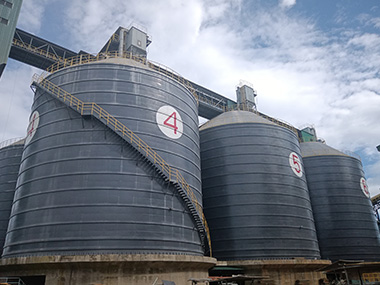
A 2023 cement production facility in Southeast Asia required two 15,000-ton capacity silos, each 32 meters in diameter and 48 meters tall. Site conditions included seismic design category D (PGA = 0.4g) and tropical humidity averaging 85% RH. The engineering team evaluated both connection types:
Bolted Design: 64 M56 Grade 10.9 anchor rods, 35 mm S355 base plate, 40 mm non-shrink grout layer. Total installed cost: $185,000 per silo. Installation time: 4 days. Predicted maintenance: rod retorquing every 5 years at $3,200 per intervention.
Welded Design: 50 mm S355 base plate with 20 mm fillet welds to embedded ring, continuous 360-degree weld. Total installed cost: $212,000 per silo. Installation time: 10 days including PWHT. Predicted maintenance: annual weld inspection at $8,500 per silo per year.
Selection: The bolted design was selected based on 30-year lifecycle cost savings of $127,000 per silo and reduced installation schedule impact. Hot-dip galvanized rods with secondary encapsulation provided corrosion protection matching the 40-year design life requirement.
6. Frequently Asked Questions
What is the minimum base plate thickness for a 20,000-ton grain silo?
For a 20,000-ton grain silo with 25-meter diameter, minimum base plate thickness is 35 mm using S355 steel with 36 M42 anchor rods. This provides adequate bending stiffness under wall load and prevents local yielding at bolt locations. Thinner plates (25–30 mm) may be used with additional stiffener ribs welded to the plate underside.
Can welded base plates be repaired if cracks develop?
Yes, but repair requires silo unloading to reduce stresses below 25% of design load. Cracks are removed by grinding to sound metal, verified by magnetic particle inspection, then re-welded using qualified procedures with controlled preheat. Repaired zones require enhanced inspection frequency—ultrasonic testing every 2 years instead of 5 years for the affected section.
How does silo height-to-diameter ratio affect anchoring choice?
Silos with height-to-diameter ratios exceeding 2.0 generate significant overturning moments requiring robust anchorage. Welded connections are preferred for H/D > 2.5 due to superior stiffness and fatigue resistance under cyclic wind loading. For H/D < 2.0, bolted connections provide adequate capacity with lower cost and easier maintenance. Intermediate ratios (2.0–2.5) require project-specific analysis considering seismic zone and cycle frequency.
Need Expert Silo Anchoring Design?
Manxing provides complete EPC silo solutions including foundation engineering, anchorage system design, and installation supervision. Our engineering team has delivered 500+ silo projects across 40 countries with full compliance to EN