
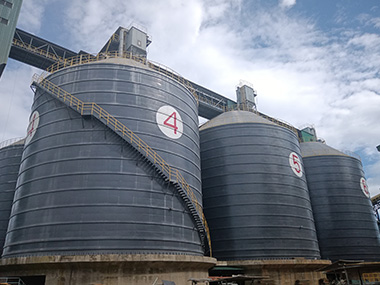

How to Choose the Right Silo Capacity for Industrial Bulk Solids Storage
Choosing silo capacity isn't about picking a number from a catalogue. It's about matching your material's bulk density, flow behaviour, and delivery logistics against the actual demand curve of your plant. Get it wrong and you're either paying for steel you don't need or shutting down production because you ran out of clinker on a Tuesday night. Here's how we approach it — with numbers, not guesswork.
1. Start With Demand, Not Volume
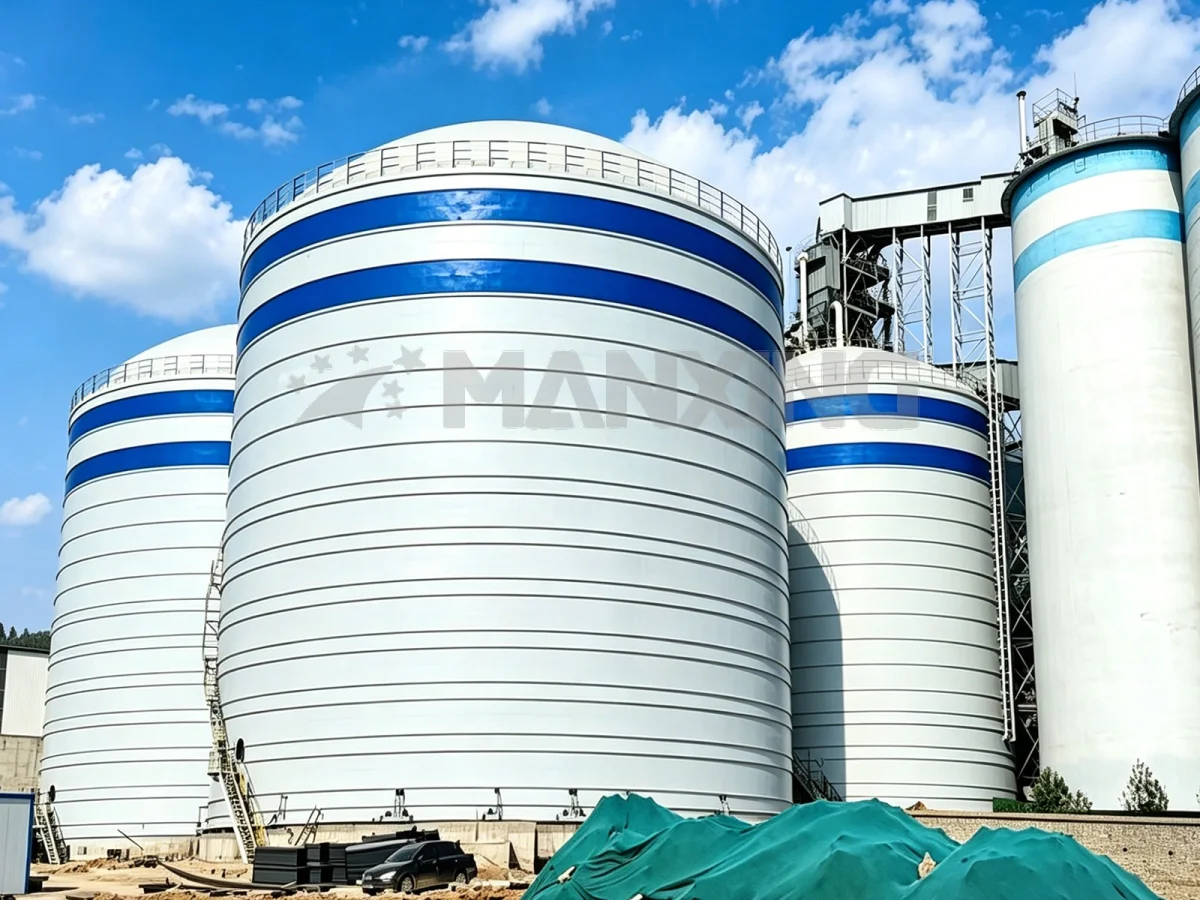
Most engineers I talk to start by asking "how big a silo do I need?" That's backwards. The right question is: how much material does my process consume, how often does it arrive, and what's the worst-case gap between deliveries?
1.1 Map Your Consumption Curve, Not Your Average
A cement plant grinding 220 tph of finished cement doesn't consume 220 tonnes every hour like clockwork. There are campaign changes, the raw mill goes down for a bearing replacement, the kiln loses 40 minutes to a shell hot-spot. Your silo has to buffer those spikes.
We ask clients for 90 days of hourly consumption data. Not monthly averages — hourly. I've seen plants where the average looks like 180 tph but the 95th percentile hits 265 tph. Size for the 95th percentile, not the mean. If you size for the mean, you'll run out of material 5% of the time, and that 5% will always happen during the worst possible shift.
1.2 Delivery Windows Dictate Minimum Capacity
If your clinker arrives by truck every 4 hours and each truck carries 32 tonnes, you need at least 128 tonnes of live storage just to survive a single missed delivery. But trucks don't always show up. In Vietnam, I watched a plant lose three consecutive deliveries because a bridge was washed out during monsoon season. They had 110 tonnes of clinker storage. They lasted 19 hours before the kiln went cold.
The rule we use: minimum working capacity = (maximum consumption rate × maximum expected delivery gap) + 15% safety margin. For that Vietnam plant, that would've been roughly 340 tonnes. They had 110. The kiln restart cost them four days and about $180,000 in lost production.
2. The Physics That Dictate Your Silo Size
You can't just divide tonnes by bulk density and call it a day. Bulk density changes with moisture, particle size distribution, compaction, and how long the material's been sitting there. A silo full of fly ash that's been standing for three weeks doesn't behave the same as one filled this morning.
2.1 Bulk Density Isn't a Constant
Take cement. Loose bulk density sits around 1.1 t/m³. After aeration and compaction in a silo, it can reach 1.4 t/m³. That's a 27% difference in the same material. If you've sized your silo based on loose density, you're overestimating your capacity by more than a quarter.
We test bulk density at three states: as-received, aerated, and compacted (after 72 hours under its own weight). For coal, the spread is even wider — 0.75 t/m³ loose, up to 0.95 t/m³ compacted. For slag, you're looking at 1.0 to 1.35 t/m³ depending on granulometry. Always design for compacted density. That's the number that determines whether your silo holds what you think it holds.
2.2 Flow Patterns Determine Usable Volume
A silo's total geometric volume and its usable volume are two different numbers. In a mass-flow silo, you can extract 95–98% of the stored material. In a funnel-flow silo, you're lucky to get 70–80%. The rest hangs up on the walls, rat-holes, or bridges over the discharge.
Here's the thing. If you need 2,000 tonnes of working capacity and you build a funnel-flow silo, you might need a total geometric capacity of 2,800 tonnes to get those 2,000 out. That's 40% more steel, more foundation load, more cost — all because the flow pattern eats your usable volume. We specify mass-flow for any material with a compressibility index above 12% or a moisture content above 3%. The cone angle and wall friction have to be calculated per Eurocode EN 1991-4, not guessed.
2.3 Angle of Repose and Wall Friction
The angle of repose tells you how material piles on a flat surface. It doesn't tell you how it behaves against a silo wall. Wall friction — measured per ASTM D6128 — determines whether material slides cleanly or sticks. For gypsum, wall friction against uncoated carbon steel can hit 35°. That's enough to create a stable rathole in anything but a steep, polished cone.
We line silos storing high-friction materials with UHMW-PE or stainless steel with a surface finish below Ra 3.2 µm. It drops wall friction by 40–60%. The lining costs $15–25/m². On a 1,200 m² wall area, that's $18,000–30,000. It pays for itself the first time you don't have to send a man in with a sledgehammer to break a bridge.
3. Working Capacity vs. Total Capacity — The Gap Nobody Talks About
When a supplier tells you a silo holds 5,000 tonnes, ask them: working capacity or total geometric capacity? The answer matters. A lot.
3.1 Dead Zones Eat Your Storage
Every silo has dead zones. The volume below the discharge cone that can't be extracted by gravity. The volume above the fill point that's reserved for dust settlement. The volume occupied by aeration pads, level sensors, and internal structures. On a typical cement silo, dead zones account for 8–15% of total geometric volume.
I remember a project in Algeria where the client specified a 3,000-tonne capacity silo. The supplier delivered a silo with 3,000 tonnes of geometric volume. After accounting for the dead zone below the aeration cone, the freeboard above the maximum fill level, and the volume taken up by the central column, the actual working capacity was 2,480 tonnes. That's 17% less than what the client thought they were buying. They found out during the first production ramp-up when the level alarm went off 20 minutes earlier than expected.
3.2 Freeboard and Dust Control
You can't fill a silo to the roof. You need freeboard — typically 8–12% of the total cylindrical height — for dust separation and to prevent over-pressurization during pneumatic filling. On a 30-metre-tall silo, that's 2.4 to 3.6 metres of unusable height. At 1.2 t/m³ bulk density, that's hundreds of tonnes of lost capacity.
We also factor in the fill pipe intrusion. A pneumatic conveying line enters the silo top and extends 1–2 metres inside. That volume is permanently occupied. It's small — maybe 2–5 m³ — but on a tight capacity design, every cubic metre counts.
4. Material-Specific Considerations That Change Everything
Not all bulk solids behave the same. The material you're storing dictates the silo geometry, the discharge system, and ultimately the capacity you can actually use.
4.1 Cohesive Powders: Fly Ash, Raw Meal, Fine Coal
Cohesive materials bridge. They rathole. They compact under their own weight and refuse to flow. For these, we design for mass-flow only — no exceptions. The cone angle must be steep enough (typically 60–70° from horizontal) and the wall friction low enough to prevent stable rathole formation.
Fly ash with a moisture content above 2% is a nightmare. It compacts, it sticks, and it can form a bridge strong enough to support a person's weight. I've seen a 1,500-tonne fly ash silo in India where the material bridged across the entire 8-metre diameter. They tried aeration, air cannons, and finally a man with a rod through the manhole. Took 11 hours to clear. The plant was burning petcoke they couldn't blend because the ash wouldn't move.
For cohesive materials, we add 20–25% to the calculated capacity to account for flow inefficiencies and the need for a minimum residual bed to protect the discharge equipment.
4.2 Abrasive Materials: Clinker, Slag, Sand, Aggregate
Abrasive materials don't bridge — they eat. Clinker at 1.45 t/m³ hitting a steel wall at 3 m/s during discharge will wear through 6 mm plate in 18–24 months if it's not lined. We specify abrasion-resistant liners: cast basalt for cones, ceramic tile for walls, or 12 mm Hardox 450 for high-impact zones.
The capacity calculation for abrasive materials includes a wear allowance. We design the silo with an initial wall thickness that accounts for 10 years of wear. That means the silo starts with thicker steel than the structural calculation requires. It costs more upfront. But I've seen plants where unlined silos lost 40% of their wall thickness in five years and had to be taken out of service for a full re-skin. That shutdown cost more than the liner would have.
4.3 Explosive Dusts: Coal, Sulfur, Certain Chemical Powders
If your material has a Kst value above 100 bar·m/s (per ISO 21873 testing), you're in dust explosion territory. Coal dust, sulfur, some alumina grades — these require explosion venting per EN 14491 or suppression per ISO 15012. The venting hardware occupies volume inside the silo top. A single explosion vent on a large coal silo can be 1.2 m × 1.2 m — that's 1.44 m² of roof area that can't be used for fill ports or ventilation.
More importantly, explosive materials often require inerting — nitrogen blanketing to keep oxygen below 12%. The inerting system needs headspace for gas distribution. We typically reserve 10–15% of the silo volume for the inert gas layer. That's capacity you can't use for material storage, but you can't operate without it.
5. Site Constraints That Override the Math
You can calculate the perfect silo capacity on paper. Then you get to site and find out the foundation can't support it, the road can't handle the trucks, or the crane can't reach high enough to erect it.
5.1 Foundation and Soil Conditions
A 5,000-tonne cement silo with a 16-metre diameter imposes a bearing pressure of roughly 280 kPa on the foundation. If your site has a allowable bearing capacity of 150 kPa — common in alluvial plains or reclaimed land — you need a piled foundation. That adds $200,000–500,000 to the project cost depending on pile depth.
In Indonesia, we had a site where the geotechnical report said 180 kPa. We drilled our own boreholes and found 90 kPa at 3 metres depth. The original ring-beam foundation design would've settled differentially by 40 mm — enough to crack the silo shell. We switched to a piled cap with 24 piles at 12 metres depth. The client wasn't happy about the cost. But a cracked silo shell would've been worse.
5.2 Delivery Logistics and Throughput
Your silo capacity is only as good as your ability to fill it. If you're receiving cement by 32-tonne trucks and the truck cycle time is 45 minutes (including weighing, discharge, and queue), you can fill at a maximum rate of about 42 tonnes per hour. To fill a 3,000-tonne silo, that's 71 hours of continuous trucking. If you only have a 12-hour receiving window per day, it takes six days to fill.
That's fine if you're filling from a steady production stream. But if you're a distribution terminal that needs to turn silos over every 48 hours, you need a faster fill rate. That means a bigger receiving system — a 150 tph pneumatic conveyor instead of truck unloading — or a bigger silo that you fill less frequently. The capacity decision and the logistics decision are the same decision.
6. Common Mistakes We've Seen in the Field
After 15 years and projects in 30-plus countries, I've seen the same mistakes repeat. Here are the ones that cost the most.
6.1 Sizing for Nameplate, Not Reality
A plant says "we produce 1,000,000 tonnes per year of cement." That sounds like 125 tph at 8,000 hours. But the plant actually runs 7,200 hours after accounting for maintenance, market downtime, and holidays. The real average is 139 tph. And the peak — during the dry season when demand spikes — hits 165 tph. Size for 165 tph, not 125.
6.2 Ignoring Future Expansion
We always ask: what's the capacity plan in 10 years? If the plant is going to increase output by 30%, the silo should be designed for that future capacity — or at least the foundation and shell should be reinforced to handle it. Adding 30% capacity to an existing silo is nearly impossible without a full rebuild. But designing the shell and foundation for future capacity from day one adds maybe 8–12% to the initial cost. That's cheap insurance.
6.3 Forgetting About Segregation
If you're storing granular material — aggregate, coal, pellets — and you fill from a central point, the coarse particles roll to the outside and the fines settle in the centre. When you discharge from the centre, you get a different particle size distribution than what you put in. For some processes, that's fine. For others — like coal blending for a kiln — it's a problem.
Segregation doesn't change your capacity calculation, but it changes your usable capacity. If the centre of the silo is full of fines that won't flow through the discharge gate, you've effectively lost that volume. We specify multiple fill points or a distributor cone for materials where segregation matters. It adds complexity. But it keeps the material blend consistent.
Case Study: 4,500-Tonne Clinker Silo — Cement Plant, East Africa
A client needed clinker storage for a 2,500 tpd kiln. The kiln produces roughly 105 tph of clinker. Clinker arrives at the silo via a 150 tph conveyor from the kiln. The silo feeds the cement mill at 120 tph (peak).
Step 1 — Demand analysis: The cement mill runs 22 hours per day (2 hours for maintenance). Peak consumption is 120 tph. Average is 105 tph. The 95th percentile from historical data was 128 tph.
Step 2 — Delivery gap: The kiln runs 330 days per year. During the annual shutdown (35 days), the mill draws from the silo. Maximum draw-down period: 35 days × 22 hours × 105 tph = 77,100 tonnes. But the silo also buffers daily imbalances — the mill runs 22 hours, the kiln runs 24. That's 2 hours × 105 tph = 210 tonnes per day of net accumulation.
Step 3 — Capacity calculation: For the annual shutdown buffer alone, they needed 77,100 tonnes. But that's impractical — it would require a silo 40 metres in diameter and 35 metres tall. Instead, the client accepted a risk: they'd reduce mill output to 80 tph during the last 10 days of the shutdown. That brought the required capacity to 4,200 tonnes. We added 7% for dead zones and flow inefficiencies. Final design: 4,500 tonnes working capacity.
Step 4 — Geometry: 18-metre diameter, 22-metre cylinder height, 70° cone angle with UHMW-PE lining. Total geometric capacity: 5,100 tonnes. Working capacity: 4,500 tonnes. Foundation: piled cap with 28 piles at 14 metres depth (site bearing capacity was 110 kPa).
The silo was commissioned in 2019. During the 2023 kiln shutdown, it performed exactly as designed — the mill ran at full output for 25 days, then reduced to 80 tph for the final 8 days. The silo hit its minimum level 36 hours before the kiln restarted. Close, but safe.
Frequently Asked Questions
Q: How do I calculate silo capacity from my plant's production rate?
Multiply your peak consumption rate (not average) by the maximum expected supply interruption time, then add 15–20% for dead zones and safety margin. For example: 120 tph × 72 hours × 1.18 = 10,195 tonnes. That's your minimum working capacity. Then check whether that volume fits your site constraints and delivery logistics.
Q: What's the difference between total capacity and working capacity?
Total capacity is the geometric volume of the silo shell. Working capacity is the material you can actually extract. The difference is typically 10–20% and includes dead zones below the discharge, freeboard above the fill point, and volume occupied by internal structures. Always specify working capacity in your procurement documents.
Q: Can I increase the capacity of an existing silo?
Sometimes. If the shell and foundation have spare capacity, you can raise the cylinder height — but only if the shell was designed for the additional wind and seismic loads per Eurocode EN 1991-1-4 and EN 1998-1. Adding height to an undesign shell is dangerous. We've seen silos buckle from a 3-metre extension that wasn't in the original structural model. If you need more capacity, the safer option is a second silo with a connecting conveyor.
Need help sizing your silo? Manxing has designed and built over 800 industrial silos across cement, clinker, fly ash, coal, slag, and aggregate plants in 30+ countries. We run the calculations, test your material, and deliver the complete EPC package — from foundation to commissioning. Contact our engineering team with your consumption data and site conditions. We'll give you a capacity recommendation with numbers, not estimates.