

Piping and Dust Collection System Setup: Engineering the Lungs and Arteries of Your Silo
Piping and dust collection setup is the circulatory and respiratory system of your bulk solids storage facility. It dictates how material enters the silo and how displaced air gets filtered before hitting the atmosphere. Get the piping wrong, and you'll choke on pressure drops or blast through elbows in six months. Get the dust collection wrong, and you're looking at a clogged filter or, worse, an unmitigated dust explosion.
Pneumatic Conveying Pipes: Getting Bulk Solids from A to B
Pipe Routing and Bend Radius
Look, I'll be straight with you. The biggest mistake I see in pneumatic conveying layouts is the obsession with saving space. Contractors cram pipes into every available gap, using tight 90-degree elbows because it's easier to fit them between structural columns. That's a recipe for disaster.
When you're pushing cement or clinker at 15 to 20 meters per second, every directional change creates an impact zone. The particles don't flow around the corner; they slam into the outer wall. If you use a short-radius elbow (1.5 times the pipe diameter), you're creating a localized wear point that will fail. You need a long-radius bend—minimum 3 to 5 times the pipe diameter. For highly abrasive materials like slag or alumina, I specify a 5D radius or even a concrete-lined bend at the discharge point.
I remember a project in Malaysia where the piping contractor used short-radius 90s to save floor space in the compressor room. We replaced 12 elbows in four months. The clinker just ate through the outer curve like a saw blade. The plant manager wasn't happy about the $8,000 emergency shutdown, but he was the one who approved the tight routing in the first place.
Pressure Ratings and Material Selection
Your piping isn't just a tube; it's a pressure vessel. ASME B31.3 governs process piping, and you'd be surprised how many installations I've seen that ignore it. If you're running a dense phase system pushing 4 to 6 bar, you can't just grab standard Schedule 40 carbon steel pipe and hope for the best. You need to calculate the wall thickness based on the operating temperature and the fatigue cycles.
For abrasive materials, I generally step up to Schedule 80 or specify a 6mm wall thickness minimum. If the material is corrosive or you're dealing with high-moisture environments—like a coastal fly ash plant—you're looking at 316L stainless steel or even internal rubber lining. Don't forget the flanges. A leaking flange on a pressurized silo inlet isn't just a mess; it's a safety hazard. Use raised-face flanges with spiral-wound gaskets, and torque them to the spec in DIN 2413. I've seen guys tighten flanges with a standard wrench and a prayer. That never works.
Dust Collection Systems: Keeping the Air Clean and the Plant Safe
Sizing the Filter (Air-to-Cloth Ratio)
The dust collector is the lungs of your silo. Every tonne of cement you blow into the silo displaces a massive volume of air. If that air isn't filtered, you're dumping product into the atmosphere and creating a health hazard. The sizing of your baghouse or jet-pulse filter comes down to one critical metric: the air-to-cloth ratio.
For standard cement dust, you want a ratio between 1.5:1 and 2.0:1. That means for every 1.5 to 2.0 cubic meters of air per minute, you need one square meter of filter cloth. If you push that ratio to 3:1 because you're trying to save money on the filter unit, the bags will blind prematurely. The differential pressure will spike, and your system will choke. ISO 15012 gives you the guidelines for dust extraction systems, but the real-world rule is simple: oversize the filter. A 20% larger filter unit costs maybe $3,000 more upfront. Replacing 48 blinded bags in a confined space costs $15,000 and a full day of downtime.
Explosion Protection and Venting
Here's the thing nobody wants to talk about until it's too late: combustible dust. Coal, fly ash, certain chemical powders—they can and do explode. If your dust collector is handling an explosive atmosphere, you need to design for it from day one. EN 14491 dictates how you protect dust collectors against explosions.
You have two choices: explosion venting or flameless venting. Venting requires directing the blast to a safe area through an explosion duct. Flameless venting uses a flame-arresting element so you can mount the collector indoors. Either way, you need to calculate the Kst value of your dust—ISO 21873 covers the testing methods for dust explosion characteristics. If you're handling coal dust with a Kst value over 200 bar·m/s, you're in St-1 explosion class, and your vent area needs to be precisely calculated. I've walked into plants where the dust collector had no venting at all. The contractor just assumed it wouldn't happen. That's not engineering; that's gambling.
Structural Integration: Mounting and Supporting the Load
Pipe Supports and Expansion Joints
Pipes don't just hang in the air. They vibrate, they expand, and they get heavy when they're full of material. If you don't support them correctly, the weight transfers to the silo nozzles, and you'll crack the shell. EN 1991 gives you the actions on structures, but the practical application is straightforward: support the pipe, not the silo.
For horizontal runs, place a support every 6 meters. For vertical runs, use guides that allow axial movement but prevent lateral sway. And you absolutely need expansion joints. Carbon steel pipe expands roughly 1.2mm for every 10 meters of length per 100°C temperature change. If you're conveying hot clinker dust at 150°C, a 30-meter pipe run is going to grow by over 50mm. Without an expansion joint, that force has to go somewhere. It'll rip the pipe off the silo roof or buckle the support structure. I specify bellows expansion joints with internal liners for abrasive flows. The liners keep the particles from chewing up the convolutions.
Silo Top-Mounted Dust Filter Integration
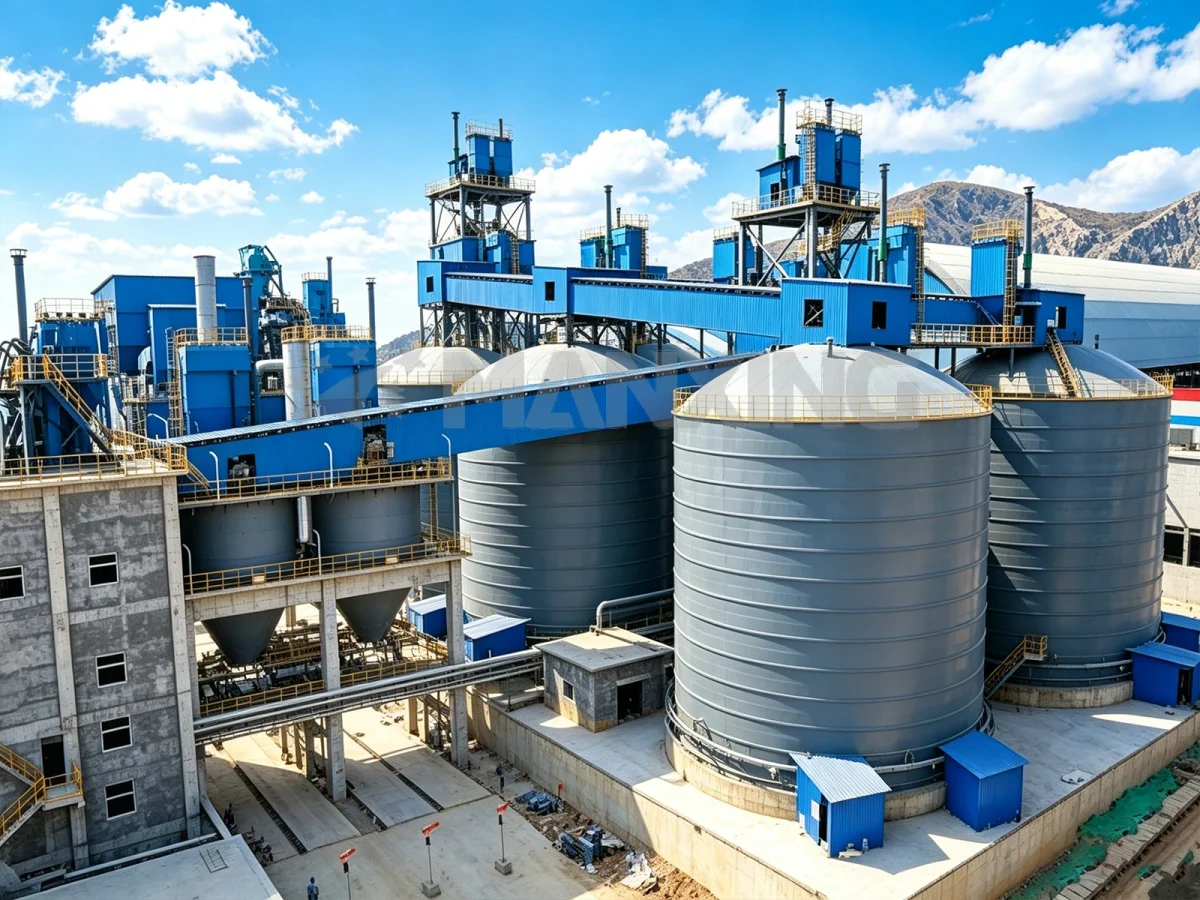
Mounting the dust collector directly on the silo roof is standard practice. It saves space and eliminates a return air duct. But you're putting a massive, vibrating load on a thin-walled steel structure. A fully loaded jet-pulse filter can weigh 2,500 kg. You can't just bolt it to the roof panels.
You need structural steel supports that transfer the load directly to the silo shell stiffeners or the columns. The roof itself needs reinforcement. I've seen 3mm roof panels buckle under a filter that wasn't properly supported. Also, consider the uplift. When the silo is filling and the filter is clogging, the pressure inside the silo can spike. If your filter isn't venting correctly, the uplift force on the roof can exceed the silo's design limits. Always check the pressure relief settings on the filter housing against the silo's design pressure.
Commissioning and Field Adjustments: Where Theory Meets Reality
Leak Testing and Pressure Checks
Before you blow a single tonne of material through the system, you need to pressure test the piping. It's not optional. ASME B31.3 requires a hydrostatic test at 1.5 times the design pressure. If you can't use water because it'll cause rust or contaminate the lines, use a pneumatic test, but you have to isolate the area. Compressed air at 6 bar stores a lethal amount of energy.
Check every flange, every weld, and every instrument connection. I use a soap-bubble test on low-pressure systems and ultrasonic detectors on high-pressure dense phase lines. A leak on a cement conveying line might just look like a white dusting on the pipe exterior. But that leak is letting moist air into the system, and moisture causes cement to harden inside the pipe. You'll be rodding out concrete-like blockages within a month.
Balancing the System
Once the system is sealed, you need to balance the airflow. Pneumatic conveying isn't a single loop; it's a network. If you have multiple silos fed by a single compressor, the line closest to the compressor will steal the air from the farthest line. You end up with a full silo at position A and an empty silo at position B.
You balance the system using restriction orifices or manual dampers at each branch. It's a tedious process. You adjust one damper, check the pressure drop, adjust the next, and repeat until the flow is within 10 to 15% variance across all lines. I've spent entire days in 45°C heat on a platform in Vietnam, turning a damper handle a quarter-turn at a time while watching a pressure gauge. The crew wanted to just open everything up and let it run. I told them that's how you get a blocked line and a week of downtime. We balanced it properly, and they've never had a blockage since.
Case Study: Fly Ash Silo Venting Failure in Vietnam
A client commissioned a 3,000-tonne fly ash silo for a new power plant. The original EPC contractor sized the dust collector based on the silo volume, not the filling rate. They used a standard 48-bag unit with a 1.8:1 air-to-cloth ratio. The problem? The filling convoy was pushing 150 tonnes per hour, generating roughly 2,500 cubic meters of displaced air per minute.
Within the first week, the filter differential pressure hit 1,800 Pa. The bags were completely blinded. The silo roof started to bulge because the displaced air had nowhere to go. The plant shut down in panic. We came in, recalculated the airflow, and replaced the filter with a 72-bag unit, dropping the air-to-cloth ratio to 1.2:1. We also added an explosion vent per EN 14491, since the fly ash had a Kst value of 180. The retrofit cost $45,000. The original undersized filter would have cost them $200,000 in structural repairs to the roof.
Frequently Asked Questions
What's the biggest mistake in pneumatic conveying pipe layout?
Using short-radius elbows to save space. It's a false economy. A long-radius bend costs maybe $200 more than a short one, but replacing a blown-out elbow costs $5,000 in parts and lost production. Always specify a minimum 3D bend radius for abrasive materials.
How often should I check dust collector differential pressure?
Continuously. You should have a differential pressure gauge wired to your PLC. If the pressure drops below 500 Pa, your bags might be torn. If it creeps above 1,500 Pa, they're blinding. I check the trend data weekly. A slow, steady climb means the bags are aging. A sudden spike means a bag just failed or the pulse valves aren't firing.
Can I mount a dust collector directly on the silo roof?
Yes, but you have to reinforce the roof structure. A standard silo roof is designed for a 2.5 kPa snow load, not a 3,000 kg vibrating filter. You need to add structural steel supports that transfer the load to the shell stiffeners. Never bolt a heavy filter directly to the roof panels.
Ready to Engineer Your Silo System?
At Manxing, we don't just design silos; we engineer the entire bulk material handling circuit. From the pneumatic conveying piping to the dust collection and explosion protection, our EPC team ensures your system is safe, efficient, and built to last. We've commissioned projects across 30+ countries, and we've seen what happens when details are ignored. Don't let your piping or dust collection be the weak link.
Contact Manxing today for a technical consultation. Let's get your silo system right the first time.