
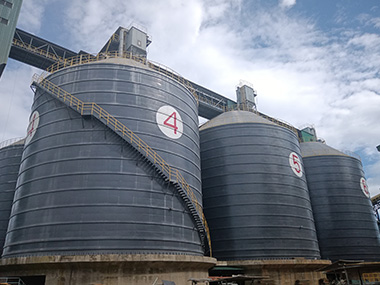

Seismic and Wind Considerations
Seismic loads on silo foundations are governed by the local seismic code — EN 1998-1 (Eurocode 8) in Europe, GB 50011 in China, or the equivalent national standard. The seismic coefficient depends on the site's seismic zone, soil importance factor, and the silo's natural period.
For a typical steel silo in a moderate seismic zone (design ground acceleration of 0.2g), the horizontal seismic force might be 10–15% of the total weight. That creates an overturning moment at the foundation level, which increases the bearing pressure on one side and decreases it on the other. The foundation must be designed so that the maximum bearing pressure doesn't exceed the allowable value, and the minimum pressure doesn't go negative (which would mean the foundation is lifting off the ground).
Wind loads follow a similar logic. For a 15m silo in a 120 km/h wind zone, the wind pressure is about 1.2 kN/m². The total wind force on the silo shell is roughly 150 kN, acting at the mid-height of the silo. The overturning moment at the foundation is about 1,500 kN·m. For a 15m-diameter raft, that adds about 25 kPa to the edge pressure on the windward side.
The critical load combination is usually: full silo + wind + seismic (reduced). Or: full silo + wind + empty silo on the other side (for multi-silo arrangements). Check all combinations. The one that produces the maximum edge pressure governs the foundation design.
Eccentric Discharge and Patch Loads
Here's a load case that doesn't get enough attention: eccentric discharge. When material flows out of a side outlet instead of a central one, the remaining material forms an asymmetric profile. That creates a horizontal thrust on the silo wall, which translates into an eccentric vertical load on the foundation.
For a silo with a side discharge opening at 3m above the foundation, the eccentric load might shift the resultant force by 0.5–1.0m from the center. On a 15m-diameter foundation, that's a 7–14% increase in edge pressure. Not huge, but enough to matter if you're already close to the bearing capacity limit.
Patch loads are another consideration. If the silo has a conical hopper with a concentrated support point — say, four legs supporting a 2,000-tonne hopper — each leg carries 500 kN. That's a point load on the foundation that's 5–10 times the average bearing pressure. The foundation must be thick enough to distribute that load — typically 800–1,200mm for a hopper support leg.
4. Construction Preparation — Before the First Truck Arrives
Site Grading and Drainage
The site needs to be graded to a stable slope — typically 1–2% away from the silo footprint — to prevent water from pooling around the foundation. Install perimeter drainage before you excavate, not after. A 150mm-diameter perforated pipe in a gravel trench, 300mm below the foundation level,