

Corrosion Protection for Steel Silos: What Actually Works in the Field
Steel silos don't fail from overloading — they fail from corrosion nobody caught in time. The protection strategy that works is a three-layer approach: proper surface preparation, a coating system matched to your stored material, and ongoing inspection tied to measurable thickness loss. Skip any one of those, and you're gambling with a structure that holds thousands of tonnes three metres above the ground.
Why Steel Silos Corrode Faster Than You Think
The hidden chemistry inside a cement silo
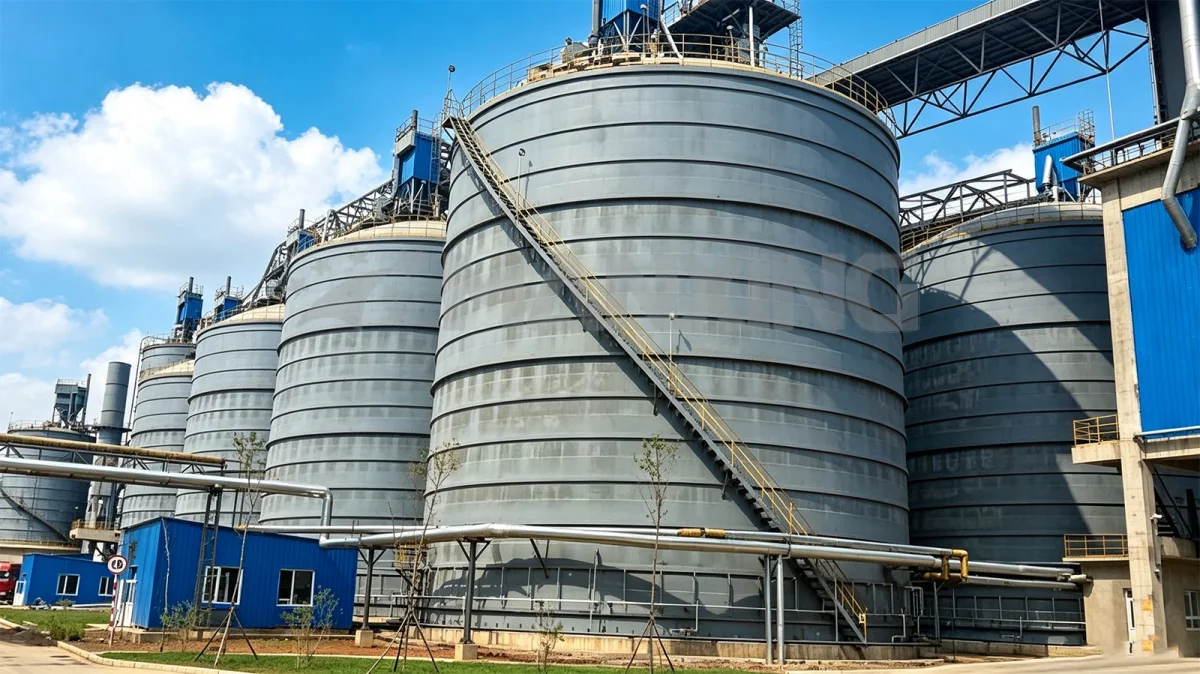
People assume corrosion happens on the outside — rain, humidity, salt air. That's part of it. But the inside of a silo storing cement, clinker, or fly ash is often worse. Cement dust is alkaline, with a pH between 11 and 13. When moisture condenses on the wall — and it will, especially in tropical or coastal environments — you get an electrolyte sitting directly on bare steel. I've seen 6 mm wall panels lose 1.5 mm in four years on the inside of a clinker silo in southern Vietnam. The outside looked fine.
Fly ash is worse in some cases. Depending on the coal source, fly ash can contain sulphur compounds that form sulphuric acid in the presence of moisture. A plant in Inner Mongolia called us after finding pitting corrosion at 0.8 mm depth on the cone section of a 2,000-tonne fly ash silo. The silo was six years old. The original coating — a single coat of standard epoxy primer — had been specified by someone who'd never stored fly ash.
Temperature cycling drives condensation
Here's the thing most designers miss: it's not the average temperature that kills you, it's the swing. A silo in Ulaanbaatar sees external temperatures from -35°C in winter to +30°C in summer. The steel wall breathes. Every cycle pushes warm, moisture-laden air toward the cold steel surface, and condensation forms. Do that 200 times a year for a decade, and you've got a corrosion rate that looks more like a marine environment than a dry climate.
We measured wall thickness on a 5,000-tonne coal silo in Hebei province that had been in service for nine years. The lower ring — the section most affected by ground-level humidity and temperature differential — had lost an average of 0.9 mm. The upper rings had lost 0.3 mm. Same silo, same coating system, completely different corrosion rates based on position.
Coating Systems That Actually Last
Surface preparation is 60% of the job
I'm not exaggerating. You can buy the most expensive coating system on the market, and if the surface preparation is wrong, it'll fail in three years. For industrial silos, we specify Sa 2.5 per ISO 8501-1 — near-white metal blast cleaning. That means the steel is blasted until at least 95% of the surface is free of all visible oil, grease, mill scale, rust, and coatings. Anything less — Sa 2, or worse, hand-tool cleaning — and you're leaving rust initiators under the coating.
I remember a project in Malaysia where the contractor argued that Sa 2 was "close enough" for a cement silo. We refused to sign off. They re-blasted to Sa 2.5. That silo is now 11 years old with no coating failures. The one next to it — built by a different contractor who accepted Sa 2 — had its first blistering at year four. Same coating, same environment, different surface prep. The difference is everything.
Epoxy vs. zinc-rich vs. what to actually specify
For most cement and clinker silos, a two-coat epoxy system at 250–350 µm total DFT (dry film thickness) is the baseline. That's not glamorous, but it works. For more aggressive environments — coastal sites, high-humidity tropical locations, or silos storing sulphur-containing materials — we go with a zinc-rich epoxy primer (75 µm) followed by two epoxy intermediate and topcoats, pushing total DFT to 400–500 µm.
The zinc-rich primer acts as sacrificial cathodic protection at the microscopic level. When the coating gets scratched or damaged, the zinc corrodes preferentially to the steel. It buys you time. In a coastal alumina silo project in Queensland, Australia, we specified a zinc-rich epoxy system at 450 µm total DFT. Eight years in, the coating is still intact with no measurable under-film corrosion. The spec cost about 30% more than a standard epoxy system. The alternative — a full recoat at year six — would have cost five times that.
Application conditions matter more than the datasheet
Every coating datasheet says "apply at 5–35°C, relative humidity below 85%." But on a real site, those conditions don't always cooperate. In Saudi Arabia, we've coated silos at 48°C ambient — the steel surface was probably 55°C. At that temperature, epoxy coatings cure too fast. The solvent pops, you get pinholes, and moisture gets in. We switched to a high-solids, high-build epoxy that could handle the heat, and we coated at night when the steel dropped to 32°C. The crew hated the night shift. The coating didn't care about their feelings.
Per EN 14918 (thermal insulation products, but the principle applies to coating application on heated substrates), surface temperature should be at least 3°C above the dew point. We check this every two hours during application. On a project in Indonesia, the dew point was 28°C and the steel was at 30°C. Two degrees of margin. We waited. The contractor wanted to push through. We didn't.
Cathodic Protection for Silo Foundations and Bases
Why the base ring is the most vulnerable point
The base ring of a steel silo sits at the intersection of three corrosion drivers: ground moisture, stored material weight (which stresses the steel and can crack coatings), and oxygen concentration cells where the steel meets the concrete foundation. It's the perfect storm. I've inspected silos where the base ring had lost 40% of its thickness while the upper rings were still within tolerance.
For silos on concrete ring foundations, we often specify an impressed current cathodic protection (ICCP) system for the embedded portion of the base ring. The system uses a DC power source to drive a protective current through the steel, counteracting the galvanic corrosion. Per NACE SP0169, the protection criterion is a minimum negative potential of -850 mV relative to a copper-copper sulphate reference electrode. We've installed ICCP systems on silos in Bangladesh, Nigeria, and Peru. The maintenance is minimal — check the reference cells quarterly, adjust the rectifier output annually.
Waterproofing the foundation interface
Before the silo even goes up, the concrete foundation needs a proper waterproof membrane. We specify a bituminous coating or a liquid-applied polyurethane membrane at a minimum thickness of 2 mm, extending from the foundation edge to 300 mm up the base ring. This stops ground wicking — capillary action that pulls moisture up from the concrete into the steel-concrete joint. It's a detail that costs maybe $800 on a 15-metre diameter silo. Skipping it can cost you the base ring in five years.
Design Details That Prevent Corrosion
Eliminate water traps in the structure
Every horizontal surface on a silo is a water trap. Angle iron stiffeners, bolt heads, platform brackets — they all collect water and hold it against the steel. In the design phase, we specify that all external stiffeners be sealed at the ends with continuous welds, not stitch welding. A 50 mm gap in a stiffener weld is an invitation for water to get inside and start corroding from within. You won't see it until the stiffener bulges or leaks rust-coloured water down the silo wall.
For bolted connections, we use hot-dip galvanized bolts per ISO 1461 (minimum coating thickness 55 µm for threads) with neoprene washers at every interface. The neoprene seals the joint and prevents galvanic coupling between dissimilar metals. On a slag silo in South Africa, we found that the original spec had used black steel bolts with no washers. After three years, every bolt head had a rust stain running 150 mm down the wall. We replaced 2,400 bolts. The plant manager wasn't happy. The original spec writer was long gone.
Ventilation and condensation control
A silo that breathes is a silo that corrodes. Every time warm air inside the silo hits the cooler roof or upper wall, condensation forms. The fix is mechanical ventilation — typically one or two axial fans on the roof, sized to provide at least one air change per hour for the head space. For a 3,000-tonne cement silo with a 12-metre diameter, that's roughly 200–300 m³/h of ventilation capacity.
We also specify aeration systems on the cone section not just for material flow, but for moisture control. Dry air injection at 0.2–0.3 bar through the cone keeps the stored material from absorbing moisture from the silo atmosphere. Less moisture in the material means less moisture in the head space, which means less condensation on the walls. It's a chain reaction, and it starts with keeping the air dry.
Inspection and Maintenance: The Schedule That Works
Ultrasonic thickness testing — when and how often
Per ASME BPVC Section V (ultrasonic examination), we recommend a baseline thickness survey at commissioning, then annual surveys for the first three years, and biennial surveys after that — unless you find something that warrants more frequent checks. The survey should cover the lower three rings (highest stress, highest moisture), the base ring, the cone-to-shell junction, and any areas where coating damage is visible.
We use a minimum of four readings per square metre in critical areas. If the original wall was 6 mm and you're reading 5.2 mm after eight years, that's a corrosion rate of 0.1 mm/year — manageable. If you're reading 4.5 mm, that's 0.19 mm/year, and you need to figure out why. At 0.25 mm/year or above, you're looking at a recoat or a structural assessment within two years.
Coating maintenance: spot repair vs. full recoat
When coating damage is localized — say, a 2 m² area where a crane bumped the silo during a transfer — spot repair works. You blast the damaged area to Sa 2.5, feather the edges of the existing coating, and apply the same coating system in layers. The overlap between new and old coating should be at least 50 mm. We've done hundreds of spot repairs that have lasted 10+ years.
But when more than 25% of the coating surface shows damage, chalking, or under-film corrosion, spot repair is a waste of money. You're treating symptoms. A full recoat — blast to bare metal, reapply the full system — costs $25–45 per square metre depending on access and location. On a 15-metre diameter, 30-metre tall silo, that's roughly 1,400 m² of surface area. Budget $35,000–$65,000 for a full external recoat. It's not cheap, but it's cheaper than replacing a corroded shell.
Case Study: 5,000-Tonne Clinker Silo — Recife, Brazil
A cement plant in Recife had a 5,000-tonne clinker silo built in 2012. Coastal location — 800 metres from the Atlantic, average relative humidity 82%, ambient temperature 26–32°C year-round. The original coating was a single coat of alkyd paint at 80 µm. By 2017, the coating had failed across 60% of the external surface. Rust staining was visible from the plant gate. The plant manager called us.
We did a full thickness survey. The wall had lost an average of 0.4 mm — still within structural tolerance, but the corrosion rate was accelerating. We specified a full recoat: blast to Sa 2.5 per ISO 8501-1, zinc-rich epoxy primer at 75 µm, two epoxy intermediate coats at 150 µm each, and a polyurethane topcoat at 50 µm for UV resistance. Total DFT: 425 µm. The recoat was completed in 2018 during a planned 14-day shutdown. The crew worked in shifts to beat the afternoon humidity spikes — coating only between 6am and 2pm when the steel surface was reliably above the dew point.
Six years later, the coating is intact. Annual thickness surveys show zero measurable loss. The total cost of the recoat was approximately $48,000. The plant has budgeted for a recoat cycle every 12–15 years going forward. That's the math that works.
FAQ
Q: How long should a coating system last on a steel silo?
A: A properly specified and applied epoxy system on a cement or clinker silo in a moderate climate should last 10–15 years before needing a full recoat. In coastal or high-humidity environments, expect 7–10 years. Zinc-rich systems push that to 12–18 years in moderate conditions. These numbers assume surface preparation to Sa 2.5 and DFT within spec. Cut corners on prep, and you're looking at 3–5 years. I've seen both.
Q: Can I use the same coating for the inside and outside of a silo?
A: Usually not. The external coating needs UV resistance — that's why we use polyurethane or acrylic topcoats outside. The internal coating needs chemical resistance to the stored material. For cement and clinker, a high-build epoxy (300–400 µm) works inside. For fly ash or coal, we sometimes specify a novolac epoxy for better chemical resistance. The environments are different, and the coatings should be too.
Q: At what wall thickness loss should I be concerned?
A: For structural shells, EN 1993-4-1 (silos — structural design) requires that the remaining wall thickness be sufficient to withstand all design loads with the specified safety factors. As a rule of thumb, if you've lost more than 10% of the original wall thickness in any localized area, you need a structural assessment. At 20% loss, you're in reinforcement or replacement territory. For a 6 mm wall, 10% is 0.6 mm. That doesn't sound like much, but it's the difference between a silo that's fine and one that needs a decision.
Need a corrosion protection spec for your silo project?
Manxing has designed and built steel silos for cement, clinker, fly ash, coal, slag, and alumina plants across 30+ countries. We specify coating systems based on your material, your climate, and your maintenance budget — not a generic datasheet. From surface prep standards to DFT specifications to inspection schedules, we deliver the full corrosion protection package as part of our EPC silo contracting service.