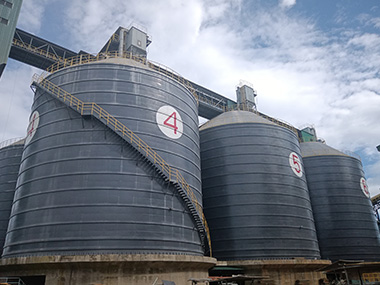
Silo Aeration System Design for Cement Fly Ash and Fine Powders
Aeration systems reduce silo compaction by introducing low-pressure air through permeable pads, restoring flowability to cement, fly ash, and fine powders that bridge or rat-hole during discharge. Properly designed aeration delivers 0.2–0.5 CFM per square foot of pad surface at 2–4 PSI, preventing material degradation while achieving discharge rates exceeding 99% of live storage capacity.
1. Fundamentals of Silo Aeration Systems
Figure 1Figure 2Figure 3
1.1 What Aeration Accomplishes Inside a Silo
Aeration loosens compacted powder by injecting controlled air through porous media installed on the silo cone or sidewalls. The air reduces interparticle friction, breaking bridges and converting static material into a fluidized state. For cement and fly ash, partial fluidization along the cone wall reduces wall friction and promotes mass-flow discharge, eliminating dead storage zones that account for 15–25% of total capacity in unaerated silos.
1.2 Aeration Airflow and Pressure Parameters
Standard aeration operates at 2–4 PSI with airflow rates of 0.2–0.5 CFM/ft² of pad area. High-moisture fly ash may require up to 0.8 CFM/ft². Total air volume per silo is calculated as: Q = A × R × N, where A is pad area (ft²), R is airflow rate per unit area (CFM/ft²), and N is the number of active pads. A 500-ton cement silo with 12 pads of 2 ft² each typically requires 14–28 CFM total.
2. Aeration Design for Cement Silos
2.1 Pad Layout and Spacing on the Cone Section
Aeration pads are installed on the lower cone at 120° or 90° intervals, depending on cone diameter. For cones with a 30° slope, pads are positioned within the lower one-third of the cone height where compaction pressure peaks. Pad spacing should not exceed 4 ft center-to-center to ensure overlapping fluidization zones. Each pad covers 1.5–3 ft², and the total aeration area equals 2–5% of the cone wall surface.
2.2 Air Velocity and Fluidization Limits
Cement fluidization velocity ranges from 0.02 to 0.05 ft/s at bulk density of 94 lb/ft³. Exceeding 0.1 ft/s causes excessive entrainment and dust carryover. Aeration pads use sintered polyethylene or ceramic media with pore sizes of 10–40 microns to distribute air uniformly without particle penetration. Differential pressure across the pad must remain below 1.5 PSI to prevent media clogging.
3. Fly Ash Aeration Considerations
3.1 Flow Characteristics That Differ from Cement
Fly ash bulk density (45–55 lb/ft³) is roughly half that of cement, and its finer particle size (10–150 microns vs. 10–100 microns for cement) increases cohesion sensitivity. Fly ash absorbs moisture readily, forming capillary bridges that increase unconfined yield strength by 30–60% at 3% moisture content. Aeration must therefore operate at higher airflow density (0.4–0.8 CFM/ft²) and include pre-drying of supply air below 40°F dew point.
3.2 Specialized Aeration for Low-Density Powders
For fly ash, aeration pads are paired with air slides installed at 5–8° inclination along the cone wall. Air slides use a 100-micron polyester membrane and require 1.5–2.5 CFM per linear foot of slide. Combined pad-and-slide systems achieve 95% discharge efficiency for fly ash with moisture content up to 4%. Slide width ranges from 12 to 24 inches depending on silo diameter.
4. Fine Powder Aeration Challenges
4.1 Moisture and Cohesion Effects on Aeration Performance
Fine powders below 50 microns exhibit exponential cohesion increase above 2% moisture. Aeration air must be dried to -40°F pressure dew point using desiccant dryers. Condensation within aeration lines causes pad blinding within 72 hours. Insulated and heat-traced air supply lines are mandatory in ambient temperatures below 40°F.
4.2 Integrating Bin Activators with Aeration Systems
For powders with high cohesion (unconfined yield strength > 2 kPa), bin activators operating at 1.5–3 Hz vibration frequency work in tandem with aeration pads. The activator loosens the central core while aeration fluidizes the wall region. Combined systems reduce peak discharge force by 40% and prevent arching in silos with outlet diameters below 12 inches.
5. Aeration Equipment Selection
5.1 Aeration Pad Types and Specifications
Sintered polyethylene pads (10–40 micron pores) suit cement and dry fly ash. Ceramic pads (5–20 micron pores) handle abrasive powders and temperatures up to 400°F. Fabric pads with polyester membrane serve air slides and low-pressure applications. Pad selection criteria include: operating temperature, chemical compatibility, abrasion resistance, and pressure drop at rated flow. Expected service life is 5–8 years for polyethylene, 10+ years for ceramic.
5.2 Blower and Air Distribution Design
Rotary lobe blowers deliver 2–6 PSI at 5–100 CFM, suitable for most aeration applications. Each silo zone requires a dedicated solenoid valve with pulse-cycle control (typically 15 seconds ON, 45 seconds OFF) to prevent over-fluidization. Air distribution manifolds use 2–4 inch diameter piping with flow balancing orifices calibrated to ±10% flow uniformity across all pads.
6. Operational Best Practices
6.1 Aeration Timing and Sequence Control
Aeration activates 10–15 minutes before discharge begins, cycling through zones sequentially to limit peak air demand. Zone sequencing follows bottom-to-top order to prevent upper-zone aeration from compacting lower material. Programmable logic controllers manage cycle timing, with interlocks preventing aeration during filling operations.
6.2 Maintenance and Monitoring Protocols
Monthly inspection includes pad differential pressure measurement (alarm threshold: 2.0 PSI), air filter replacement, and solenoid valve function testing. Annual pad inspection requires silo entry to check for material infiltration, membrane degradation, and mounting integrity. Filter elements on blower inlet require replacement every 2,000 operating hours.
Design Tip: For silos storing both cement and fly ash, design the aeration system for fly ash parameters (higher airflow, lower bulk density, moisture-sensitive air supply). This ensures the system handles the more demanding material without modification, and cement performance remains well within safe margins.
Case Study: 800-Ton Fly Ash Silo Aeration Upgrade
A concrete batching plant experienced chronic bridging in its 800-ton fly ash silo, with discharge rates dropping to 60% of design capacity. Investigation revealed undersized aeration pads (8 pads × 1 ft²) operating at 0.15 CFM/ft² — below the 0.5 CFM/ft² required for 3.5% moisture fly ash.
The retrofit installed 16 ceramic pads (2 ft² each) on a 90° interval, added two 24-inch air slides at 6° inclination, and upgraded the blower from 20 CFM to 45 CFM at 4 PSI. A desiccant dryer was added to maintain supply air dew point at -40°F. Post-upgrade discharge efficiency reached 97%, and live storage recovery increased from 580 tons to 775 tons.
Frequently Asked Questions
Q1: How do I calculate the total aeration air volume for my silo?
Multiply the number of pads by each pad's surface area and the recommended airflow rate per square foot. For cement: 0.3 CFM/ft². For fly ash: 0.5–0.8 CFM/ft². A 20-ton cement silo with 6 pads of 2 ft² each requires 6 × 2 × 0.3 = 3.6 CFM minimum. Always add 20% margin for line losses and future demand.
Q2: Can aeration pads be installed on existing silos without structural modification?
Yes, in most cases. Aeration pads bolt or weld to the cone wall through pre-drilled holes. The added load is negligible (under 5 lbs per pad). However, verify that the cone wall thickness supports the mounting hardware and that internal pad protrusion (1.5–2 inches) does not interfere with discharge equipment.
Q3: What is the typical service life of aeration pads, and how do I know when to replace them?
Polymer pads last 5–8 years; ceramic pads last 10–15 years. Replace pads when differential pressure exceeds 2.0 PSI at rated flow, visible membrane damage is present, or material infiltration is confirmed during inspection. A sudden increase in aeration energy consumption of 30% or more indicates pad degradation.
Engineer Your Aeration System with Manxing
Manxing delivers complete EPC silo solutions including aeration system design, equipment supply, and installation for cement, fly ash, and fine powder storage projects. Our engineering team calculates pad layout, airflow requirements, and control logic tailored to your material properties and silo geometry. Contact Manxing for a free aeration system assessment.