
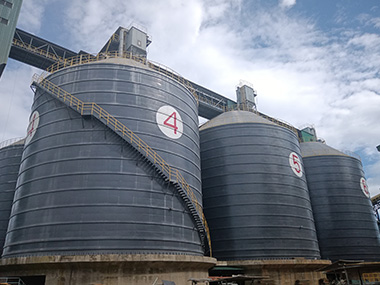

Steel Silo Thermal Insulation Retrofit: What Actually Works When the Original Design Falls Short
Thermal insulation retrofit on an existing steel silo typically costs between $18 and $45 per square metre of shell surface, depending on system choice and access complexity. The work is almost always driven by one of three problems: condensation damaging stored material, material degradation from temperature swings, or regulatory pressure to reduce energy losses. If you're reading this, you probably already have one of those problems and a silo that wasn't designed to handle it.
Why Steel Silos Lose Thermal Performance Over Time
The degradation mechanisms nobody budgets for
Most steel silos I've inspected after 10–15 years of service have lost 20–35% of their original insulation effectiveness. Not because the insulation material itself failed, but because the system around it did. Fasteners corrode. Vapor barriers get punctured during maintenance walks. Thermal bridging at stiffener connections gets worse as the steel fatigues.
I pulled a core sample from a clinker silo in Vietnam last year — 12-year-old mineral wool that had settled 40 mm at the bottom of the panel. The top third of the insulation was essentially useless. The plant manager told me they'd never touched it since commissioning. That's the problem. Insulation systems aren't maintenance-free, but they're almost never on the maintenance schedule.
The other killer is moisture ingress. Once water gets into mineral wool or glass fibre, thermal conductivity jumps by 3–5x. A system rated at R-2.5 at installation drops to R-0.6 after two wet-dry cycles. And in coastal or high-humidity environments, that happens faster than you'd think. I've seen it in 18 months.
When condensation becomes a structural problem
Condensation on the inside of a steel shell isn't just a material quality issue. It's a corrosion accelerator. At relative humidity above 60% on the steel surface, corrosion rates on uncoated carbon steel hit 0.1–0.2 mm per year. Over a decade, you're losing 1–2 mm of shell thickness. On a silo designed with 6 mm shell plates and a 1.5 mm corrosion allowance, that's your entire safety margin gone.
Fly ash plants get hit hardest. The material absorbs moisture, clumps, and stops flowing. I've seen a 2,000-tonne fly ash silo in Indonesia where the entire lower cone was bridged solid because condensation had turned the ash into concrete. They had to send a crew in with jackhammers. Three days of downtime. The insulation retrofit that should've cost $35,000 ended up costing $280,000 in lost production and emergency remediation.
Insulation Systems That Actually Work for Bulk Solids Silos
External cladding with mineral wool — the workhorse approach
For most retrofit projects, external insulation with mineral wool boards and profiled metal cladding is the right call. It's proven, it's repairable, and the materials are available everywhere. The typical build-up: 80–120 mm mineral wool (density 100–150 kg/m³), vapour barrier, 0.5–0.7 mm profiled aluminium or galvanized steel cladding. Thermal resistance lands between R-2.0 and R-3.2 depending on thickness.
The key detail most people miss: the vapour barrier has to be on the warm side. In hot climates storing cold material, that means inside the insulation. In cold climates storing warm material, it's outside. Get this wrong and you've just built a condensation trap. I've seen a cement silo in northern China where the contractor put the barrier on the wrong side. Within six months, the mineral wool was saturated and dripping. They had to strip the whole thing and start over.
Fastener spacing matters more than you'd expect. On a vertical shell, I specify fasteners at 300 mm centres horizontally and 400 mm vertically for boards up to 100 mm thick. Thicker boards need closer spacing — 250 mm horizontal — or they'll sag and create gaps. Gaps are thermal bridges. Thermal bridges are condensation points. The chain is short.
Spray-applied polyurethane for complex geometries
Where the silo has lots of penetrations, stiffener rings, or irregular geometry, spray polyurethane foam (SPF) is worth the extra cost. Closed-cell SPF at 50–80 mm thickness gives you R-3.0 to R-4.5, and it conforms to any shape. No gaps. No thermal bridges at transitions.
The downside: it's sensitive to application conditions. Surface temperature has to be above 10°C and below 45°C. Relative humidity below 80%. Wind speed below 15 km/h during application. I've had crews in Saudi Arabia spraying at 5am because by 9am the steel surface was 60°C and the foam was curing before it adhered. You plan the work around the weather, not the other way around.
Cost-wise, SPF runs $35–$60 per square metre installed, compared to $18–$30 for mineral wool boards. But on a silo with heavy stiffener rings and multiple nozzles, the labour savings on complex detailing often close the gap. Run the numbers for your specific geometry before deciding.
Internal insulation — when you can't touch the outside
Sometimes the silo is in a congested plant, or the shell is structurally loaded to capacity and can't take additional cladding weight. Internal insulation is the answer, but it's a different animal entirely.
The insulation has to be compatible with the stored material. For cement and clinker, that means nothing that sheds fibres into the product. Encapsulated mineral wool or rigid calcium silicate boards are the usual choices. For coal, you need spark-resistant materials — no exposed metal fasteners on the interior surface.
Internal insulation also reduces the effective storage volume. A 100 mm internal lining on a 20-metre-diameter silo takes out about 31 cubic metres of capacity. On a 5,000-tonne silo, that's roughly 1.5% of total volume. Usually not a dealbreaker, but it needs to be in the calculation.
Structural Considerations During Retrofit
Wind load changes you didn't expect
Adding external cladding and insulation to a steel silo increases the shell diameter by 100–150 mm. That doesn't sound like much, but wind load is proportional to projected area. On a 30-metre-tall silo, you're adding 3–4.5 square metres of wind-facing surface. At a design wind speed of 150 km/h (basic wind speed per ASCE 7 or equivalent), that's an additional 2–4 kN of total wind force on the shell.
More importantly, the cladding adds mass at the top of the silo where it matters most for dynamic response. A 120 mm mineral wool and cladding system weighs approximately 25–35 kg/m². On a 25-metre-diameter silo, that's 15–27 tonnes of additional dead load. The shell and foundation need to handle it.
I always run a structural check before specifying a retrofit. Eurocode 1 (EN 1991-1-4 for wind actions) and EN 1993-4-1 for steel silos give you the framework. If the silo is more than 15 years old, get a structural engineer to verify the shell can take the additional load. I've seen two cases where the existing shell was too thin and we had to switch to a lighter insulation system — thinner boards, lighter cladding — to stay within limits.
Anchoring insulation to a 20-year-old shell
The existing shell surface is rarely clean. There's corrosion, old paint, residual material dust, and sometimes biological growth in humid climates. Surface preparation is critical. I specify minimum SA 2.5 blast cleaning for any surface that will receive adhesive-bonded fasteners. For mechanical fasteners, wire brushing plus a compatible primer is usually sufficient.
Adhesive bonding works well on clean, painted surfaces. I've used epoxy-based structural adhesives with pull-off strengths of 1.5–2.5 MPa on prepared steel surfaces. But the surface has to be clean. I've seen adhesive bonds fail at 0.3 MPa because the crew didn't degrease the shell. Four hours of extra prep work would've saved a week of rework.
For mechanical fasteners, I prefer self-drilling screws with thermal break washers for retrofits. They're fast, they don't require pre-drilling in most cases, and the thermal break washer reduces heat transfer through the fastener by 60–70%. Without it, each fastener is a condensation point waiting to happen.
The Condensation Calculation That Saves Your Silo
Dew point analysis for your specific material
You can't size insulation without knowing the dew point on the inner shell surface. The calculation is straightforward: you need the internal air temperature, the external design temperature, the relative humidity inside the silo, and the thermal resistance of the existing shell plus the proposed insulation.
For a cement silo in a temperate climate — internal temperature 50°C, external design temperature -10°C, internal RH 40% — the dew point inside the silo is around 28°C. The inner shell surface has to stay above that. With a bare steel shell (R ≈ 0.0005 m²K/W), the inner surface temperature is essentially the internal air temperature, so no condensation. But if the silo is storing cold material in a hot, humid environment — say, 10°C material in 35°C, 85% RH ambient — the dew point is 32°C and the inner shell surface at 10°C is well below it. Condensation is guaranteed without insulation.
The insulation thickness calculation follows from there. You need enough thermal resistance to keep the inner shell surface above the dew point temperature. For the second scenario above, you'd need approximately 60 mm of mineral wool (thermal conductivity 0.035 W/mK) to keep the inner surface above 32°C. I always add a 10–15% safety margin because material properties drift over time.
Thermal bridging at penetrations and seams
The insulation calculation for the shell is the easy part. The hard part is every penetration, connection, and edge. Stiffener rings, roof-to-shell junctions, cone-to-shell transitions, manhole frames, nozzle connections — each one is a thermal bridge that can create a local condensation zone.
I detail every penetration individually on retrofit projects. A typical stiffener ring on a cement silo might be 200 mm deep and 8 mm thick, welded to the shell. Without insulation continuity, that ring acts as a heat sink. The steel temperature at the ring drops 15–25°C below the surrounding shell. Condensation forms on the ring and drips onto the material below.
The fix: extend insulation over the stiffener ring with a minimum of 50 mm coverage beyond the ring edge. Use the same insulation thickness as the shell. Seal all joints with compatible tape or mastic. It's tedious work, but it's the difference between a retrofit that works and one that just moves the problem.
Execution — What Happens When You Actually Start Work
Weather windows and crew logistics
Insulation retrofit is weather-dependent in ways that structural steel work isn't. Rain stops everything — wet insulation is ruined insulation. Wind above 25 km/h makes cladding installation dangerous and imprecise. Temperatures below 5°C affect adhesive curing and sealant performance.
I plan retrofit projects around a 4-day weather window minimum. That gives you one day for surface prep, two days for insulation and cladding installation, and one day for sealing and detail work. If the forecast shows a break in weather, you move fast. I've had crews of 8–12 people on a silo shell for 10-hour shifts during a weather window in Malaysia. We got 80% of a 25-metre-diameter silo done in three days. The remaining 20% — penetrations, edges, touch-ups — took another two days.
Access is the other constraint. Most steel silos don't have permanent external ladders or platforms at the right heights for insulation work. Scaffolding or swing-stage access adds $8–$15 per square metre to the project cost. On tall silos (30+ metres), scaffolding can be 20–25% of the total retrofit budget. I've used rope-access teams for cladding installation on silos over 35 metres tall — it's faster and cheaper than scaffolding, but you need experienced crews and the right safety protocols.
Keeping the silo operational during retrofit
This is the question every plant manager asks: can we keep producing while the insulation goes on? The answer is usually yes, with caveats. External insulation work doesn't require silo emptying. The shell is accessible from outside, and the material inside is unaffected.
But you need to manage a few things. First, drilling into the shell creates steel dust. If the silo is storing food-grade or high-purity material, you need dust containment. Second, vibration from drilling and fastening can disturb material flow in a nearly-empty silo. I specify a minimum material level of 30% capacity during shell penetration work. Third, if you're working on the roof, you need to isolate the dust collection system — steel dust in a baghouse is a fire hazard.
I ran a retrofit on a 4,000-tonne coal silo in South Africa while the plant was running at full capacity. We worked in 5-metre vertical bands, starting at the top and moving down. Each band took two days. The silo stayed in service the whole time. The only interruption was a 4-hour shutdown to isolate the dust collector while we worked on the roof junction. Total project duration: three weeks. Zero lost production except those four hours.
Case Study: Fly Ash Silo Retrofit — Cement Plant, Central China
A 3,000-tonne fly ash silo built in 2008 had no thermal insulation. The plant is in a region with summer temperatures reaching 38°C and winter temperatures dropping to -8°C. Relative humidity averages 75% in summer. The fly ash was absorbing moisture from the air inside the silo, causing bridging in the discharge cone and blocking the pneumatic conveying system.
The plant had tried two fixes before calling us: a larger dust collector on the silo top (didn't help) and aeration pads in the cone (helped for two months, then clogged with moist ash). The real problem was condensation on the inner shell surface during summer nights when the steel cooled faster than the air inside.
We specified 100 mm mineral wool boards with 0.6 mm aluminium cladding on the shell and cone. The roof got 80 mm of the same system. Total insulated surface area: 1,850 m². The structural check showed the shell could handle the additional 28 tonnes of dead load with no reinforcement needed.
Execution took 18 working days with a crew of 10. We worked in 4-metre bands from top to bottom. The silo remained in service at 40–60% capacity throughout. The only shutdown was 6 hours for roof penetration sealing.
Result: internal shell condensation dropped to zero. The fly ash moisture content stabilized at 0.3–0.5% (down from 1.2–2.1% before retrofit). Bridging incidents went from 3–4 per month to zero in the first six months after completion. The project cost $62,000. The plant estimated they'd been losing $15,000–$20,000 per month in downtime and material waste before the retrofit. Payback period: under four months.
Frequently Asked Questions
Q: How do I know if my silo needs insulation retrofit?
Look for three signs: visible condensation on the external shell (in cold climates) or internal shell rust patterns (in humid climates), material flow problems that correlate with weather changes, or energy bills that are higher than design specifications. A thermographic survey will give you a definitive answer in a day.
Q: Can I insulate only part of the silo shell?
Yes, and sometimes you should. The upper shell above the material fill level is often the priority because it's where the greatest temperature differential exists. The lower shell and cone, if they're always in contact with material, may not need the same insulation level. I've done partial retrofits covering 40–60% of the shell surface that solved 80% of the condensation problem. Run the thermal calculation for each zone separately.
Q: What's the service life of a retrofit insulation system?
Properly installed external mineral wool with metal cladding lasts 15–25 years before major maintenance. The cladding and fasteners degrade faster than the insulation itself — expect to replace 5–10% of fasteners and reseal joints at the 10-year mark. SPF systems last 20+ years but are harder to repair locally. Internal insulation lifespan depends on material abrasion from the stored product — for abrasive materials like clinker or coal, plan for inspection and patching every 5–7 years.
Need a Thermal Insulation Retrofit Assessment?
Manxing provides EPC silo services including thermal assessment, insulation system design, structural verification, and installation supervision. We've completed insulation retrofits on steel silos ranging from 500 to 15,000 tonnes across cement, fly ash, coal, and slag applications.
Send us your silo dimensions, stored material, and climate data. We'll get back to you with a preliminary thermal calculation and retrofit scope within 5 working days.
Contact Manxing Engineering →