

Steel Silo Capital Expenditure Planning: What It Actually Costs and Where Budgets Go Wrong
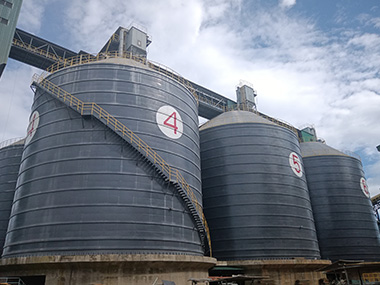
Planning capital expenditure for a steel silo isn't just about the tank price. A 5,000-tonne cement silo in Southeast Asia typically runs $180,000–$320,000 for the steel structure alone, but total installed cost including foundations, conveying, and dust collection often hits $450,000–$650,000. The biggest budget killers aren't the silo shell — they're the foundations nobody sized correctly and the conveying systems that get value-engineered into failure.
1. Breaking Down the Real Cost Structure
Most owners I've worked with start with a number they heard from a colleague or found online. That number is almost always wrong. Here's why.
1.1 Steel Shell and Structural Components
The silo shell itself — walls, roof, stiffeners, platforms — usually accounts for 35–45% of total project cost. For a bolted steel silo storing cement at 8,000 tonnes capacity, you're looking at roughly 85–110 tonnes of steel depending on the diameter-to-height ratio and local wind loads. At current steel prices, that's $120,000–$160,000 for material alone.
But here's where it gets tricky. A 12-metre-diameter silo and an 18-metre-diameter silo holding the same tonnage don't scale linearly. The larger diameter means thicker wall panels (typically 4–6 mm corrugated steel versus 3–4 mm), more stiffeners, and a heavier roof structure. I've seen estimates that assumed linear scaling come in 25–30% under actual cost.
Welded silos versus bolted silos also shift the equation. Bolted construction runs 10–15% more on steel cost but cuts field labour by 40–60%. For a project in Indonesia where skilled welders were scarce and expensive, the bolted option saved us three weeks on site and about $28,000 in labour. That's not a small number.
1.2 Foundation Costs — The Silent Budget Killer
If there's one line item that destroys budgets, it's the foundation. I've watched a 3,000-tonne clinker silo project in Vietnam where the geotechnical report was based on two boreholes for a 20-metre-diameter footprint. The soil was softer than expected — we hit a clay layer at 4 metres that the report missed. The ring-beam foundation had to go from 1.2 metres deep to 2.5 metres, and we added 14 piles at $1,800 each. That was a $47,000 change order before the first steel plate arrived.
For a typical 6,000-tonne cement silo on decent soil, budget $35,000–$60,000 for the foundation. On poor soil or seismic zones, double that. Eurocode 7 (EN 1997) governs geotechnical design in most international projects, and it requires proper site investigation — not a guess based on the neighbour's project.
The silo's load pattern matters too. Unlike a building with distributed loads, a silo concentrates enormous point loads through the wall or column structure. A 10,000-tonne silo exerts roughly 1,200–1,800 kN/m of wall load on the ring beam. Get the soil bearing capacity wrong and you're looking at differential settlement that cracks the foundation and warps the shell.
1.3 Ancillary Systems: Conveying, Aeration, and Dust Collection
The silo is just a tank. The systems that fill it, empty it, and keep it breathing are where another 30–40% of your budget goes.
Pneumatic conveying systems for cement typically run $25,000–$50,000 for a single silo loading system, depending on distance and capacity. A 100-tonne-per-hour cement feeding system with a rotary valve, air slide, and baghouse can hit $65,000–$90,000. I've seen plants try to save money by reusing old conveying lines. Six months later they're dealing with blockages, moisture ingress, and a silo that can't be filled fast enough to meet demand.
Dust collection isn't optional — it's regulated. ISO 15012 and EN 14491 set the standards for dust explosion prevention and control. A properly sized baghouse for a cement silo with a 15-metre diameter runs $15,000–$30,000. Cut corners here and you're not just risking a fine — you're risking an explosion. Coal and fly ash silos are even more critical because the dust is combustible. I won't sugarcoat it: I've seen the aftermath of a coal dust explosion in a storage facility. The silo survived. The building next to it didn't.
2. The Factors That Swing Costs by 30% or More
Two identical silo projects on paper can end up with wildly different price tags. Here's what moves the needle.
2.1 Site Conditions and Logistics
A silo project in suburban Shandong province and one in rural Mozambique are completely different animals. In China, you've got established steel fabrication within 200 kilometres, experienced erection crews, and roads that can handle a 40-tonne crawler crane. In parts of Africa or Central Asia, you might be shipping everything by sea and then 800 kilometres by road, with a crew that's never erected a bolted silo before.
Shipping costs for a 5,000-tonne silo to a landlocked site can add $30,000–$80,000 depending on the route. I worked on a project in Laos where the only access road had a 12-tonne weight limit. We had to bring in a smaller crane and extend the erection timeline by two weeks. That added $18,000 in equipment and labour costs that nobody had budgeted.
Weather windows matter too. In the Gulf, you're not doing outdoor welding at 45°C with 90% humidity — at least not safely. We shifted to night shifts on a project in Qatar, which meant lighting, overtime premiums, and slower productivity. The erection cost per tonne of steel went from $850 to $1,150.
2.2 Material Selection and Abrasion Allowance
Not all bulk materials are kind to steel. Cement is relatively gentle. Coal is abrasive. Slag is brutal. Limestone with a Mohs hardness of 3–4 will eat through a standard 4.5 mm wall panel in high-traffic zones within 8–10 years.
For abrasive materials, you need to specify either thicker steel (adding 15–25% to shell cost) or wear liners. A 6 mm bottom cone with a 10 mm wear plate on a slag silo adds $8,000–$15,000 to the shell cost but extends service life from 5 years to 15+ years. That's a straightforward payback calculation.
Coal silos present a different problem — corrosion from sulfur compounds and moisture. I've seen unlined carbon steel coal silos develop pinhole leaks in the lower ring within 3 years. A proper epoxy coating system (300–400 microns DFT) adds $12,000–$20,000 but prevents that. Some clients opt for stainless steel lower rings (304L or 316L), which triples the material cost for that section but eliminates the corrosion issue entirely.
2.3 Seismic and Wind Load Requirements
Seismic design per EN 1998 (Eurocode 8) or equivalent local codes can add 10–20% to the structural cost. In high-seismic zones like Chile, Turkey, or parts of Indonesia, the silo needs additional wall thickness, more robust stiffeners, and a foundation designed for lateral loads that can exceed 0.3g.
Wind loads follow a similar pattern. A silo in a typhoon-prone area (South China Sea, Philippines, Vietnam coast) needs to be designed for wind speeds of 50–60 m/s. That means heavier anchors, more closely spaced stiffeners, and a roof that won't peel off. I've inspected silos after Typhoon Haiyan — the ones designed to code survived with minor damage. The ones that weren't? Scattered across a rice paddy.
3. Lifecycle Cost vs. Initial Capital
Here's where I get opinionated. Too many owners make silo procurement decisions based on the lowest bid. That's a mistake that compounds over 20 years.
3.1 Maintenance Costs Over a 20-Year Horizon
A well-built steel silo with proper coating maintenance should last 25–30 years. But "proper maintenance" isn't free. Budget $2,000–$5,000 per year for inspection, touch-up coating, bolt retorquing, and seal replacement. Over 20 years, that's $40,000–$100,000 — and it's money well spent.
Skip the maintenance and you're looking at major repairs. I inspected a 15-year-old cement silo in Malaysia where the owner had never retorqued the bolts. The lower rings had lost 40% of their preload, and water had infiltrated through the panel joints. The corrosion inside the wall cavity had reduced the effective thickness by 1.5 mm. The repair cost $65,000 — more than ten years of preventive maintenance would have run.
Coal and slag silos have higher maintenance profiles. Abrasion means cone replacements every 8–12 years ($15,000–$30,000 each time). Temperature monitoring systems need calibration and sensor replacement annually ($500–$1,500). Dust collector bags need replacement every 2–4 years depending on hours of operation ($2,000–$8,000 per changeout).
3.2 Downtime Costs — The Number Nobody Calculates
When a silo goes down, the whole plant feels it. A cement plant producing 2,000 tonnes per day loses roughly $40,000–$80,000 per day in lost production when the main blending silo is offline. That's not a theoretical number — I've been on the phone at 2am helping a plant in Shandong troubleshoot a blocked discharge because the aeration system had failed. They were looking at 36 hours of downtime. The fix cost $2,000 in parts. The downtime cost was $65,000.
This is why I push clients to invest in redundancy. A second discharge point, backup aeration fans, or a manual bypass gate adds $5,000–$15,000 to the capital cost but can save six figures in a single incident. The math isn't complicated.
4. Budget Planning Framework
Here's a practical framework I've used across dozens of projects. It's not perfect, but it's better than guessing.
4.1 Cost Estimation by Project Phase
Break your budget into phases. FEED (Front-End Engineering Design) should consume 3–5% of total project cost and give you an estimate accurate to ±15%. Detailed engineering takes another 5–8%. Procurement and fabrication is 40–50%. Erection and commissioning is 20–30%. The remaining 5–10% covers project management, inspection, and contingency.
That contingency line is critical. I've never seen a silo project that didn't have at least one surprise. Soil conditions, weather delays, shipping damage, design changes — something always comes up. Budget 8–12% contingency on the total project cost. If you don't use it, great. If you do, you're not scrambling for funds.
4.2 Cash Flow Timing
Silo projects have a lumpy cash flow profile. You'll typically pay 10–20% upfront on contract signing, another 20–30% on material procurement, 20–30% on fabrication completion, and the balance on erection and commissioning. For a $500,000 project, that means $50,000–$100,000 at signing, $100,000–$150,000 at the 8–12 week mark, and the remainder at 20–28 weeks.
Plan your cash flow accordingly. I've seen projects delayed not because of engineering or fabrication problems, but because the owner's payment approval process took three weeks longer than the contract allowed. The fabrication shop doesn't care about your internal PO process — they'll stop work and reschedule.
5. Case Study: 10,000-Tonne Cement Silo — Vietnam
A cement plant in northern Vietnam needed a 10,000-tonne blended cement silo to support a new grinding circuit. The initial budget from the owner's corporate office was $380,000 — based on a similar project in Thailand from 2018.
Our FEED study identified three issues. First, the site had a high water table — 1.5 metres below grade — requiring a piled foundation instead of a simple ring beam. Second, the local wind code required design for 55 m/s typhoon winds, which added 12% to the shell steel weight. Third, the owner wanted a dual discharge system with a central aeration cone and an external recycling loop, which added $45,000 to the mechanical scope.
The revised budget was $520,000. The owner pushed back hard. We walked them through the numbers line by line — foundation piles at $2,200 each (28 piles), additional steel at $18,500, and the dual discharge system at $45,000. They approved the revised budget.
During construction, we hit a surprise — a buried concrete slab from a previous structure that wasn't on any site survey. It delayed foundation work by 10 days and cost $8,500 in additional excavation. The contingency covered it. The project was completed at $528,000 — 1.5% over the revised budget and 39% over the original guess. The silo has been running since 2021 with zero structural issues.
6. Frequently Asked Questions
Q: What's the typical cost per tonne of storage capacity for a steel silo?
A: For cement and similar materials, expect $35–$65 per tonne of capacity for the total installed cost. A 5,000-tonne silo runs $180,000–$320,000. Coal and abrasive materials push that to $45–$80 per tonne because of wear protection and explosion-proofing requirements. These numbers assume a greenfield site with standard soil conditions — poor soil or seismic zones can add 20–40%.
Q: How long does a steel silo project take from approval to commissioning?
A: For a single silo under 10,000 tonnes, plan 20–28 weeks. FEED and detailed engineering take 6–8 weeks. Fabrication takes 8–12 weeks. Erection takes 4–8 weeks depending on weather and crew size. Commissioning and load testing add 1–2 weeks. Multiple silos or complex sites can stretch this to 36–40 weeks. I've seen fast-track projects done in 16 weeks, but that requires parallel engineering and fabrication, which increases coordination risk.
Q: Should I choose a welded or bolted steel silo?
A: Bolted silos win on erection speed and field labour — 40–60% faster to assemble with less skilled labour. Welded silos win on airtightness and lower material cost, but require certified welders and longer field time. For most industrial applications above 2,000 tonnes, I recommend bolted construction. The 10–15% material premium pays for itself in reduced erection time and easier future maintenance. The exception is liquid or gas-tight applications, where welded construction is necessary.
Get Your Silo Budget Right the First Time
Manxing has delivered steel silo EPC projects across 30+ countries — from 500-tonne fly ash silos to 30,000-tonne clinker storage. We provide detailed FEED studies with ±15% cost accuracy before you commit to full engineering. No surprises, no budget blowouts.
Contact our engineering team for a project-specific cost breakdown: manxingstorage.com
Tell us your material, capacity, and site location. We'll send you a preliminary budget range within 5 working days.