
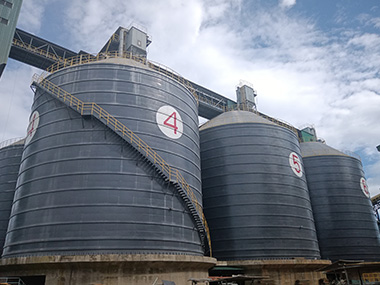

Powder Coating Systems for Industrial Steel Silos: What Actually Works in the Field
A powder coating system on a steel silo is a multi-layer engineered finish — typically 80–200 µm total DFT — applied electrostatically and heat-cured to protect structural steel from corrosion, chemical attack, and UV degradation. For cement, fly ash, coal, and slag silos operating in harsh environments, a properly specified powder coating system delivers 15–25 years of maintenance-free service life. That's the direct answer. The longer answer is what this article covers.
Why Industrial Silos Need More Than "Standard" Paint
Most structural steelwork gets a basic alkyd or acrylic system — 60–80 µm, one or two coats, done in a day. That's fine for a warehouse frame in a temperate climate. A bulk storage silo is a different animal entirely.
The Operating Environment Is Brutal
Think about what a cement silo actually endures. Internal temperatures swing from ambient to 80–100°C during grinding cycles. The stored material is alkaline — pH 11–13 for fresh cement, sometimes higher with slag blends. Condensation cycles inside the silo create a wet-dry corrosion loop that eats through thin coatings fast. Externally, you've got UV exposure, wind-driven dust abrasion, and in coastal or tropical locations, salt-laden air that accelerates under-film corrosion.
I inspected a fly ash silo in Gujarat, India, after just four years in service. The original coating system — a generic epoxy primer with polyurethane topcoat, maybe 120 µm total — had blistered across 30% of the shell surface. The plant manager told me they'd been "maintaining it regularly." They hadn't. They'd been patching it reactively, which is a different thing entirely. The root cause was coating specification, not maintenance frequency.
What the Standards Actually Require
ISO 12944 classifies atmospheric corrosion categories from C1 (low) to C5 (very high) and CX (extreme). Most industrial silo sites fall into C4 or C5 — that's the range where you need a minimum 160 µm system for a 15+ year design life. For silos storing hygroscopic materials like cement or fly ash, the internal surfaces often need chemical resistance testing per ISO 2812-1 (immersion resistance) in addition to the standard salt spray requirements.
EN 14491 adds another dimension for combustible dust environments — your coating system can't generate static discharge, and surface resistivity needs to stay below 10⁹ ohms if the silo handles coal, grain dust, or similar materials. That rules out some standard polyester formulations unless they're specifically modified with conductive additives.
Coating System Architectures That Actually Perform
There's no single "best" coating for every silo. The right system depends on the stored material, climate, expected service life, and whether you're coating in-shop or on-site. Here's what I've seen work consistently.
Epoxy-Polyester Hybrid Systems (The Workhorse)
For most cement and clinker silos, a zinc-rich epoxy primer (25–40 µm DFT) followed by an epoxy-polyester intermediate coat (60–80 µm) and a polyester or polyurethane topcoat (50–80 µm) gives you 130–200 µm total. This is the system we default to on Manxing projects unless the environment demands something more aggressive.
The zinc-rich primer provides cathodic protection at scratches and cut edges — that's the layer that saves you when a bolt gets dropped during erection and chips through the topcoat. The intermediate coat builds film thickness and provides chemical resistance. The topcoat handles UV and weather exposure. Salt spray resistance for a well-applied system like this runs 1,500–3,000 hours per ASTM B117 before first corrosion at a scribe.
Cost range: $18–35 per square meter for materials and application, depending on system thickness and whether you're doing it in a controlled shop environment or on-site. Shop-applied is always cheaper and higher quality — you control temperature, humidity, and surface preparation. On-site coating costs 30–50% more and the quality ceiling is lower.
Pure Epoxy Systems for Chemical Resistance
When the stored material is aggressively alkaline or the silo handles chemicals, alumina, or certain mineral powders, I spec a full epoxy system. Two-component epoxy primer (40–60 µm) plus two coats of epoxy build coat (80–100 µm each). Total DFT: 200–260 µm. No topcoat needed — epoxy handles UV poorly, but if the silo is painted with a UV-stable finish or the epoxy is pigmented with aluminium flake, you can get away without one.
The trade-off is brittleness. Pure epoxy systems don't handle thermal cycling as well as hybrid systems. On a silo in northern China where ambient temperatures swing from -25°C in winter to 35°C in summer, I've seen pure epoxy systems develop micro-cracking after 8–10 years. The coating doesn't fail — it just needs attention sooner than a hybrid system would.
Thermal Spray Aluminium for Extreme Environments
For coastal installations, high-humidity tropical sites, or silos storing corrosive materials like gypsum or certain chemical powders, thermal spray aluminium (TSA) over a sealed epoxy layer is the gold standard. You're looking at 150–250 µm of aluminium applied by arc spray, sealed with a thin epoxy or silicone sealer (20–40 µm). Service life: 25–30+ years with minimal maintenance.
The downside is cost — $45–70 per square meter — and the fact that TSA requires skilled applicators and proper equipment. I've seen three TSA jobs done badly for every one done well. Bad TSA has pinholes, poor adhesion, and inconsistent thickness. It's worse than no coating at all because it creates localized corrosion cells that are hard to detect until they've caused real damage.
Surface Preparation: Where Most Failures Start
You can buy the best coating system in the world and it'll fail in two years if the surface prep is wrong. This is the single most common failure mode I see on silo coating projects, and it's almost always a scheduling or cost-cutting decision.
Blast Cleaning Standards and What They Mean
ISO 8501-1 defines surface preparation grades. For industrial silo coatings, you need Sa 2½ (very thorough blast cleaning) as the minimum. Sa 2 (thorough) is acceptable only for light-duty interior coatings on non-critical structures. Sa 3 (visually clean) is overkill for most silo work and adds 20–30% to your prep cost without proportional benefit.
Sa 2½ means the surface is free from visible oil, grease, dirt, mill scale, rust, and paint coatings. Any remaining traces are limited to slight staining or shadowing. I've stood in front of blast-cleaned steel panels with a inspector in Shandong and argued for 20 minutes about whether a faint discolouration on 5% of the surface was "staining" (acceptable) or "residual mill scale" (not acceptable). That's how precise this needs to be.
Surface profile — the roughness of the blast-cleaned steel — matters too. For most epoxy and hybrid systems, you want 40–70 µm peak-to-valley profile per ISO 8503-1. Too smooth and the coating doesn't mechanically key properly. Too rough and you get peak exposure — the high points of the profile poke through the coating and corrode from the top down.
The Clock Starts Ticking After Blasting
Once steel is blast-cleaned to Sa 2½, you've got a window. In dry conditions (relative humidity below 60%), you have 4–6 hours before flash rusting begins. Above 80% humidity, that window shrinks to 1–2 hours. In tropical conditions — I'm thinking of a project in southern Vietnam where the humidity was 92% at 6am — you're looking at 30–45 minutes.
The primer has to go on within that window. Every coating specification I write includes a maximum time-between-blast-and-prime requirement, and every contractor I've worked with has tried to push that window longer because they're behind schedule. Don't let them. Flash rust under a coating is a failure waiting to happen.
Application Methods and Quality Control
Electrostatic Spray: The Standard for Silo Panels
Flat silo panels — the ones that get bolted or welded together on-site — are almost always coated in a shop using electrostatic spray. The powder particles carry a negative charge (typically 60–100 kV), the steel substrate is grounded, and the charged particles wrap around edges and into recesses. Transfer efficiency runs 60–80% for manual spray, up to 85–90% for automated systems with reciprocators.
For cylindrical silo shells that are too large to transport flat, on-site coating is sometimes unavoidable. In that case, conventional airless spray with liquid coatings is more practical than powder — you can't set up a powder cure oven on a 25-meter-diameter silo in the field. We've done this on several projects in the Middle East where the silos were slip-formed on-site and had to be coated in place. The quality is acceptable if you control the environment — we erected temporary enclosures with dehumidifiers to keep the surface temperature at least 3°C above dew point during application.
Curing: Temperature, Time, and What Happens When You Get It Wrong
Powder coatings don't dry — they cure. That's a chemical cross-linking reaction that requires specific temperature-time combinations. Most polyester and hybrid powders cure at 180–200°C for 10–15 minutes at metal temperature. Epoxy powders typically cure at 160–180°C for 15–20 minutes.
The critical phrase is "metal temperature," not "oven temperature." A 6 mm steel panel takes longer to reach cure temperature than a 3 mm panel. If you set the oven to 200°C and pull the parts out after 10 minutes, the thick sections might only be at 165°C — under-cured, soft, and prone to premature failure. We specify cure schedules based on the thickest section in the assembly, not the average.
Under-cured powder coating looks fine visually. It passes a basic MEK rub test. It even passes initial adhesion testing. But six months in service, it starts to soften, lose adhesion, and fail. I've seen this on a coal silo project in Indonesia where the contractor rushed the cure cycle to meet a deadline. The coating looked perfect at handover. Eighteen months later, we were stripping and recoating 40% of the shell.
Testing and Inspection Points
Every coating job should include these checks, minimum:
- Wet film thickness during application (for liquid coatings) — catches thin spots before they cure.
- Dry film thickness per SSPC-PA 2 — minimum 90% of specified DFT at any measurement point, no single reading below 80%.
- Adhesion testing per ASTM D4541 (pull-off) — minimum 3.5 MPa for epoxy systems on steel, 5.0 MPa for zinc-rich primers.
- Holiday detection per ASTM D5162 for internal coatings on silos storing conductive materials — any pinhole or void is a corrosion initiation point.
- Surface cleanliness per ISO 8502 series — dust, salt, and oil contamination checks before coating application.
Case Study: 8,000-Tonne Cement Silo — Coastal Vietnam
A cement terminal near Ho Chi Minh City needed two 8,000-tonne capacity steel silos for blended cement storage. Site conditions: coastal location (3 km from the South China Sea), average annual temperature 27°C, relative humidity 75–90%, monsoon season from May to November. Design life requirement: 20 years before first major maintenance.
We specified a thermal spray aluminium system: 200 µm arc-spray aluminium over Sa 2½ blast-cleaned steel, sealed with a 30 µm epoxy sealer coat. External surfaces got an additional polyurethane topcoat (60 µm) for UV protection and colour matching to the client's corporate standard. Total external system: 290 µm. Internal system: 230 µm.
The panels were shop-coated in our facility in China, shipped to Vietnam, and erected by a local contractor under our supervision. The biggest challenge was protecting the coated surfaces during transport and erection — we used padded slings, edge protectors on all bolt holes, and required the erection crew to wear soft-soled shoes on the coated shell. Sounds excessive. It's not. One dropped spanner can chip through 290 µm of coating in a fraction of a second.
Commissioning was in March 2019. Last inspection was November 2023 — four and a half years in service. DFT measurements showed less than 5% reduction from original values. No blistering, no delamination, no corrosion at bolt holes or weld seams. The client's maintenance team has done zero coating work since handover. That's what a properly specified and applied system looks like.
Common Mistakes and How to Avoid Them
Mistake #1: Specifying Coating Thickness Without Specifying Surface Prep
A coating specification that says "200 µm epoxy system" without referencing ISO 8501-1 surface preparation grade is incomplete. The coating will fail on a poorly prepared surface regardless of thickness. Always pair DFT requirements with surface prep standards, profile requirements, and cleanliness checks.
Mistake #2: Ignoring the Internal Environment
External coating gets all the attention because it's visible. But the internal surfaces of a cement or fly ash silo are in a far more aggressive environment — constant material contact, condensation, and chemical exposure. I've seen projects where the external coating was a beautiful 200 µm system and the internal was a single coat of cheap alkyd at 40 µm. The internal coating failed in three years. The external is still fine after ten. Specify both environments independently.
Mistake #3: No Touch-Up Specification for Field Joints
Every bolted or welded joint on a steel silo is a coating discontinuity. The shop coating stops at the edge of the panel. If you don't specify a field-applied touch-up system for every joint, those bare steel edges will corrode from day one. We spec a minimum 150 µm DFT touch-up coat on all field joints, applied over Sa 2½ hand-abraded surfaces, and we inspect every joint individually.
Frequently Asked Questions
How long does powder coating last on a steel silo?
A properly specified and applied powder coating system — meaning correct surface prep, correct film thickness, correct cure — delivers 15–20 years of service life in C4 environments (industrial, coastal) and 20–25+ years in C3 environments (urban, moderate humidity). Thermal spray aluminium systems push that to 25–30+ years. The key qualifier is "properly applied." I've seen 200 µm systems fail in 5 years due to poor surface prep, and 120 µm systems last 15 years because the surface was immaculate.
Can powder coating be applied on-site, or does it have to be shop-applied?
Powder coating requires a cure oven — typically 180–200°C for 10–20 minutes. That's practical in a shop setting where panels pass through a conveyor oven. On-site, you'd need to enclose the entire silo and heat it to cure temperature, which is technically possible but economically absurd for large silos. For on-site coating, liquid coatings (epoxy, polyurethane) applied by airless spray are the practical choice. We use shop-applied powder coating for all panelized silo components and reserve liquid coatings for field touch-ups and joints.
What's the cost difference between powder coating and conventional paint for a silo?
For shop-applied systems on silo panels, powder coating runs $20–40 per square meter including surface preparation. Comparable liquid coating systems (epoxy primer + polyurethane topcoat) run $18–35 per square meter. The material costs are similar, but powder coating has lower VOC emissions (essentially zero), higher transfer efficiency (less waste), and generally better edge coverage. The real cost advantage of powder coating is in the shop environment — faster cure times, less rework, and better consistency. On-site, liquid coatings win on practicality.
Need a Coating Specification for Your Silo Project?
Manxing provides complete EPC silo solutions — from structural design through coating specification, fabrication, and erection. We've delivered coated steel silo systems across 30+ countries for cement, clinker, fly ash, coal, slag, and chemical storage applications. Every coating system we specify is matched to the stored material, the site environment, and the client's maintenance budget. No generic specs. No one-size-fits-all.
Contact our engineering team at manxingstorage.com for a project-specific coating specification and cost estimate.