
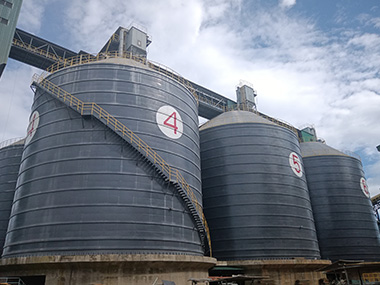

Steel Silo Chain Jack Lifting: The Top-Down Method That Actually Works
Steel silo chain jack lifting is a top-down construction method where the roof and upper shell courses are assembled on the ground, then raised incrementally using hydraulic jacks to allow welding of new shell rings underneath. We use it because it eliminates 90% of high-altitude work, cuts crane rental costs by up to 60%, and keeps the crew safely on the ground where the welding quality is actually inspectable.
The Mechanics of Chain Jack Lifting
How the System Actually Works
The concept is deceptively simple. You build the top of the silo first—the roof structure, the top shell course, and sometimes the second course—directly on the foundation pad or a temporary low-level platform. Around the perimeter, you erect a series of vertical columns, usually 12 to 24 depending on the diameter. On top of these columns sit the hydraulic chain jacks.
Each jack pulls a heavy-grade chain that runs down, attaches to a lug welded to the silo shell, and returns to the jack's base. When the central hydraulic power unit fires up, all jacks pull simultaneously. The shell rises. You stop the lift at exactly 1.8 meters—the height of a standard shell plate. Slide the next ring of plates into position. Weld it. Then lift again. You repeat this cycle until the silo reaches its full height.
It's elegant. But the execution is brutal if you get the tolerances wrong.
Hydraulic Jacks vs. Mechanical Jacks
Some contractors still try to use mechanical screw jacks for this. I don't recommend it. For anything over 2,000 tonnes of total shell weight, mechanical jacks are a headache. They bind. They don't synchronize well. And if one thread strips, you've got a catastrophic uneven load distribution.
We use hydraulic jacks operating at 700 bar. They give you precise, smooth control. More importantly, they integrate with load cells. Every jack reports its exact tonnage back to the central PLC in real-time. If Jack Number 7 is pulling 12 tonnes and Jack Number 8 is pulling 18 tonnes, the system alarms. You stop. You fix it. You don't guess.
Under ASME B30.1, these hydraulic cylinders require pilot-operated check valves. If a hose bursts—and I've seen it happen—the check valve locks the cylinder in place. The silo doesn't drop. It just sits there, waiting for you to swap out a hose.
Why We Ditch the Crane for Big Silos
The Cost of High-Capacity Crane Time
Look, I'll be straight with you. Traditional silo construction using a 600-tonne crawler crane gets expensive fast. You're paying $15,000 to $20,000 a day for the crane alone, plus the matting, the mobilization, and the operator. For a 40-meter diameter silo, you need that crane on site for 45 to 60 days.
With chain jacking, you use a 50-tonne mobile crane for three days to set the columns and the jacks. After that, the lifting gear costs you about $400 a day in electricity and labor. The math works. On a recent project in Vietnam, we saved the client $200,000 in heavy equipment rental just by switching to the jack-up method.
Wind Speed Limits and Site Constraints
Crane operators won't pick a load if wind speeds exceed 14 meters per second. In coastal areas or open plains, that shuts you down 30% of the time. Chain jacking is different. Because the shell is attached to the columns via the chains, the structure is inherently stable. We can safely lift in winds up to 10 meters per second, provided we've calculated the wind load correctly according to EN 1991-1-4.
Site constraints matter too. If you're building inside an existing plant, you might not have the laydown area for a massive crane. The chain jack columns fit within a 2-meter footprint around the silo perimeter. You can squeeze them into tight spaces where a crane simply can't swing.
The Critical Risks Nobody Talks About
Uneven Lift and Structural Distortion
Here's the thing. A 30-meter diameter silo shell is flexible. It's not a rigid concrete tank. If one side lifts 10mm faster than the other, the shell ovalizes. You get buckling. You get weld cracks.
I remember a project in Malaysia where the crew got cocky and skipped the intermediate survey. One jack lagged by 15mm. We heard the shell groan from 20 meters away. Stopped the lift, re-synced the jacks, and didn't lose a minute of sleep over it, but the welders were white as sheets. Now, we enforce a strict tolerance: no jack can deviate more than 3mm from the average lift height at any given moment. The PLC monitors this 200 times a second.
Chain Fatigue and Hydraulic Failure
Chains are your lifeline. We use Grade 80 alloy steel chains, rated for a minimum breaking load of 800 MPa. But they fatigue. Every lift cycle stresses the links. Under ISO 4301, you must inspect chains for elongation and link deformation every 500 cycles. If a chain stretches by more than 3% of its original pitch, you replace it. No exceptions.
Hydraulic failure is rare, but messy. A blown seal at 40 meters isn't dangerous if the check valves hold, but it's a mess to clean up. We carry spare seal kits for every cylinder on site. A swap takes 20 minutes. Waiting for a part to ship from Europe takes three weeks.
Execution: From First Ring to Final Height
Assembly and Welding at Ground Level
This is where chain jacking truly shines. Welding a vertical seam at ground level is infinitely easier than welding it 40 meters in the air. You can use submerged arc welding (SAW) for the vertical seams, which gives you a deposition rate of 8 to 12 kilograms per hour. Compare that to stick welding in the air, where you're lucky to get 2 kilograms per hour.
Because the welders are on solid ground, we can achieve 100% radiographic testing (RT) on the critical shell seams. The acceptance criteria under EN 1090 Execution Class 4 are strict, but ground-level welding consistently hits Class 1 and 2 quality. You can't fake quality when the RT film is right there.
The Lifting Sequence and Tolerances
We lift at a rate of 2 to 3 meters per hour. It's slow. It has to be slow. Fast lifting induces dynamic loads that the columns aren't designed for. The PLC ramps the pressure up over 30 seconds, holds for the lift, and ramps down over 30 seconds.
Before every lift, we verify the attachment lugs. These lugs are welded to the shell and take the full weight of the silo. We calculate the lug load based on the total shell weight plus a 1.35 safety factor for dynamic impact. If the shell weighs 400 tonnes, the lugs are rated for 540 tonnes. We test them ultrasonically before the first lift.
Real-World Case Study
5,000-Tonne Clinker Silo in Vietnam
We took on a contract for a 42-meter diameter, 38-meter high clinker silo outside Da Nang. The site was a nightmare. Monsoon season was approaching, and the ground was soft clay. A 600-tonne crane would have required a massive concrete mat just to stand on.
We opted for chain jacking. We installed 18 hydraulic jacks on H-beam columns anchored to the foundation piles. The total shell and roof weight was 480 tonnes. We lifted the silo in 21 cycles over 14 working days. The ambient temperature hit 42°C, so we ran the lifts at 4:00 AM when the steel was cool and the thermal expansion wasn't throwing off our tolerances.
The client was skeptical. They'd only built silos with cranes before. But when we finished the lift and lowered the shell onto the base ring, the horizontal seam tolerance was within 2mm. They didn't even need shims for the final weld. The project came in $200,000 under budget and three weeks ahead of schedule.
Frequently Asked Questions
What is the maximum height for chain jack lifting?
There's no hard physical limit, but economics dictate the cutoff. For silos over 50 meters high, the columns become massive, and the chain weight starts eating into your payload capacity. We've successfully jacked silos up to 45 meters. Beyond that, we usually switch to a hybrid method or traditional crane construction.
How do you control wind loads during the lift?
We calculate the wind load on the exposed shell using EN 1991-1-4, applying a basic wind velocity specific to the site's 50-year return period. If the predicted wind speed during the lift window exceeds 10 meters per second, we don't lift. We also tie the shell to the columns using guide rollers. These rollers allow vertical movement but prevent lateral sway. If the wind hits 12 m/s, the rollers lock the shell to the columns.
Can chain jacking be used for existing silo repairs?
Absolutely. We've used it to lift existing silos off their foundations to repair base rings or replace corroded bottom plates. The process is the same, but you have to account for the existing structural integrity. If the shell is thinned from abrasion, the lug loads might tear the shell. We always do a thickness survey before attaching lugs to an old silo. If the shell is below 6mm, we reinforce the lug areas with external doubler plates.
Why Manxing Uses Chain Jacking
At Manxing, we don't just design silos. We figure out how to build them without killing anyone or blowing the budget. Chain jack lifting is our standard for any steel silo over 25 meters in diameter. It's safer, it's faster, and the weld quality is undeniable.
If you're planning a bulk storage facility and want to know if the jack-up method works for your site, talk to our engineering team. We'll run the load calculations, check the wind data, and give you a straight answer. No corporate fluff. Just the math.
Ready to start your silo project? Contact Manxing today for a free engineering assessment and cost analysis.