
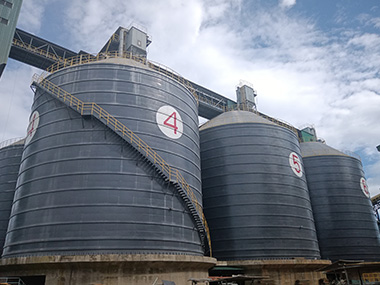

Steel Silo Tandem Crane Lifting: Engineering, Execution & Risk Management
Tandem crane lifting is a method where two cranes share the load of a single steel silo component or assembled shell ring during erection. You use it when one crane can't handle the weight, the reach, or the geometry alone. I've specified it on projects from 8,000-tonne clinker silos in Vietnam to 15,000-tonne cement silos in Saudi Arabia — and I've also told clients not to do it when the site couldn't support it. Here's what actually matters.
1. When Tandem Lifting Becomes Necessary
1.1 Weight Thresholds That Force the Decision
A single 250-tonne crawler crane can lift a 12-tonne shell ring at 18 metres radius. That's comfortable. But once you're moving assembled roof sections weighing 35-45 tonnes, or lifting a 20-metre-diameter cone assembly at 28 metres radius, you're past the envelope of most single-crane operations without stepping up to a 500-tonne or larger unit. And here's the thing — a 500-tonne crane isn't always available. In West Africa, I waited eleven weeks for a 600-tonne unit to be mobilized from South Africa. The project was bleeding $14,000 per day in standby costs.
Tandem lifting lets you combine two smaller cranes — say, two 250-tonne units — to handle loads that would otherwise require one massive crane. The math isn't perfectly additive, though. You never get 500 tonnes of combined capacity. Load-sharing efficiency typically runs 70-80% of the theoretical sum, depending on geometry and rigging. So two 250-tonne cranes give you roughly 350-400 tonnes of usable tandem capacity, not 500. Factor that in or you'll be sorry.
1.2 Site Constraints That Eliminate Alternatives
Some sites make tandem lifting the only viable option. I worked a slag silo project in northern China where the silo had to be erected inside an existing structure — a pre-engineered building with 24-metre clear height and 6-metre column spacing. No crane could get inside. The shell plates had to be fed through a 4-metre-wide opening and lifted from above using two cranes positioned on either side of the building. That was tandem or nothing.
Underground utilities create another common constraint. A cement plant in Indonesia had a network of stormwater culverts running directly beneath the planned crane pad. We couldn't place a single heavy crane there without shoring up 80 metres of culvert — $380,000 in groundworks alone. Two lighter cranes on either side of the utility corridor solved it without touching the culverts.
1.3 Schedule-Driven Decisions
Sometimes tandem lifting is about time, not physics. If you've got two cranes already on site for other lifts — structural steel, equipment, piping — and adding a tandem lift sequence costs zero mobilization, the economics shift. I've seen projects where the tandem approach saved 3-4 weeks compared to waiting for a larger crane. At $12,000-18,000 per day in overhead, that's $250,000-500,000 in savings. The math is brutal and simple.
2. Engineering the Lift: Load Distribution and Rigging
2.1 Calculating the Load Share
This is where most plans fall apart. You can't just assume each crane takes 50%. The load share depends on the geometry — the angle of each sling, the position of the lift points relative to the load's center of gravity, and the rigidity of the load itself. For a symmetrical silo roof section with two lift points, the split might be 50/50. For an asymmetric assembly — say, a cone with a offset discharge chute — one crane might carry 65% while the other carries 35%.
I run these calculations in 3D using the actual sling geometry, not a 2D approximation. The difference matters. On a 12,000-tonne fly ash silo in India, our 2D sketch showed a 55/45 split. The 3D model showed 62/38 because the slings weren't vertical — they were at 18° from vertical, which shifted the load toward the steeper sling. That 7% difference was the margin between a safe lift and an overload alarm on Crane A.
Every crane's load chart must be de-rated for the actual radius and configuration. A 250-tonne crane might show 42 tonnes at 28 metres radius with a 35-metre boom. But if you're on outriggers at 80% extension on a pad with 15 kPa bearing capacity, you might need to de-rate another 10-15% for stability margins. Check the ground bearing pressure against the crane manufacturer's requirements. I've seen crane mats sink 40 millimetres into unprepared ground during a tandem lift. The load shifted. Nobody was hurt, but it was close.
2.2 Rigging Design and Spreader Bars
You need a spreader bar — or two — to distribute the load between the cranes and keep the slings from crushing the shell plate edges. For a typical silo shell ring, I specify a spreader bar rated at 1.5 times the maximum single-crane load. So if Crane A might see 28 tonnes, the spreader bar is rated at 42 tonnes minimum. That gives you a safety factor of 1.5 against yield, which is standard per ASME BTH-1 for below-the-hook lifting devices.
The spreader bar itself adds weight. A steel spreader bar for a 15-metre-wide lift might weigh 1.5-2.5 tonnes. That weight comes out of your crane capacity. Don't forget it. I've reviewed lift plans where the rigging weight was omitted entirely — the plan showed 35 tonnes of silo steel, but the actual lifted weight was 37.8 tonnes with rigging. At 85% of crane capacity, that 2.8 tonnes was the difference between a green light and a red one.
Slings need to be matched in length to within 50 millimetres for a tandem lift. Uneven slings mean uneven load sharing. I specify polyester flat webbing slings rated with a 7:1 safety factor, and I require that both slings come from the same manufacturing batch. Different batches can have different elongation characteristics under load, which changes the geometry mid-lift.
2.3 Dynamic Load Factors
A tandem lift isn't static. When you hoist, the load accelerates. When you swing, it swings. When you lower, it decelerates. Each of these introduces dynamic forces. For a controlled hoist at 0.5 m/s² acceleration, you're looking at a dynamic amplification factor of 1.05-1.1. For a sudden stop — say, a crane operator hits the emergency stop because someone walked into the exclusion zone — that factor can jump to 1.3 or higher.
EN 13001-2 requires that crane structural design account for these dynamic factors, but it's your lift plan that has to manage them in practice. I specify a maximum hoist speed of 0.3 m/s for tandem lifts above 20 tonnes. Slower, yes. But the load stays predictable. One project in Brazil tried to hoist at 0.8 m/s to save time. The load swayed 400 millimetres laterally. They stopped, waited 20 minutes for it to dampen, then restarted at 0.25 m/s. Lesson learned.
3. Execution: Coordination, Communication, and Control
3.1 The Lift Director's Role
Every tandem lift needs one person with absolute authority — the lift director. Not the crane operator. Not the rigging supervisor. One person. That person gives every command, and every command goes through a single radio channel. I've seen tandem lifts fail because two people were giving instructions on different channels. Crane A heard "hoist" while Crane B heard "hold." The load twisted 12° in three seconds. We aborted.
The lift director should be positioned where they can see both cranes and the load simultaneously. That's not always possible on a congested site. In those cases, I position spotters at each crane with cameras feeding back to the lift director's tablet. It's not ideal, but it works. The key is that every crane operator receives commands from one source only.
I require a pre-lift meeting — a "lift briefing" — with every person involved. That means both crane operators, both signal persons, the rigging crew, the lift director, and the site safety officer. The briefing covers the lift sequence, the communication protocol, the abort criteria, and the emergency procedures. It takes 20 minutes. It's non-negotiable. I've cancelled lifts because the crane operator from the second crane didn't show up to the briefing. No briefing, no lift.
3.2 Synchronized Hoisting
Two cranes hoisting at different speeds will tilt the load. A 1° tilt on a 15-metre-wide assembly shifts the center of gravity by 130 millimetres. That's enough to change the load share by 5-8%. At 2°, you're looking at 10-15% shift. At 3°, you're in the danger zone.
I specify that the maximum allowable tilt during a tandem lift is 1.5°. The lift director monitors this with an inclinometer mounted on the load — a wireless unit that transmits to a display. If the tilt exceeds 1.5°, the lift stops. Both cranes hold. The lift director assesses and corrects.
The hoist speed differential between the two cranes should be less than 0.1 m/s. That requires operators who've practiced together. If you've got two operators who've never worked in tandem, I recommend a dry run with a test load — typically 50% of the actual lift weight — before the real thing. The dry run takes an hour. It's the cheapest insurance you'll ever buy.
3.3 Weather Limits
Wind is the enemy of tandem lifting. A 15 m/s wind gust on a 100 m² sail area — say, a silo roof section — generates about 14 kN of lateral force. That's 1.4 tonnes pushing sideways. The cranes aren't designed for lateral loading during hoisting. They're designed for vertical lifting with minimal sway.
I set the wind speed limit at 10 m/s (36 km/h) sustained, with gusts not exceeding 12 m/s. That's conservative, but I've been caught before. A project in coastal Vietnam had a forecast of 8 m/s winds. Ten minutes into the lift, a squall hit at 16 m/s. The load swung, one crane's load moment indicator tripped, and we had to set the load down on emergency cribbing. The whole abort sequence took 45 minutes. Nobody was hurt, but the schedule took a 6-hour hit.
Check the weather forecast for the full duration of the lift plus two hours. Tandem lifts take longer than single-crane lifts — coordination overhead adds 30-50% to the timeline. A lift that would take 40 minutes with one crane might take 60-70 minutes with two. Plan for that.
Before either crane touches the pad, verify the ground bearing pressure with a plate load test. I've seen sites where the geotechnical report said 150 kPa, but the actual pad — built by a subcontractor who compacted in 300 mm lifts instead of 150 mm — tested at 90 kPa. That's a 40% shortfall. The crane manufacturer's outrigger load at full extension might be 180 kPa. Do the math before you position the cranes, not after. A $2,000 plate load test can prevent a $200,000 crane tip-over.
4. Risk Management and Common Failure Modes
4.1 Load Shift and Sling Failure
The most common tandem lift failure isn't a crane collapse — it's a load shift. The load shifts, one crane takes more than its share, and either the crane's load moment indicator trips (best case) or the crane's structural margin is exceeded (worst case). I've seen three load shifts in 15 years. All three were caused by sling slippage on unpadded edges.
Every sharp edge that contacts a sling needs edge protection. I specify minimum 10 mm thick rubber or polyurethane padding on all edges within 500 mm of a sling contact point. For shell plates with rolled edges, the radius might be 6 mm — too tight for a polyester sling without protection. A sling loaded over a 6 mm radius edge loses 30-40% of its strength due to local stress concentration. That's not theoretical. I've tested it. A 20-tonne-rated sling failed at 12.8 tonnes over an unprotected edge.
4.2 Communication Breakdown
Radio failure during a tandem lift is a critical incident. Both operators need to hear every command simultaneously. If one operator loses radio contact and the other doesn't, you have a situation where one crane is responding to commands and the other is holding or — worse — continuing the last command it received.
I require two independent communication channels: a primary radio system on a dedicated frequency and a backup system — either a second radio on a different frequency or a wired intercom between the lift director and each crane. Both systems are tested before the lift. If either fails, the lift stops. No exceptions.
Hand signals are not a substitute for radio communication on a tandem lift. The distance between cranes can be 30-50 metres. At that range, hand signals are unreliable. I've seen signal persons use hand signals because the radio battery died. The operators interpreted the signals differently. The load tilted 2.1°. We aborted. Use radios.
4.3 Crane Configuration Errors
Crane load charts are configuration-specific. A 250-tonne crane with a 40-metre boom, 100% outrigger extension, and 6.5 tonnes of counterweight removed for transport will have a completely different load chart than the same crane with full counterweight. I've reviewed lift plans where the crane configuration on site didn't match the configuration used for the lift plan. The plan assumed 100% counterweight. The crane had 70%. That's a 30% reduction in capacity — on a tandem lift where you're already operating at 80% of capacity, that's catastrophic.
Verify the crane configuration physically. Walk around the crane. Check the counterweight blocks. Count them. Check the outrigger extension — are they fully extended or partially? Check the boom length — is it the length specified in the plan? I've caught configuration errors on three projects. On one, the crane had 2 tonnes less counterweight than specified. On another, the outriggers were at 75% extension instead of 100%. Both would have resulted in overloads during the tandem lift.
5. Case Study: 10,000-Tonne Clinker Silo — Cement Plant, Central Vietnam
Project Parameters
Silo diameter: 22.4 metres. Silo height: 48 metres. Roof assembly weight: 38.6 tonnes including steel structure, air slides, and ductwork pre-attached. Site constraint: existing 6-metre-wide conveyor trench running 12 metres south of the silo centerline. Available cranes: two Liebherr LTM 1250-6.1 (250-tonne capacity each). Maximum single-crane reach required: 32 metres radius.
Why Tandem Was Selected
A single 250-tonne crane at 32 metres radius has approximately 22 tonnes of available capacity after rigging weight. That's well below the 38.6-tonne roof assembly. A 500-tonne crane was available but would have required closing the conveyor trench for 14 days to set up — $190,000 in lost production. Trench closure was unacceptable.
Tandem lifting with two 250-tonne cranes positioned on opposite sides of the trench gave us a combined capacity of approximately 36 tonnes at the required geometry — after applying a 75% tandem efficiency factor and deducting 2.8 tonnes for the spreader bar and slings. That left us with 33.2 tonnes of usable capacity against a 38.6-tonne load. Still short.
The solution: we removed the ductwork from the roof assembly and lifted it separately. That reduced the tandem lift weight to 31.4 tonnes. With 33.2 tonnes of capacity, we had a 5.4% margin. Tight, but acceptable per EN 13001-2 for a planned lift with full engineering review.
Execution
Ground bearing: verified at 165 kPa via plate load test. Crane mats: 2.4 m × 2.4 m × 200 mm timber-composite mats under each outrigger. Spreader bar: custom-fabricated, 14 metres long, rated at 50 tonnes, weight 1.8 tonnes. Slings: four polyester slings, 8 metres long, 10-tonne WLL each, from the same manufacturing batch.
Lift briefing: 25 minutes with all personnel. Communication: primary radio on Channel 7, backup radio on Channel 12. Wind: 6 m/s sustained, gusts to 8 m/s. Lift duration: 55 minutes from first hoist command to load set on the shell rim. Maximum tilt recorded: 1.1°. No incidents.
The ductwork was lifted two days later as a single-crane lift — 7.2 tonnes at 28 metres radius, well within the 250-tonne crane's capacity. Total additional cost for the tandem approach versus waiting for a 500-tonne crane: approximately $45,000 including the custom spreader bar, additional rigging, and the extra ductwork lift. Savings versus trench closure: $190,000. Net benefit: $145,000.
6. Alternatives to Tandem Lifting
6.1 Hydraulic Gantry Systems
Hydraulic gantries can lift 50-500 tonnes with precise synchronization — the hydraulic system maintains equal lift across all points automatically. No radio coordination required. The downside: gantries are slow. A 40-tonne lift that takes 55 minutes with tandem cranes might take 4-6 hours with a gantry. And gantries need a firm, level foundation — typically a reinforced concrete pad or a heavily compacted gravel base. On soft ground, gantries sink.
I've used gantries on three projects. All three were in confined spaces where crane access was impossible. If you've got crane access, cranes are faster and more flexible.
6.2 Strand Jacks
Strand jacks are the heavy-lift specialists. A single strand jack can lift 200-400 tonnes. Multiple jacks — 4, 8, 12 — can lift thousands of tonnes with millimetre-level precision. They're used for bridge deck launches, offshore module installations, and the occasional silo roof lift in extremely confined spaces.
The cost is significant. A 4-point strand jack system for a 40-tonne lift might cost $80,000-120,000 in rental and setup. For a 40-tonne silo roof, that's overkill. Strand jacks make sense above 150 tonnes or when millimetre-level placement accuracy is required. Below that, cranes are more economical.
Frequently Asked Questions
Q1: What's the maximum weight you can lift with two 250-tonne cranes in tandem?
Theoretical combined capacity is 500 tonnes, but practical tandem capacity is 70-80% of that — roughly 350-400 tonnes — depending on geometry, sling angles, and rigging weight. For a specific lift, you need to calculate the actual load share based on the center of gravity and sling geometry. Never assume 50/50. I've seen splits as uneven as 68/32 on asymmetric loads. Always run the numbers for your specific lift.
Q2: Do both cranes need to be the same model?
No, but it helps. Different crane models have different hoist speeds, different load chart characteristics, and different response times to operator inputs. If you're pairing a 250-tonne crane with a 200-tonne crane, the smaller unit will reach its capacity limit sooner, and you'll need to manage the lift so the larger crane takes the majority of the load. I've done mixed-model tandem lifts successfully, but I prefer same-model pairs when possible. The hoist speed matching is better, and the operators can anticipate each other's crane behavior.
Q3: What standards govern tandem crane lifting?
The primary standards are EN 13001 (crane safety — general design), EN 13852 (offshore cranes, but the load-sharing principles apply), and ASME B30.5 for mobile cranes in North America. For rigging, ASME BTH-1 covers below-the-hook lifting devices. In China, GB/T 3811 applies to crane design, and GB 6067 covers crane safety. Your lift plan should reference the applicable standard for your jurisdiction and have it reviewed by a qualified engineer — not the crane operator, not the site manager, but a structural or lifting engineer with tandem lift experience.
Manxing's Approach to Complex Silo Erection
At Manxing, we've delivered EPC silo projects across 30+ countries — cement, clinker, fly ash, coal, slag, and aggregate storage. Tandem crane lifting is one tool in our erection methodology, not a default. We evaluate every lift against the full range of options: single crane, tandem crane, hydraulic gantry, strand jack, or slide-in erection. The right method depends on the load, the site, the schedule, and the risk profile — not on what equipment happens to be available.
If you're planning a silo project and the erection geometry is complex — existing structures, utility corridors, height restrictions, or loads that exceed single-crane capacity — we can help you evaluate the options. Our engineering team has designed tandem lift plans, gantry lift plans, and hybrid erection sequences for silos up to 20,000 tonnes capacity. We don't guess. We calculate, verify, and then execute.
Contact Manxing's engineering team for a site-specific erection assessment: manxingstorage.com