
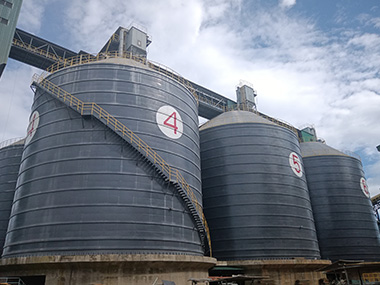

Steel Silo Erection Safety Protocol: Field-Tested Procedures for Industrial Projects
Erection safety isn't a paperwork exercise — it's the difference between a silo that stands for 25 years and one that buckles on day three. The two non-negotiable rules? Never exceed 60% of the crane's rated capacity during panel lifts, and never allow unsecured workers above 6 metres without dual-point harness anchorage. Everything else in this article builds from those two lines.
1. Pre-Erection Planning and Risk Assessment
1.1 Site-Specific Hazard Mapping
Before the first panel leaves the ground, you need a hazard map that covers more than the obvious. I've seen crews in Indonesia spend three days rerouting a lift sequence because nobody checked the 110 kV overhead line 80 metres from the silo centreline. The crane's boom radius at full extension put the load within the exclusion zone. That's a planning failure, not an operational one.
Your hazard map should identify: overhead power lines (minimum 6-metre horizontal clearance per OSHA 1926.1408), underground utilities (call 811 or your local equivalent — don't assume the as-built drawings are correct), prevailing wind patterns (sustained winds above 12 m/s should halt all lifts), adjacent structures that create wind funnelling, and soil bearing capacity at each outrigger position. We once had a 250-tonne crane sink 150 mm into a compacted gravel pad in Brazil because the geotechnical report was from the dry season. The pad looked solid. It wasn't.
1.2 Lift Plan Documentation
Every lift needs a written plan. Not a generic one — a specific plan for that silo, that crane, that day. The document should include: crane model and configuration (boom length, counterweight arrangement, outrigger span), rigging specifications (shackle ratings, sling angles, spreader beam dimensions if used), panel weights and centre-of-gravity locations, maximum wind speed for the lift (typically 9 m/s for sheet steel panels, 12 m/s for pre-assembled sections), communication protocol (radio channel, hand signal backup, designated signal person), and exclusion zone radius (we use 1.5 times the silo diameter — conservative, but I've watched a 4-tonne panel swing 8 metres in a gust).
The lift plan gets reviewed by the site safety officer, the crane operator, and the erection crew lead. All three sign it. If any one of them isn't comfortable, the lift doesn't happen. That's not bureaucracy — that's the system working.
1.3 Crew Competency Verification
Check certifications before anyone climbs. Crane operators need a valid licence for the specific crane class (not just "crane licence" — a mobile crane licence doesn't cover a tower crane). Riggers need documented training in load estimation and sling inspection. Workers at height need fall protection training that's current within 12 months. I've turned people away from sites in the Middle East because their "certification" was a photocopy with no issuing body listed. It happens more than you'd think.
On a project in Vietnam, we had a crew of 30 erectors. Four couldn't demonstrate proper harness hook-off technique during the morning briefing. They spent the day on ground-level tasks. The crew lead wasn't happy, but nobody got hurt. That's the trade-off.
2. Foundation and Anchor Bolt Integrity
2.1 Anchor Bolt Torque Verification
Anchor bolts are the single most overlooked failure point in silo erection. The concrete might be fine, the steel might be fine, but if the bolts aren't torqued to spec, the whole structure is compromised. For a typical 5,000-tonne cement silo using M48 Grade 8.8 anchor bolts, the specified torque is usually between 1,200 and 1,600 Nm depending on the bolt class and lubrication. We check every bolt with a calibrated torque wrench — not a sample, every bolt.
Here's the thing. I remember a project in Malaysia where the civil contractor had installed 192 anchor bolts. We checked them during the handover inspection. Forty-three were below 80% of specified torque. Twelve were finger-tight. The civil contractor argued they'd "settle in." They didn't. We re-torqued all 192 over two days. The silo's been standing for eight years now with zero issues. Those two days probably saved the client $2 million in potential remediation.
2.2 Base Plate Levelling and Grouting
Base plates need to be levelled to within ±2 mm across the full circumference. We use optical levels, not spirit levels — the radius is too large for anything else to be accurate. After levelling, the gap between the base plate and the concrete foundation gets filled with non-shrink grout. The grout needs to achieve at least 35 MPa compressive strength before any structural load goes on it. In cold weather (below 5°C), that can take 72 hours or more. Don't rush it. I've seen crews start erecting on 24-hour grout because the schedule was tight. The base plates shifted 4 mm within a week. The whole first ring had to be re-aligned.
3. Panel Lifting and Assembly Safety
3.1 Wind Speed Monitoring During Lifts
Wind is the enemy of panel erection. A 2-metre-wide steel panel at 15 metres elevation acts like a sail. At 10 m/s wind speed, the lateral force on a standard 1,200 mm wide × 3,000 mm long silo panel is roughly 450 N — enough to make the panel swing unpredictably and overload the rigging. Our protocol: measure wind speed at the lift height (not ground level) using an anemometer mounted on the crane or a nearby structure. Sustained winds above 9 m/s — stop the lift. Gusts above 12 m/s — secure everything and wait.
We were erecting a 60-metre-tall slag silo in Shandong when the wind picked up from 6 m/s to 14 m/s in about 20 minutes. The weather forecast said calm conditions. We had a 4-tonne panel at 35 metres, half-bolted. The crew lead made the call to lower it immediately. Took 15 minutes. The wind hit 16 m/s ten minutes later. That panel would have been a sail. Nobody argued with the decision.
3.2 Temporary Bracing and Stabilisation
Every panel section needs temporary bracing before the crane releases the load. The rule: minimum two diagonal braces per panel section, anchored to ground anchors or the previous ring. The braces need to resist a lateral load of at least 1.5 kN at the panel top — that's roughly equivalent to a 15 m/s gust on a standard panel. We use adjustable steel pipe braces with turnbuckles, rated to 5 kN minimum.
Don't rely on bolts alone for temporary stability. The bolt holes in a silo panel are designed for final assembly loads, not erection-stage wind loads. If you've got a partially erected ring with no bracing and the wind picks up, you're gambling. I've seen a 12-metre section of a silo ring bow outward by 80 mm because the crew skipped the bracing to save time. The panels didn't fail, but the re-alignment took three days.
3.3 Bolt Tightening Sequence and Quality Control
The bolt tightening sequence matters more than most crews realise. For a bolted silo shell, the standard sequence is: hand-tighten all bolts in the ring, then torque to 50% of specified value in a star pattern (skip every other bolt), then torque to 100% in the same pattern. This distributes the clamping force evenly and prevents panel distortion. For high-strength bolts (Grade 10.9), we use the torque-turn method or direct tension indicators — not just a torque wrench — because friction variability can give false readings.
We check 100% of bolts in the first three rings (the highest stress zone) and a random 20% sample in upper rings. If the sample failure rate exceeds 5%, we check 100% of that ring. On a 12,000-tonne clinker silo in the UAE, that meant checking roughly 2,400 bolts in the first three rings alone. Took a full day. Worth every minute.
4. Working at Height: Fall Protection Systems
4.1 Harness and Lanyard Requirements
Anyone working above 1.8 metres needs a full-body harness with a double lanyard (one hook always connected). The harness needs to meet EN 361 or ANSI Z359.11, and the lanyard needs an energy absorber rated for the potential fall distance. On a silo erection, the fall distance can be significant — if you're working at 40 metres on the shell, a fall arrest system needs to limit the arrest force to 6 kN maximum. That means the lanyard length plus energy absorber deployment can't exceed the available clearance below the work position.
We use retractable fall arresters (EN 360) for vertical work on the shell and horizontal lifelines for circumferential work. The horizontal lifeline gets engineered for the specific span — a 20-metre span between anchor points on a 30-metre-diameter silo has different tension requirements than a 10-metre span. Don't just string a cable between two points and call it done. The lifeline needs to be designed so that a fall at mid-span doesn't create enough tension to pull out the end anchors.
4.2 Access Systems and Edge Protection
Getting workers to the work position safely is half the battle. We use a combination of: external scaffolding for the lower rings (up to about 15 metres), mast climbing work platforms for the mid-section, and rope access or suspended platforms for the upper sections and roof. Each access method has its own risk assessment. Scaffolding needs to be designed for the specific loading — a scaffold that's fine for two workers and hand tools isn't fine for a crew of six with a pile of panels.
Edge protection on the silo shell during erection is temporary but critical. We install a temporary guardrail system on the top ring as soon as it's stable — top rail at 1 metre, mid-rail at 0.5 metre, toe board at 150 mm. The guardrail posts bolt to the shell panels using existing bolt holes where possible. If the top ring isn't stable enough for guardrails, the workers use fall arrest systems with no exception.
5. Crane Operations and Rigging Safety
5.1 Crane Selection and Ground Conditions
The crane needs to handle the heaviest single lift with at least a 25% margin. For most industrial silo projects, the heaviest lift is a pre-assembled roof section or a bundled panel set — typically 3 to 8 tonnes. But the crane also needs the reach. A silo with a 20-metre diameter and 40-metre height means the crane needs to place a load at roughly 50 metres radius at 45 metres height. That's not a small crane. We typically use 150 to 300 tonne mobile cranes for silos in this range, or tower cranes for taller structures.
Ground conditions under the outriggers are where things go wrong. The outrigger pad needs to distribute the load to a maximum of 150 kPa on the soil — that's the typical safe bearing capacity for compacted fill. If the soil is weaker, you need larger outrigger pads or timber mats. We calculate the actual ground pressure for each lift position and verify it against the geotechnical report. On a project in Nigeria, the soil bearing capacity was 80 kPa — half what we needed. We had to bring in steel mat spreaders that doubled the contact area. Added two days to the schedule. Better than a crane tip-over.
5.2 Rigging Inspection and Load Management
All rigging gets inspected before each shift. Slings (wire rope or synthetic) get checked for broken wires, kinks, corrosion, and deformation. Shackles get checked for bent pins and cracked bodies. Spreader beams get checked for weld cracks and deformation. Anything that fails inspection gets tagged out immediately — red tag, removed from site, replaced. No exceptions, no "it'll be fine for one more lift."
We keep a rigging inspection log on site. Every sling, every shackle, every beam — logged, inspected, signed. If an inspector shows up and asks for the log, it needs to be current. On a project in Saudi Arabia, the third-party inspector rejected an entire set of 20 slings because the inspection tags were three days out of date. The slings were physically fine, but the paperwork wasn't. We replaced the tags and re-inspected on site. Took an hour. The inspector was right to flag it.
6. Electrical and Pneumatic System Safety During Erection
6.1 Temporary Power and Lockout/Tagout
During erection, the site runs on temporary power — generators, distribution boards, extension cords. All temporary electrical installations need to meet the local electrical code (in China, that's GB 50194; in Europe, HD 60364; in the US, NFPA 70E). Every distribution board needs RCD protection with a 30 mA trip threshold. Every cable needs to be routed away from sharp edges and pinch points. Every connection needs to be weatherproof if there's any chance of rain.
Lockout/tagout applies during erection too. If you're working on a conveyor system that's been partially installed, and someone could energise it from a remote panel, you lock it out. We use a group lockout system — each worker applies their own lock to a common lockout station. The equipment doesn't get energised until every lock is removed. I've seen a conveyor start up in Indonesia because a subcontractor didn't know the lockout was in place. The worker on the belt was lucky — he was 3 metres from the tail pulley, not in it. We shut down the entire site for a safety stand-down after that.
6.2 Pneumatic Testing Safety
If the silo includes a pneumatic conveying system or aeration system, pressure testing happens during or shortly after erection. The test pressure is typically 1.5 times the working pressure — for a system designed at 350 kPa, that's 525 kPa. The test area gets barricaded at a radius of at least 5 metres. Nobody stays in the test zone during pressurisation. We use a remote pressure gauge and a camera so the test operator can monitor from a safe distance.
The biggest risk during pneumatic testing isn't the pressure itself — it's the stored energy in the system. A 10-metre length of 150 mm diameter pipe at 525 kPa stores roughly 9 kJ of energy. If a fitting fails, that energy releases instantly. We test in stages: 25% of test pressure, hold and inspect; 50%, hold and inspect; 75%, hold and inspect; 100%, hold for 30 minutes. If anything leaks at any stage, we depressurise, fix it, and start over.
Case Study: 8,000-Tonne Fly Ash Silo Erection — Jiangsu Province, China
Project parameters: 22-metre diameter, 38-metre height, 8,000-tonne capacity, bolted steel shell construction. Erection crew of 24 workers, 200-tonne mobile crane, 45-day erection schedule. The site was adjacent to an operating power plant with active conveyor systems within 30 metres of the silo centreline.
The challenge was the wind. The site was in a river valley with predictable afternoon wind patterns — calm mornings, gusty afternoons. We structured the lift schedule around this: all panel lifts between 6:00 and 11:00, bolt tightening and bracing between 11:00 and 14:00, and no lifts after 14:00 when wind speeds consistently exceeded 10 m/s. This added roughly 15 minutes of non-productive time per day (the crane couldn't be repositioned during the wind window), but it eliminated the risk of a panel lift in gusty conditions.
On day 23, the crew was erecting the 18th ring at approximately 28 metres height. The morning wind was 4 m/s — well within limits. At 10:45, the anemometer at lift height showed a sudden jump to 11 m/s. The crew lead radioed the crane operator to hold position. The gust lasted 90 seconds, then dropped back to 5 m/s. The crew lead waited another 10 minutes to confirm the trend, then resumed the lift. The panel was placed and braced by 11:15. Total delay: 35 minutes. No incident, no damage, no injury. That's what a functioning safety protocol looks like in practice — not dramatic, just disciplined.
The silo was completed on day 44, one day ahead of schedule. Zero lost-time incidents. Zero equipment damage. The client's safety auditor noted the wind monitoring protocol as a best practice and adopted it for their other sites.
Frequently Asked Questions
Q: What's the maximum safe wind speed for steel silo panel erection?
For individual panel lifts, we cap sustained wind speed at 9 m/s (approximately 32 km/h or 20 mph) measured at the lift height. For pre-assembled sections or roof structures with larger sail areas, we reduce that to 7 m/s. Gusts above 12 m/s trigger an immediate work stoppage regardless of the average. These limits are based on EN 1991-1-4 wind load calculations for typical panel geometries and are conservative enough to account for wind funnelling around the partially erected structure. If your site has unusual topography — valleys, cliff edges, urban canyons — you need a site-specific wind assessment, not a generic number.
Q: How often should anchor bolts be re-checked after initial torqueing?
We check anchor bolts at three stages: immediately after initial torqueing (before erection begins), after the first three rings are erected (to catch any relaxation from initial loading), and after the silo is fully loaded for the first time (concrete creeps and steel relaxes under sustained load). For the first check, we verify 100% of bolts. For subsequent checks, we sample 20% — if any bolt is below 90% of specified torque, we check 100%. In our experience, bolt relaxation of 5-10% in the first 48 hours is normal. Anything above 15% suggests a problem — either the bolt was undertorqued initially, the grout is compressing, or the base plate isn't seated properly.
Q: Can silo erection proceed during rain?
Light rain (below 5 mm/hr) is generally acceptable for bolt tightening and bracing work, provided the workers have appropriate PPE and the panels aren't so wet that footing becomes hazardous. We don't lift panels in rain — the reduced friction on the panel surface makes rigging less predictable, and the crane operator's visibility degrades. Thunderstorms are an automatic stop — lightning risk to the crane boom and the partially erected steel structure is unacceptable. In tropical climates where afternoon thunderstorms are predictable, we plan the lift schedule around them, just like we do with wind. The key is having a clear, written threshold in the site safety plan so the crew lead doesn't have to make a judgment call in the moment.
Need a Site-Specific Erection Safety Plan?
Manxing provides EPC silo contracting across cement, clinker, fly ash, coal, slag, and aggregate projects worldwide. Our erection safety protocols are developed from 15+ years of field experience across 30+ countries — not from a textbook. Every project gets a custom lift plan, a dedicated safety officer, and a crew that's been through our internal competency programme.
Contact our engineering team at manxingstorage.com for a project-specific safety review or erection planning consultation.