
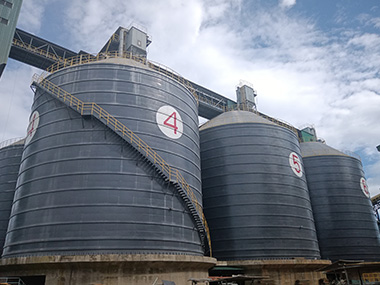

Steel Silo Working at Height Plan: Engineering Safety Into Every Metre Above Ground
A working-at-height plan for steel silo construction isn't paperwork — it's the document that decides whether your crew goes home intact. The two questions every site manager asks me: At what height does a formal plan become mandatory? In most jurisdictions, any work above 2 metres requires documented controls, but silo work typically starts at the bolted shell — usually 12–30 metres up. What's the single most overlooked risk? It's not the fall itself. It's the rescue. If you can't extract an injured worker from a silo roof within 30 minutes, your plan is incomplete.
Why Silo Height Work Is Nothing Like Building Construction
Look, I've spent 15 years on silo sites across 30 countries, and I can tell you — the guys who get hurt are the ones who treat a silo like a high-rise building. It's not. The geometry, the surface conditions, the environmental exposure — everything's different.
The Cylinder Problem: No Flat Surfaces, No Rest
A steel silo shell curves away from you. There's no floor to stand on, no wall to lean against, no edge to brace your foot against. At 18 metres diameter, the curvature is gentle enough that you don't notice it — until you're lying on your back after a slip and you realise there's literally nothing to grab. The shell plate is 6–12mm thick, often coated with epoxy or zinc, and when it's wet with condensation at 5am, it's as greased as an ice rink.
I remember a project in Vietnam — 2,400-tonne clinker silo, 34 metres tall. A bolter lost his footing on a shell joint at 22 metres. His lanyard caught him, but he swung into the shell and cracked two ribs. The rescue took 45 minutes because the only access was a manlift that couldn't reach the exact azimuth. We had to rig a secondary rope system from the roof. That's when I learned: your rescue plan has to account for the fact that you can't just drive an ambulance to the point of injury.
Wind Loading on Workers — Not Just the Structure
When we design a silo shell, we calculate wind loads per EN 1991-1-4. A 30-metre silo in a 140 km/h wind zone sees shell pressures of 1.2–2.0 kPa. But here's what the structural calcs don't cover: a worker lying prone on the shell presents a different profile than the cylinder. Wind gusts at height are unpredictable. I've stood on a silo roof at 28 metres in what the anemometer said was 40 km/h and felt a gust that nearly took my legs out. At 60 km/h sustained, you stop work. Period. No production schedule is worth it.
The working-at-height plan needs a wind threshold — written down, not left to the foreman's gut feeling. I specify 50 km/h sustained or 70 km/h gusts as the stop-work trigger. Measure it with a calibrated anemometer at working height, not from the ground where wind speed can be 40% lower.
Condensation, Dust, and the Slip Factor
Fly ash and cement silos breathe. Moisture migrates through the shell, condenses on the inner surface, and wicks through bolt holes. The outer surface near bolt lines stays damp for hours after sunrise. Coal silos generate fines that settle on every horizontal surface — roof beams, handrail tops, platform edges. A 2mm layer of cement dust on a steel grating reduces the coefficient of friction by half. Your plan has to address surface conditions daily, not just at mobilisation.
The Regulatory Framework: What Actually Applies
Every country has its own code, but the principles converge. If you're building a silo in a jurisdiction without specific silo standards — and most don't have them — you fall back to general working-at-height regulations. Here's what I keep in my back pocket.
EN Standards for Fall Protection Equipment
EN 361 covers full-body harnesses. EN 362 for connectors. EN 355 for energy absorbers. EN 363 is the system standard — it tells you how to assemble an arrest system from those components. EN 795 covers anchor devices, and this is where silo work gets tricky. A standard EN 795 Type A anchor plate is rated at 5,000 kg static, but that's tested on a flat concrete surface. On a curved silo shell, the load distribution changes. I've seen anchor plates bend on 16mm shell plates under a 150 kg dynamic load. The fix: spreader plates behind the shell, minimum 200 × 200 × 10mm, to distribute the load across at least four bolt pitches.
For Chinese projects, GB 30862 is the anchor device standard. It's broadly aligned with EN 795 but has additional testing requirements for repeated loading. If your client is a state-owned enterprise, they'll want GB compliance — and rightly so.
OSHA 1926.501 — The 1.8 Metre Threshold
In the US market, OSHA's 6-foot (1.8m) trigger is lower than most international standards. That means if you're working for an American client or on a US-funded project, your plan has to kick in earlier. The 100% tie-off requirement above 1.8 metres is non-negotiable. I've had subcontractors argue with me about this on a project in Texas. I told them: "You can argue with me, or you can argue with the OSHA inspector. Your call." They tied off.
ISO 15012 and Dust Explosion Risk During Height Work
Here's one nobody thinks about. You're grinding, welding, or cutting on a silo shell. The plant is running. There's cement dust or coal dust in the air. ISO 15012 requires a hot-work permit that includes explosion risk assessment. At height, you can't just run to the ground if something ignites. Your working-at-height plan has to integrate with the hot-work permit system. I've seen plans where the fall protection section and the hot-work section were written by different people who never talked to each other. That's a gap that kills people.
Risk Assessment: The Hierarchy of Controls Applied to Silos
The hierarchy is eliminate, substitute, engineer, administer, PPE. Most plans jump straight to PPE. That's lazy engineering. Let me walk through what a proper assessment looks like for a silo project.
Elimination: Can You Build at Ground Level?
This is my favourite question. Can you pre-assemble larger sections on the ground and lift them? For bolted silos, the answer is often yes. We've pre-assembled 6-metre-high shell rings — complete with stiffeners, ladder brackets, and paint touch-up — and lifted them in one piece. That moves 70% of the height work to ground level. The lift plan becomes the critical document, not the height-access plan. For a 30-metre silo, that's the difference between 200 person-hours at height and 60.
The trade-off: you need a bigger crane. A 12-metre shell ring with stiffeners weighs 8–12 tonnes. That's a 100-tonne crane minimum, depending on radius. But the crane cost is almost always less than the combined cost of scaffolding, access equipment, extended schedule, and heightened insurance premiums for prolonged height work.
Engineering Controls: Platforms, Nets, and Anchor Systems
When you can't eliminate height work, you engineer the environment. For slip-form or welded silo construction, I specify a permanent external access platform that travels with the jump-form system. It's a cantilevered ring at 2.5 metres below the working face, with 1.1-metre guardrails to EN 12811 and kick plates. The platform supports 3 kN/m² — enough for three workers and a bolt crate.
For bolted silos erected from the top down, I prefer a combination: a roof-mounted monorail system for the upper sections, and a manlift for the lower shell. The monorail carries a personnel basket rated for two workers plus tools at 500 kg total. It's slower than free-climbing, but it eliminates unprotected movement on the shell. The manlift handles the lower 15 metres where the shell is accessible from ground-based equipment.
Safety nets are underrated. EN 1263-1 compliant nets, installed 3 metres below the working level, catch both personnel and tools. I specify a mesh size of 60mm and a minimum breaking strength of 2.2 kN per mesh. On a 20-metre silo in Saudi Arabia, a wrench fell from the roof, hit the net, and bounced back up 1.5 metres before settling. Without the net, it would have hit a worker on the platform below. The crew heard it hit. Nobody said anything for about three seconds. Then the foreman said, "That's why we have nets." Case closed.
Administrative Controls: Permits, Briefings, and the Buddy System
Every height work session starts with a permit. Not a generic one — a specific permit for that day, that section, that crew. The permit covers: wind speed at time of start, surface conditions (dry, damp, dusty), rescue equipment pre-staged, communication check with ground control, and medical response time confirmed.
The buddy system isn't optional. Two workers minimum at any height point. One works, one watches. The watcher's job isn't to chat — it's to maintain visual contact and initiate rescue if the worker goes into suspension. Suspension trauma sets in within 10–15 minutes of a harness arrest. Blood pools in the legs, cardiac output drops, and the worker can lose consciousness even if the fall was only 2 metres. Your rescue plan has to get them down — or at least get their legs elevated — within that window.
Fall Protection Systems: What Works on a Silo Shell
Not every fall protection system works on a curved, vertical, sometimes-inclined surface. I've seen some creative — and some terrifying — solutions on sites around the world.
Horizontal Lifelines on Cylindrical Surfaces
A horizontal lifeline (HLL) around the silo circumference seems logical. It's not. The problem is geometry. An HLL rated for a flat roof assumes the anchor points are in a straight line. On a cylinder, the line curves, and when a worker falls, the lateral force on the end anchors is enormous. I've calculated the lateral load on a 20-metre-diameter silo: a 100 kg worker falling 2 metres generates a lateral anchor load of 12 kN — enough to tear a standard EN 795 anchor off a 10mm shell plate.
The solution: intermediate anchors every 3 metres, with energy-absorbing posts. The system becomes expensive — roughly $1,200 per linear metre installed — but it's the only safe way to run an HLL on a cylinder. Alternatively, use vertical lifelines on fixed ladder systems. The ladder structure already carries the load path to the ground, and the fall distance is limited by the ladder's vertical orientation.
Self-Retracting Lifelines (SRLs) — The 3-Second Rule
SRLs are great for vertical movement. They lock within 0.3 metres of fall initiation. But on a silo shell, the worker isn't falling vertically — they're sliding down the curve. The SRL may not lock if the fall vector is more horizontal than vertical. I specify SRLs with a 3-second lock test in the horizontal plane. If the device doesn't lock within 3 seconds of a horizontal pull at 1 metre, it doesn't go on my site.
Another issue: SRLs have a maximum cable length, typically 6–12 metres. On a 30-metre silo, you need multiple anchor points and the worker has to transfer between SRLs. Each transfer is a moment of unprotected exposure. The plan has to minimise transfers — ideally, no more than two per work cycle.
Anchor Point Design for Bolted Shells
This is where I see the most field failures. Someone drills a hole in the shell, bolts an anchor plate, and calls it done. The shell plate is 8mm thick. The anchor is rated for 5,000 kg. But the shell plate isn't a structural beam — it's a membrane. Under a point load, it deforms. I've measured 15mm deflection in an 8mm shell plate under a simulated fall load. The anchor didn't fail — the shell did.
My specification: anchor points on bolted shells use a back-plate of minimum 12mm steel, 300 × 300mm, with four M20 bolts through the shell. The back-plate distributes the load across a 200mm diameter area. For welded silos, I weld a permanent pad eye to the shell — 20mm thick, 150 × 150mm, with a 50mm hole, fillet welded all around to AWS D1.1. Each pad eye is load-tested to 12 kN before use. That's twice the maximum arrest force for a 100 kg worker with an energy absorber.
Emergency Rescue Planning: The Part Everyone Skips
Here's the uncomfortable truth: most working-at-height plans I review have a rescue section that says "call emergency services." That's not a plan. That's a prayer.
Rescue Time Windows and Medical Reality
Suspension trauma — also called orthostatic shock — is the medical reason rescue can't wait. After a fall arrest, the worker hangs in the harness. The leg straps compress the femoral veins. Blood pools. Within 10 minutes, the worker feels nauseous. Within 20, they may lose consciousness. Within 30, cardiac arrest is possible. Your rescue plan has to get the worker down or at least get their legs above heart level within 15 minutes.
On a silo, that's hard. The nearest hospital might be 45 minutes away. The site ambulance — if there is one — can't drive up the shell. You need a mechanical rescue system: a descender device, a stretcher that can be rigged for vertical extraction, and a crew trained in rope rescue. I require a minimum of two trained rope-rescue technicians on site whenever height work is happening. They don't do other work. They watch, they pre-stage equipment, and they respond.
Stretcher Selection for Silo Rescue
A standard ambulance stretcher is useless on a silo. You need a vertical rescue stretcher — a SKED or equivalent — that can be attached to a descender and lowered down the shell. The stretcher has to fit through the manhole opening at the silo roof, which is typically 600mm diameter. I've measured: a SKED stretcher in its compact configuration is 450 × 180mm. It fits. Barely. But it fits.
For confined-space rescue inside the silo — which is a different plan but often triggered by the same incident — you need a tripod and winch system rated for 200 kg. The tripod sits on the roof, the winch lowers a rescuer through the manhole, and the rescuer attaches the stretcher to the casualty. Total system weight: 45 kg. Setup time for a trained crew: 4 minutes. I time it during every drill.
Training and Competency: The Human Factor
Equipment doesn't save people. Trained people save people. I've seen a $2,000 harness fail because the wearer put it on backwards. I've seen a $50,000 SRL destroyed because someone used it as a towing line. Training isn't a line item — it's the foundation.
Minimum Competency for Silo Height Work
Every worker on my sites holds a working-at-height certificate — minimum 8 hours of classroom and practical training, refreshed annually. But that's the baseline. For silo-specific work, I add a 4-hour silo orientation that covers: shell surface hazards, anchor point locations, rescue procedures, and communication protocols. The orientation is site-specific. A certificate from a training centre in Jakarta doesn't prepare you for a silo in Ulaanbaatar where it's -20°C and the steel is brittle.
I also require a practical rescue drill within the first 48 hours of mobilisation. The drill simulates a fall arrest at the highest point of the day's work. The rescue team has to extract the "casualty" and deliver them to the ground within 15 minutes. If they can't, we don't start work until they can. I've stopped mobilisation twice in my career over failed drills. Both times, the client was unhappy. Both times, I'd do it again.
Communication Systems at Height
Radios are mandatory. Not phones — radios. At 30 metres on a steel shell, you're in a partial RF shadow. I specify UHF radios with a repeater on the silo roof. Each worker carries a radio on a chest harness, with a push-to-talk earpiece so both hands stay free. The ground controller maintains a continuous listening watch. If a worker doesn't check in every 10 minutes, the controller initiates a welfare check. No check-in in 15 minutes triggers a rescue response.
On a project in Malaysia, the radio check saved a life. A worker at 26 metres didn't respond. The controller called the rescue team. They found the worker unconscious from heat stress — 42°C ambient, 80% humidity. He was on the ground and in the shade within 12 minutes. Heat stroke at that temperature kills in 30. The radio discipline gave him the margin.
Case Study: 3,000-Tonne Cement Silo — Working at Height Plan in Practice
Project: 3,000-tonne cement silo, 32 metres tall, 16 metres diameter, bolted construction. Location: East Africa, coastal climate, 35°C average, 90% humidity during rainy season.
Challenge: The client wanted the silo erected in 45 days. The original plan called for full-height scaffolding — 32 metres of tube-and-fit scaffold around the circumference. Scaffold erection alone would take 12 days. We proposed an alternative: top-down erection with a roof-mounted monorail and a 20-tonne crawler crane for shell lifts.
Height Work Plan:
- Shell erection: 4-person crew on monorail basket, 2-person ground crew for bolt supply. Maximum height exposure: 32 metres. Anchor system: 12 pad eyes welded to the roof structure, each tested to 12 kN. SRLs with horizontal lock capability.
- Roof installation: 2-person crew on permanent roof platforms (pre-assembled on ground). Fall protection: double lanyards with 100% tie-off. Rescue: descender pre-rigged on each platform anchor.
- Stiffener welding: 2-person crew on manlift for lower 15 metres, monorail basket for upper sections. Hot-work permits integrated with height permits. Fire watch on ground with 20-metre visual coverage.
Results: Erection completed in 38 days — 7 days ahead of schedule. Zero lost-time incidents. One medical treatment case (minor laceration from a bolt thread). Rescue drill time: 11 minutes from fall simulation to ground delivery. The client's safety auditor noted the plan as "exemplary" — the first time that phrase appeared on one of their projects.
Cost comparison: Scaffolding estimate: $48,000 material + $36,000 labour = $84,000. Monorail + manlift alternative: $22,000 equipment + $18,000 labour = $40,000. The height work plan didn't just improve safety — it saved $44,000 and 12 days of schedule.
FAQ
Q: At what height does a working-at-height plan become mandatory for silo construction?
A: In most jurisdictions, the threshold is 2 metres — that's the OSHA trigger in the US and the EN standard baseline in Europe. But for practical purposes, silo work above 6 metres demands a formal, written, site-specific plan with rescue procedures. Below 6 metres, you can use a generic plan with site-specific addenda. Above 6 metres, the plan has to address anchor systems, rescue extraction, and environmental monitoring. I draw the line at 12 metres for requiring a dedicated rescue team on standby.
Q: Can workers use the silo's permanent ladder system for fall protection during construction?
A: Only if the ladder has an integrated fall arrest rail — either a rigid rail per EN 353-1 or a cable system per EN 353-2. A plain ladder with rungs is not fall protection. I've seen crews clip their lanyards to ladder rungs. That's not a rated anchor. The rung-to-stringer connection is typically a 6mm fillet weld — it'll hold a static load, but a dynamic fall load can crack it. If the permanent ladder isn't equipped with a rail system, you need temporary fall protection: a vertical lifeline attached to anchor points above the ladder, with the worker using a shuttle device that follows the lifeline.
Q: How often should fall protection equipment be inspected on a silo site?
A: Three levels. First: pre-use inspection by the wearer — every time they put it on. Visual check of webbing, buckles, and energy absorber deployment indicator. Takes 30 seconds. Second: weekly formal inspection by a competent person — documented, with serial numbers recorded. Third: annual manufacturer-level inspection, including load testing of energy absorbers and SRLs. I've seen a harness that passed the pre-use check fail the weekly inspection because a stitching line was UV-degraded — invisible at arm's length, obvious under close inspection. The weekly check caught it. The worker would have found it the hard way.
Need a Working-at-Height Plan for Your Silo Project?
Manxing has delivered EPC silo projects across 30+ countries — from 500-tonne fly ash silos to 30,000-tonne clinker terminals. Our engineering team develops site-specific working-at-height plans that meet EN, OSHA, GB, and ISO requirements, with integrated rescue procedures and equipment specifications. We don't hand you a template. We hand you a plan that's been tested on a real shell, in real wind, with real crews.
Contact our engineering team at manxingstorage.com for a project-specific height work assessment.