
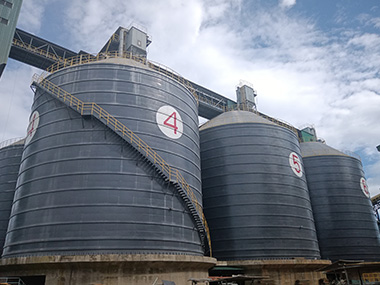

Steel Silo Erection Load Calculations: What Every EPC Contractor Needs to Get Right
Erection load calculations determine the temporary forces a steel silo shell experiences before it's complete — wind on a half-built wall, crane reactions on a single ring, bolt-up stresses in a structure that can't yet support itself. Get them wrong and you're looking at a collapsed shell, a delayed project, or worse. Get them right and the silo goes up straight, on schedule, without anyone getting hurt.
The Loads You Can't Ignore During Erection
Dead Loads and Temporary Conditions
A finished silo carries its own weight through a continuous shell. During erection, that weight is concentrated at whatever section you've bolted up so far. A 25-meter-diameter cement silo with 12 mm shell plates weighs roughly 180 tonnes when complete. But at the 8-meter mark — three rings up — you've got maybe 40 tonnes hanging off a foundation that's designed for the full load plus seismic. The bolts are torqued to spec, sure, but the base plate isn't fully engaged yet. I've seen crews keep bolting upward without checking whether the lower rings could handle the cantilever moment. They can't. Not always.
The math is straightforward: calculate the self-weight of erected sections, add the weight of any attached platforms or ladders, then check the foundation bolts for pull-out at the current height. For a typical 20-meter-tall silo erected in 2.5-meter rings, the critical moment usually occurs at the 6-to-10 meter range — high enough to generate real leverage, low enough that the foundation hasn't been fully loaded yet.
Wind Loads During the Vulnerable Phase
Here's where most erection plans fall apart. A completed silo is a pressure vessel — the shell is continuous, the roof distributes load, and the whole thing acts as a cantilever beam fixed at the base. During erection, you've got an open-top cylinder with no roof, no stiffening rings, and maybe half the shell plates installed. The wind load on that partial structure is calculated differently, and the allowable stress is lower because you don't have the full cross-section resisting bending.
EN 1991-1-4 gives you the wind pressure coefficients for cylindrical structures, but those assume a closed shell. For an open-top silo at 60% height, I apply a shape factor of 0.7 on the windward face and 0.4 on the leeward — conservative, but I've watched a 30-meter shell bow 150 mm under a 90 km/h gust when it was only two-thirds complete. The crew stopped work for six hours. That's a full shift lost because nobody ran the wind check for the intermediate condition.
Crane and Equipment Loads
The erection crane isn't just lifting panels — it's applying a concentrated reaction at the top of the shell. A 25-tonne panel lifted by a 50-tonne crane generates a vertical reaction of maybe 30 tonnes at the pick point, plus a horizontal component from swing. That load goes straight into the top ring, which is the weakest section of the structure at that moment. I've specified temporary internal bracing for silos over 20 meters diameter — steel tubes crisscrossing the interior, pinned to the shell at four points. It adds maybe $8,000 to the erection cost. It also prevents the ovalization that would otherwise make the next ring impossible to fit.
Structural Analysis Methods for Erection Stages
Finite Element Modeling for Partial-Height Conditions
You can't just run the final design model and assume the erection case is covered. The boundary conditions are different — the base is fixed, but the top is free. The load path is different — there's no roof to distribute wind, no material inside to provide internal pressure. I model each erection stage as a separate load case: 25%, 50%, 75%, and 100% height. For each stage, I check shell buckling under wind, base plate bearing under self-weight, and bolt tension at the foundation.
The software doesn't care about erection sequence. You have to tell it. I've seen analysis reports that show the completed silo passing every check — and the same silo failing buckling at the 50% stage because nobody modeled the intermediate condition. The shell slenderness ratio changes as you go up. A 12 mm plate at 8 meters height has a different critical buckling stress than the same plate at 25 meters with the full weight above it compressing the lower section.
Stability Checks for Unbraced Shell Sections
An unbraced cylindrical shell is a buckling machine. The critical external pressure for a perfect cylinder is given by the formula in EN 1993-1-6, but that's for a finished structure with stiffening rings. During erection, you might have a 10-meter-tall shell with no rings installed yet — just the raw plate. The critical buckling pressure drops by 40-60% compared to the stiffened case. I've calculated wind suction on a 22-meter-diameter shell at 70% height and gotten a buckling factor of 1.3. That's below the required 2.0. The fix? Install the stiffening rings within two rings of the current top, or add external temporary bracing.
Connection Design for Temporary Conditions
Field-bolted silos rely on friction connections — the bolts are torqued to a specified preload, and the load transfers through friction between the plates. During erection, those bolts are the only thing holding the shell together. A standard M20 bolt in a friction connection needs 110 kN of preload to develop the design shear capacity. But if the bolt is only torqued to 80 kN because the crew didn't calibrate the wrench that morning, you've lost 27% of your connection capacity. I've pulled out torque wrenches that were off by 30% — not because they were broken, but because they hadn't been calibrated in six months. That's a $200 calibration check versus a $50,000 rework job.
Common Mistakes That Cause Failures
Ignoring Differential Settlement During Erection
Foundations settle. That's normal. But during erection, the load isn't evenly distributed — you're adding weight to one side as you bolt up panels in sequence. A 30-meter-diameter silo foundation can tolerate 15 mm of differential settlement when it's fully loaded and the soil is consolidated. During erection, with only 30% of the load applied, the soil is still consolidating. I've measured 8 mm of differential settlement on a silo foundation in Vietnam after just three rings were installed. The shell was out of plumb by 25 mm at the top. We had to jack the shell back into alignment before continuing. That cost three days and $12,000 in labor.
Underestimating Wind on Partial Structures
The wind speed in the erection plan is usually the 10-year return value — maybe 120 km/h for a coastal site. But the allowable wind speed during erection isn't the same as the design wind speed for the completed structure. A half-built shell can't handle the same wind pressure. I've set the erection wind limit at 60 km/h for silos over 20 meters diameter — half the design value. The crew hates it because it means stopping work on windy days. But I've seen what happens when they don't stop. In Malaysia, a 28-meter shell was at 70% height when a squall hit — 85 km/h gusts. The shell ovalized by 200 mm. They had to cut out two panels and re-weld. That was a $40,000 mistake and a two-week delay.
Poor Sequencing of Panel Installation
You can't just bolt panels in any sequence. The shell needs to be balanced — you install panels in a star pattern, not a linear sequence. If you bolt up three panels on one side before touching the other side, you're creating an eccentric load that pulls the shell out of round. I've seen shells go from 5 mm out-of-round to 30 mm because the crew installed four consecutive panels on the east side. The fix? Pull them off and start over. That's a day lost, minimum. The rule is simple: never install more than two consecutive panels on the same quadrant before rotating to the opposite side.
Standards and Codes That Apply
EN 1991 (Eurocode) Actions on Structures
EN 1991-1-4 covers wind actions, and it's the standard I use for most international projects. It gives you the basic wind velocity, the pressure coefficient for cylindrical structures, and the rules for dynamic response. But it doesn't specifically address erection conditions — you have to interpret the clauses for temporary structures. The key is Clause 7.4.2, which allows you to reduce the wind load for structures with a design life under two years. Most erection periods are 3-6 months, so you can apply a factor of 0.75 to the basic wind velocity. That's a 44% reduction in wind pressure. But I don't always take it — if the site is exposed or the erection period overlaps with monsoon season, I use the full value.
ASME for Pressure Vessel Considerations
Some silos are designed as pressure vessels — coal silos with pneumatic feeding, cement silos with aeration systems. ASME Section VIII gives you the design rules for pressure-containing equipment, but it doesn't cover erection. The erection loads for a pressure vessel silo are different because you've got internal pressure testing after completion. During erection, there's no internal pressure, but you might have vacuum from wind suction. I've calculated the critical external pressure for a 20-meter-diameter cement silo at 50% height and gotten 2.5 kPa. The shell can handle 4 kPa with stiffening rings, but without them, it buckles at 1.8 kPa. That's a 28% margin — not enough. The rings go in early.
GB Standards for Chinese Projects
For projects in China, GB 50009 covers wind loads and GB 50017 covers steel structure design. The wind load calculation is similar to Eurocode but with different pressure coefficients — GB uses a terrain category system (A, B, C, D) instead of the Eurocode exposure categories. The erection wind limit in GB 50017 is 50 km/h for heights above 15 meters. I've worked on projects where the local contractor wanted to keep working at 65 km/h because "the wind isn't that strong." I showed them the clause. They stopped. The standard exists for a reason.
Practical Field Considerations
Weather Windows and Monitoring
You can't control the weather, but you can plan around it. I've got a weather station on every erection site — not the phone app, a proper anemometer with a data logger. The trigger is 60 km/h sustained or 80 km/h gust. When it hits, work stops. No exceptions. I've had crews argue that they're "almost done" with a ring. I don't care. A ring takes two hours to bolt up. A collapse takes two seconds. The math isn't close.
The monitoring doesn't stop after erection. I've installed settlement markers on foundations and plumb lines on shells for the first 30 days after completion. You're looking for movement — anything over 5 mm in 24 hours means something's wrong. In Indonesia, we caught a foundation settling 3 mm per day after the silo was loaded. We offloaded half the material and injected grout under the base plate. That saved the silo. Without the monitoring, we wouldn't have known until the shell cracked.
Bolt Torque and Temporary Bracing
Every bolt in a field-bolted silo has a specified torque. For M20 bolts in a friction connection, it's 350 N·m ± 10%. For M24, it's 600 N·m. The torque wrench gets calibrated every 30 days, and I've got a logbook to prove it. I've rejected entire rings because the torque records were missing. The crew thinks I'm being difficult. I'm not — I'm making sure the connection does what the calculation says it will.
Temporary bracing is another thing that gets value-engineered out. I've seen erection plans with no internal bracing for a 25-meter shell. The contractor saved $15,000 on steel tubes. Then they spent $30,000 on crane time trying to fit panels to an ovalized shell. The bracing isn't optional — it's insurance. I specify it for every silo over 18 meters diameter, and I've got the photos to prove it works.
Load Testing and Verification
After erection, I want proof the shell can handle the design load. For a cement silo, that means filling it in stages — 25%, 50%, 75%, 100% — and measuring settlement and plumb at each stage. The shell shouldn't move more than 10 mm at the top during filling. If it does, you've got a problem. I've seen a silo in the Philippines move 40 mm during the first fill. Turned out the foundation bolts were undertorqued — only 60% of spec. We retorqued, refilled, and it stayed put. But that was a week of downtime and a very unhappy client.
Case Study: 3,000-Tonne Coal Silo Erection in Shandong
We erected a 28-meter-diameter, 35-meter-tall coal silo for a power plant in Shandong Province. The shell was 10 mm thick at the top, stepping up to 16 mm at the base. Erection period was 45 days, scheduled for October-November — right when the seasonal winds pick up. The original erection plan had no internal bracing and a wind limit of 80 km/h. I changed both.
We installed temporary internal bracing at the 12-meter mark — four steel tubes, 150 mm diameter, pinned to the shell at 90-degree intervals. Cost: $6,500. We set the wind limit at 55 km/h based on the buckling analysis for the 50% height condition. The crew stopped work six times over 45 days due to wind. Total downtime: 14 hours. Without the bracing and the lower wind limit, I estimate we would have had at least one ovalization event — probably at the 18-meter mark where the shell is thinnest. That would have cost $25,000 in rework and a week of delay. The bracing paid for itself four times over.
The foundation settlement monitoring showed 3 mm of differential settlement after the shell was complete. We adjusted the base plate shims before loading. First fill was 25% — no movement. Full load after 30 days: 5 mm total settlement, within the 10 mm allowance. The silo's been running for three years now. No issues.
Frequently Asked Questions
What's the difference between erection loads and operational loads?
Operational loads assume the silo is complete — full shell, full roof, full material load, and the foundation is fully consolidated. Erection loads are temporary — partial shell, no roof, no material, and the foundation is still settling. The load path is different, the boundary conditions are different, and the allowable stresses are different. You can't just use the operational load case and assume it covers erection. It doesn't.
How do you calculate wind load on a partially erected silo?
You use the same wind pressure formula from EN 1991-1-4, but you apply it to the current height and the current shape factor. For an open-top shell at 60% height, I use a shape factor of 0.7 on the windward face and 0.4 on the leeward. Then you check the shell buckling under that pressure using the slenderness ratio for the current height. If the buckling factor is below 2.0, you need to stop work or add bracing. It's not complicated math, but it has to be done for every stage.
When should temporary bracing be removed?
After the shell is complete and the roof is installed. The roof provides the stiffening that the temporary bracing was substituting for. I've seen crews remove bracing after the shell is bolted but before the roof is on — that's a mistake. The shell needs the roof to act as a complete structure. Remove the bracing too early and you're back to the same buckling risk you were trying to avoid. The sequence is: complete shell, install roof, remove bracing, then load.
Get Your EPC Silo Project Right the First Time
Manxing has designed and erected steel silos across 30+ countries — cement, clinker, coal, fly ash, slag, and more. We don't just hand you a drawing and walk away. We model every erection stage, specify the temporary bracing, set the wind limits, and stand on site while the shell goes up. Contact us for a project review or a second opinion on your erection plan. We've seen what goes wrong. We know how to keep it from going wrong on your site.