
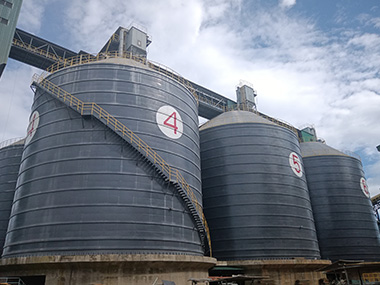

Steel Silo Radar Level Measurement: What Actually Works in Cement, Fly Ash, and Coal Storage
Radar level measurement in steel silos gives you continuous, non-contact readings that survive dust, condensation, and temperature swings that kill ultrasonic and capacitance probes. For bulk solids like cement, fly ash, coal, and slag, frequency-modulated continuous-wave (FMCW) radar at 78–80 GHz delivers ±2 mm accuracy even in heavy dust — and that's the technology we default to on every Manxing EPC project unless the material profile says otherwise.
Why Radar Wins for Bulk Solids in Steel Silos
The Dust Problem That Kills Other Technologies
Ultrasonic level sensors fail in cement silos. I've seen it a dozen times. The acoustic signal attenuates so fast in a dust cloud that the receiver picks up nothing but noise. Capacitance probes work until the material builds up on the probe itself — then you're measuring the coating, not the level. Laser sensors? Forget it during filling. The dust density in a cement silo during pneumatic conveying can hit 50,000 mg/m³. That's opaque.
Radar doesn't care. The 80 GHz signal penetrates dust that would blind every other technology. We installed radar units on a 4,000-tonne fly ash silo in Gujarat where the client had gone through three ultrasonic sensors in eight months. The radar's been running for three years without a single false echo. The maintenance manager still doesn't believe it.
Accuracy You Can Build a Process Around
At 80 GHz, the beam angle is narrow — typically 3° to 5° depending on the antenna. That matters inside a steel silo where you've got a cone bottom, maybe a central discharge chute, and walls that reflect signals like a funhouse mirror. A wide beam picks up the silo wall and gives you a level reading that jumps around by half a meter. A tight beam goes straight to the material surface and stays put.
Here's the thing. For inventory management, ±50 mm is fine. For automated filling control that prevents overfills and structural overload, you need ±10 mm or better. FMCW radar at 80 GHz gives you ±2 mm at distances up to 100 meters. That's not marketing — that's what we measure on commissioning with a tape measure and a level rod.
Temperature and Pressure Don't Phase It
Steel silos in direct sun can see internal temperatures of 60–80°C. In coal storage, you might have spontaneous heating pushing surface temperatures past 100°C. Radar electronics rated for -40°C to +80°C (or +200°C with an extended-temperature variant) handle that without drama. The signal doesn't care about air density changes the way ultrasonic does. And since it's non-contact, you're not putting a probe into an abrasive cement stream that'll wear through a steel rod in six months.
Choosing the Right Radar for Your Material
Dielectric Constant: The Number Nobody Checks
Radar reflects off the material surface based on the dielectric constant (DK) of the bulk solid. The higher the DK, the stronger the reflection. Cement has a DK of about 4–6. Fly ash sits around 3–5. Coal is tricky — 2.5 to 4 depending on moisture and rank. Below DK 2, you start losing reliable echoes.
This is where I see projects go wrong. A client in Indonesia ordered radar for a talc silo without checking the DK. Talc's around 1.5–2.5. The radar worked when the silo was full — strong echo from the large surface area. But at low levels, the echo disappeared into the noise. We had to retrofit a guided-wave radar with a stilling well. Cost them three weeks of downtime and a $12,000 change order.
Always check the material DK before specifying. If it's below 2.5, consider guided-wave radar (GWR) instead of free-space radar, or plan for a stilling well in the silo cone.
Frequency Selection: 80 GHz vs. 24 GHz
Twenty-four GHz radar was the industry standard for a decade. It works. But the beam angle at 24 GHz with a standard antenna is 10°–15°. In a narrow silo — say 3 meters diameter — that wide beam hits the walls and creates false echoes that the software has to filter out. Eighty GHz with a 3° beam avoids the walls entirely.
For silos under 15 meters tall and 4 meters diameter or larger, 24 GHz is adequate and cheaper. For anything taller, narrower, or with internal obstructions (ladders, aeration pipes, temperature probes), 80 GHz is the right call. The price gap has narrowed — 80 GHz units now run $1,800–$3,200 versus $1,200–$2,000 for 24 GHz. That's a 30–50% premium for a step change in reliability.
I'm not a fan of 10 GHz units for steel silos. The beam is so wide you're basically measuring the average level of the entire silo interior, including the cone, the walls, and whatever bird built a nest on the ladder last spring.
Antenna Material and Coating Build-Up
Cement and fly ash stick to everything. PTFE (Teflon) antenna housings resist build-up better than bare stainless steel, but in a high-moisture environment — think fly ash silo in monsoon season — even PTFE gets coated. Some manufacturers offer flush-mounted ceramic antennas that shed material naturally. We've had good results with those on slag and gypsum applications.
The self-cleaning function on modern radar units helps. It periodically boosts the transmitter power to burn off light coatings. But if you're dealing with material that cakes hard — wet fly ash, for instance — you need a physical cleaning schedule. We spec a quarterly antenna inspection on cement and fly ash silos. Takes 15 minutes with a manhole access. Skip it for two years and you'll wonder why your level readings are drifting.
Explosion Protection: Don't Skip This
Coal dust, fly ash, and some mineral powders are combustible. EN 14491 and ISO 15012 govern dust explosion protection in silos. Your radar needs to be ATEX or IECEx certified for the zone you're installing in. For coal silos, that's typically Zone 20/21 (dust). For cement, you might get away with non-hazardous area classification, but I'd still spec Ex-rated equipment. The cost difference is maybe $400 per unit. The insurance implications of getting it wrong are not worth calculating.
We had a project in Vietnam where the client saved money by buying non-Ex radar for a coal silo. The insurance inspector caught it during commissioning. Full replacement, six-week delay, and the client paid our standby rates while we waited. That "saving" cost them about $45,000.
Installation: Where Good Radar Goes Bad
Mounting Position and the Center-of-Silo Myth
Everyone wants to mount the radar dead center of the silo roof. Makes sense, right? The material surface is flatest in the middle. Except it's not. During filling, the material forms a cone — either a coming-in cone or a going-out cone depending on the fill/discharge pattern. A center-mounted radar sees the peak of that cone, which can be 1–3 meters above the average level.
The correct mounting point is offset from center by about one-third of the silo radius. That puts the beam on the slope of the cone where the level is closer to the true average. For a 6-meter diameter silo, that's roughly 1 meter off center. We mark this on every roof plan we issue.
Also — and this is basic but I still see it wrong — the radar must be mounted perpendicular to the material surface, not perpendicular to the roof. On a cone roof with a 15° slope, the radar needs to be tilted 15° from the roof plane. Use a mounting bracket with adjustable angle. Don't just bolt it flat to the roof and hope the software compensates.
Stilling Wells and Bypass Chambers
For materials with low dielectric constant or extreme dust conditions, a stilling well — a vertical pipe installed inside the silo — gives the radar a calm, dust-free measurement environment. The radar mounts on top of the well and measures the level inside the pipe, which tracks the silo level through a series of equalization holes.
The downside: stilling wells in abrasive service (crushed limestone, coal) wear through in 2–3 years. We use Schedule 80 pipe with a sacrificial liner. Budget for replacement every 36 months. A bypass chamber — an external standpipe connected to the silo — avoids the wear problem but introduces plugging risk with sticky materials. For cement and fly ash, I'd take the stilling well every time.
Cabling and Grounding
Radar units run on 4–20 mA with HART protocol, or increasingly on Modbus or Profibus. The cable run from silo roof to control room can be 200–400 meters. Use shielded twisted pair, ground the shield at one end only (the control room end), and keep the cable at least 300 mm away from power cables. I've seen VFD noise on an unshielded cable create a 30 mm oscillation in the level reading. The operator thought the silo was breathing.
Grounding the radar housing to the silo roof is mandatory. Steel silos are lightning targets. A direct strike induces enough voltage to fry the electronics through the mounting flange. We install a dedicated grounding bus bar on every silo roof, bonded to the lightning protection system per IEC 62305. The radar housing connects to that bus with a 6 mm² copper conductor. Not optional.
Calibration, Commissioning, and Ongoing Verification
Initial Calibration: Empty and Full
Calibrate with the silo empty first. Set the zero point at the bottom reference — usually the discharge flange or the top of the cone. Then fill to a known level and set the span. If you can't fill to a known level during commissioning (and you usually can't), use a manual tape measurement at a known distance from the radar. We carry a 50-meter certified tape on every commissioning trip.
The radar's internal echo mapping software needs to be configured during commissioning. It learns the silo geometry — roof height, cone angle, any obstructions — and filters out false echoes from ladders, pipes, and wall joints. This takes about 30 minutes per unit if you know what you're doing. The first time I did it on a project in Egypt, it took four hours because the manual was in German and my German is terrible.
Periodic Verification
Check the radar reading against a manual measurement every six months. On a 2,000-tonne cement silo, a 100 mm level error is about 15 tonnes of material. That's the difference between "we need to order more" and "we're out of cement and the batch plant is stopped." We include a dip wire or tape measure access point on every silo we build. It's a $200 line item that prevents $20,000 mistakes.
For critical applications — like a coal silo feeding a kiln — we recommend a redundant radar or a backup technology (guided-wave radar or a nuclear level switch). The cost of a kiln shutdown is $5,000–$15,000 per hour. Two radars at $2,500 each is cheap insurance.
Case Study: Fly Ash Silo Level Measurement Upgrade — Cement Plant, Philippines
A 3,500-tonne fly ash silo at a cement plant in Luzon was running with a single ultrasonic level sensor that failed every 4–6 weeks during the monsoon season. The plant was losing track of inventory and had two near-overfill incidents in one year. They called us in to redesign the level measurement system.
We replaced the ultrasonic with an 80 GHz FMCW radar, PTFE antenna, mounted 1.2 meters off-center on the silo roof. The silo is 18 meters tall, 5 meters diameter, with a central discharge chute and four aeration pipes running vertically along the walls. The 3° beam angle avoided all obstructions. We added a stilling well as a backup measurement path — 6-inch Schedule 40 stainless steel pipe with 10 mm equalization holes at three levels.
Commissioning took one day. We calibrated empty against the discharge flange, then verified at 25%, 50%, and 75% fill levels using a tape measurement through the manhole. The radar read within ±3 mm of the tape at all four points. The plant's DCS historian showed the level signal was stable to ±5 mm over a 72-hour continuous run — compared to the ultrasonic's ±50 mm noise floor.
Total cost: $2,800 for the radar, $1,200 for the stilling well, $600 for cabling and grounding. The plant's previous annual spend on ultrasonic replacements was $4,500. Payback period: eight months. That was two years ago. The radar hasn't been touched since.
Frequently Asked Questions
Can radar measure through foam or material dust during filling?
Yes, 80 GHz FMCW radar penetrates dust clouds that would stop every other technology. During pneumatic filling of a cement silo, dust concentrations can exceed 30,000 mg/m³. The radar signal passes through with minimal attenuation. Foam is a different story — thick foam on the material surface (common in some chemical and mineral applications) can absorb the radar signal. If you've got foam, test before you buy. Some manufacturers offer a "foam detection" mode that adjusts the signal processing, but it's not magic.
What's the maximum distance radar can measure in a steel silo?
Eighty GHz FMCW radar measures reliably up to 100 meters for bulk solids with a DK above 2. For cement and fly ash (DK 4–6), we've verified accurate readings at 60 meters. Beyond that, the echo gets weak and you need a high-sensitivity unit or a parabolic antenna. Most steel silos for industrial applications are under 40 meters tall, so range isn't usually the constraint. Beam angle and dust are the real challenges.
Do I need a different radar for a steel silo versus a concrete silo?
The silo wall material doesn't matter to the radar — it measures the distance to the material surface, not the wall. But steel silos are smoother internally than concrete, which means fewer false echoes from wall texture. Concrete silos with form-tie holes and surface irregularities can create a cluttered echo profile that requires more careful software configuration. The radar unit itself is identical. The difference is in the commissioning time — budget an extra hour per unit for concrete silos.
Manxing EPC Silo Projects: Integrated Level Measurement from Day One
At Manxing, we don't treat level measurement as an afterthought. It's part of the silo design from the first layout drawing. We specify the radar type, mounting position, stilling well geometry, cable routing, and DCS interface before the silo steel goes up. That means no field modifications, no "we'll figure it out during commissioning" surprises, and no change orders because the radar can't see past a pipe that was added in the field.
We've installed radar level systems on over 200 steel silos across cement, fly ash, coal, slag, and alumina applications in 30+ countries. Every system we deliver includes a calibrated echo profile, a commissioning report with verification measurements, and a maintenance schedule tailored to the material and environment.
If you're planning a new silo or upgrading an existing level measurement system, send us your material specs and silo dimensions. We'll spec the right radar, the right mounting, and the right backup — before the first bolt goes in. Contact Manxing's engineering team for a no-obligation technical review.
```