

How Capacitance Level Probes Actually Work in Steel Silos (And Where They Fail)
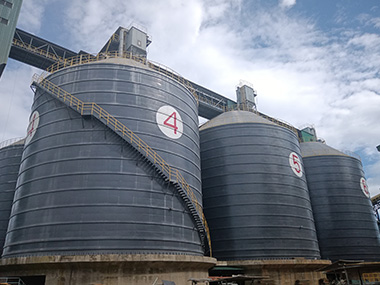
A capacitance level probe measures material level by detecting the dielectric difference between air and the bulk solid surrounding the probe rod. They work well in cement, fly ash, and coal silos — but fail badly in high-humidity slag or sticky ores unless you spec the right probe geometry and active shield. Here's what 15 years of commissioning these systems across 30+ countries has taught me about getting them right.
The Physics Behind Capacitance Level Measurement
How the dielectric constant drives the reading
Every bulk solid has a dielectric constant — a number that describes how much electrical charge it can store relative to a vacuum. Air sits at roughly 1.0. Portland cement powder runs between 4 and 8 depending on fineness and moisture. Fly ash typically lands around 5 to 12. Coal varies wildly from 3 to 15 depending on rank and water content.
The probe acts as one plate of a capacitor, the steel silo wall acts as the other, and the material between them is the dielectric. As material rises along the probe rod, the capacitance value changes. The transmitter converts that change into a 4–20 mA signal proportional to level. Simple in theory. Messy in practice.
Here's the thing — the relationship isn't perfectly linear. A 10 mm change in level near the bottom of a 30-metre silo produces a different capacitance delta than the same 10 mm change near the top. Most modern transmitters linearise this internally, but I've seen plants where nobody configured the silo geometry in the transmitter, so the DCS showed 60% full when the silo was actually at 42%. That's a $15,000 overfilling incident waiting to happen.
Why bulk solids are harder than liquids
Liquids are forgiving. They settle flat, they have consistent density, and they don't bridge. Bulk solids? They rat-hole, they segregate by particle size, and they build up on probe rods like concrete on a rebar. I remember a project in Vietnam where a cement plant installed a standard capacitance probe in a 2,500-tonne clinker silo. Within three weeks, the probe was coated with a 15 mm layer of calcium-silicate deposit that shifted the baseline capacitance by 30%. The level reading drifted upward even as the silo emptied. They were running blind.
The fix was an active-shield probe with a compensating electrode that measured the coating on the main rod and subtracted it from the reading. Cost about $800 more than the standard probe. Saved them from a $40,000 silo collapse.
Probe Selection — Getting the Geometry Right
Rod vs. cable probes for different silo heights
For silos under 15 metres, a rigid rod probe is usually the right call. It's simpler, cheaper, and you don't have to worry about the cable swinging in a pneumatic filling stream. I've used rod probes up to 6 metres in diameter cement silos with no issues — as long as the mounting is rigid and the probe doesn't touch the wall.
Once you go past 15 metres, cable probes take over. A weighted cable hangs from the top mount and stays taut under gravity. But here's where people mess up: in a silo with a central cone or a fluidising bottom, the cable can swing 300–500 mm off-centre during filling. If your silo diameter is only 4 metres, that swing puts the cable within 200 mm of the wall. At that distance, the wall's capacitance contribution skews the reading. I spec a stilling well for any cable probe in a silo under 6 metres diameter. Adds maybe $1,200 to the installation. Worth every cent.
The coating problem and active compensation
Some materials love to stick to probe surfaces. Wet fly ash, raw meal with 8% moisture, gypsum with its natural tackiness — these will build up on a standard probe rod and create a false high-level signal. The material is gone from the silo, but the coating remains, and the probe still reads "full."
Active-shield probes solve this with a third electrode — a shield that runs parallel to the main sensing rod. The transmitter drives the shield at the same potential as the main rod, so the electric field can't "see" the coating on the main rod. It only sees material beyond the shield. The coating becomes electrically invisible. This isn't marketing fluff — I've verified it on-site with a multimeter and a bucket of wet cement slurry. The reading stayed within 2% even with 20 mm of buildup on the rod.
Downside: active-shield probes cost 40–60% more than standard probes. And they need a transmitter that supports the shield drive — not all do. Check the datasheet before you spec.
Installation Mistakes That Ruin Accuracy
Mounting position and angle considerations
The probe should mount at the silo top, offset from centre by at least one-third of the silo radius. Why? Because material doesn't fill flat. It forms a cone — either a positive cone (material piles higher in the centre) or a negative cone (material slides toward the walls). If you mount dead centre, you're measuring the peak of the cone, not the average level. That can be off by 15–25% from the actual volume.
I spec the probe at 0.4R from the wall — 40% of the radius in from the shell. That position tracks the average level within 5% for most materials. For silos with pneumatic filling from one side, I move the probe to the opposite side of the inlet. The material stream creates a slope, and you want to measure on the shallow side, not the pile.
Angle matters too. The probe must be vertical — within 2 degrees. In a 20-metre silo, a 5-degree tilt puts the bottom of a rod probe 1.7 metres off-axis. That's enough to hit a wall, a structure, or a fluidising pad. I've seen a probe bent 30 degrees off-vertical because the mounting flange was welded to a roof that deflected 40 mm under snow load. The probe touched the wall and shorted out. Took three days to pull it and straighten it.
Grounding and the steel silo shell
The steel silo wall is the reference electrode for the capacitance measurement. If the probe isn't properly grounded to the silo shell, the reading drifts with humidity, static charge, and nearby electrical noise. I've seen a probe in a coal silo in Inner Mongolia swing 20% on a dry winter day because static charge built up on an ungrounded flange.
The fix is a dedicated ground wire — 6 mm² copper minimum — bolted directly to the silo shell with a star washer that bites through paint and corrosion. Not to the mounting flange. Not to a nearby pipe. To the shell itself. And the transmitter's ground terminal must connect to the same point. Ground loops in a steel silo are real, and they'll drive you crazy if you don't think about them during design.
Calibration and Field Verification
Dry vs. wet calibration methods
Dry calibration means setting the zero and span with the probe in air and then with a known material covering the rod. You can do this with the probe removed — dip it in a bucket of the actual material, measure the capacitance, and set the span. It's fast and works for materials with stable dielectric constants like dry cement or coal.
Wet calibration means calibrating with the probe installed and the silo at a known level. This is the only reliable method for materials with variable moisture — raw meal, wet fly ash, slag with 5–12% water content. The dielectric constant changes with moisture, and a dry calibration in a bucket of bone-dry material won't match the real reading in a silo where the material has 6% moisture. I've seen 15% errors from this mismatch.
For wet calibration, you need a reliable reference point. A radar level gauge on the same silo works. So does a weigh system if the silo is on load cells. If neither exists, you can use a tape drop — lower a weighted tape from the top until it hits the material surface. It's low-tech, but it's accurate to ±50 mm in a 20-metre silo. That's good enough for a field calibration.
When to recalibrate (and when you're wasting time)
Recalibrate when the material changes. If a cement silo switches from OPC to fly ash, the dielectric constant shifts from ~6 to ~10. That's a 67% change in the capacitance-per-metre value. Your span setting is now wrong by a similar margin. Recalibrate.
Don't recalibrate just because the reading "looks off." I've been called to plants where the operator swore the probe was reading 10% high. Turned out the silo had a rat-hole — a stable channel of material running from the outlet to the surface. The probe was reading the surface level correctly. The volume calculation was wrong because the rat-hole meant the silo held less material than the level suggested. The probe was fine. The volume table was wrong. Recalibrating the probe wouldn't have helped.
Annual recalibration is a reasonable schedule for stable materials. Quarterly for anything with variable moisture or composition. Monthly if you're dealing with sticky materials that coat the probe — even with active shields, extreme buildup can eventually overwhelm the compensation.
Where Capacitance Probes Win — And Where They Don't
Best applications: cement, fly ash, coal
Capacitance probes are the workhorse of the cement industry for a reason. Dry cement powder has a stable dielectric constant, low moisture, and minimal coating tendency. A standard rod probe in a cement silo will run for 5–8 years with nothing more than an annual visual inspection. I've seen probes installed in 2006 still giving accurate readings in 2024. The electronics in the transmitter head might need replacement after 10–12 years, but the probe rod itself is essentially permanent.
Coal is similar, though moisture is more variable. A thermal power plant in Jiangsu runs 12 capacitance probes on their coal silos — 8 metres diameter, 22 metres tall. They recalibrate every six months when they switch from low-moisture anthracite (3% water) to high-moisture lignite (25% water). The dielectric constant shifts from ~4 to ~12. Without recalibration, the level reading would be off by 20%. With it, they hold ±3% accuracy.
Worst applications: sticky slag, high-moisture materials
Ground granulated blast furnace slag with 8–12% moisture is a nightmare for capacitance probes. It coats the rod, it bridges between the rod and the wall, and its dielectric constant swings wildly with moisture content. I've tried active-shield probes in slag silos and they work — for about six months. Then the coating builds up on the shield itself, and the compensation fails. You end up with a probe that reads 80% full when the silo is empty.
For slag, I spec guided radar (TDR) instead. It's 3–4 times the cost of a capacitance probe, but it doesn't care about coating, moisture, or dielectric constant. The radar pulse reflects off the material surface regardless of what's stuck to the antenna. In a 5,000-tonne slag silo, the extra $2,000 for radar over capacitance pays for itself in the first year by eliminating false readings and manual tape drops.
High-moisture raw meal (10–15% water) is another problem child. The material is conductive enough that it can create a short between the probe rod and the silo wall if the coating is thick enough. I've seen probes in raw meal silos fail completely — the transmitter reads 100% all the time because the coating creates a permanent conductive path. The only fix is to pull the probe and clean it. In a plant running 24/7, that means a silo outage every 4–6 weeks. Not acceptable.
Case Study: Cement Plant in Shandong — Probe Failure and Redesign
A 5,000-tonne cement silo in Shandong province was experiencing intermittent level spikes — the DCS would show 95% full for 10 minutes, then drop back to 60%. The plant thought the probe was faulty. They replaced it twice. Same problem.
I visited the site in August 2022. Ambient temperature was 38°C, and the silo roof was hitting 55°C in direct sun. The probe was a standard rod type, mounted dead centre, with a transmitter that had no temperature compensation in the output circuit. The capacitance reading was drifting with roof temperature — as the steel shell expanded during the day, the distance between the probe and the wall changed by 2–3 mm. That tiny change was enough to shift the reading by 15% because the transmitter's span was set too tight.
The fix was threefold: moved the probe to 0.4R from the wall, replaced the transmitter with one that had automatic temperature compensation, and widened the span setting by 20% to give the signal more headroom. Total cost: $1,800 for the new transmitter and a day of labour. The spikes disappeared. The plant had spent $4,200 replacing probes that were never broken.
Frequently Asked Questions
Q: Can a capacitance probe measure level in a steel silo that's 30 metres tall?
Yes, but use a cable probe, not a rod. A 30-metre rod probe would need to be shipped in sections and welded on-site — impractical and expensive. A cable probe with a bottom weight hangs from the top mount and handles 30 metres without issue. Just make sure the silo diameter is at least 6 metres, or spec a stilling well to prevent the cable from swinging into the wall during filling. For silos over 25 metres, I also recommend a guided radar probe as a backup — the capacitance probe handles day-to-day level, and the radar provides a cross-check during filling when the cable might swing.
Q: What accuracy can I realistically expect from a capacitance probe in a cement silo?
±2–3% of the probe length for dry, stable materials like cement or coal. That's ±600 mm on a 20-metre probe. For materials with variable moisture — raw meal, wet fly ash — expect ±5–8% unless you recalibrate every time the moisture changes. The probe itself is capable of ±1% repeatability. The error comes from material variability, not the instrument. If you need ±1% volume accuracy, put the silo on load cells and use the capacitance probe for trending only.
Q: How do I know if my capacitance probe is coated and giving false readings?
Compare the probe reading against an independent reference — a radar gauge, a weigh system, or a manual tape drop. If the capacitance probe consistently reads 5–10% higher than the reference, coating is the likely culprit. Another telltale sign: the reading doesn't drop when the silo is emptied. If the silo is at 0% on the weigh system but the capacitance probe still shows 15–20%, there's material stuck to the rod. Pull the probe and inspect it. If you see a crust of hardened material, you need an active-shield probe or a different measurement technology.
Need Help Specifying Level Measurement for Your Silo Project?
Manxing has designed and commissioned level measurement systems for over 200 industrial silos across cement, fly ash, coal, and slag applications. We don't just supply equipment — we specify the right probe geometry, mounting position, and transmitter configuration for your specific material and silo geometry. Contact our engineering team for a free level measurement review on your next project.