
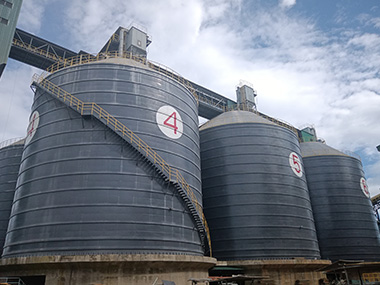

Cold Weather Silo Installation: What Changes When the Temperature Drops Below Zero
Steel doesn't care about your schedule. When you're erecting a 5,000-tonne cement silo at minus 20°C, the material behaves differently, welds crack where they wouldn't in summer, and concrete foundations take twice as long to cure. Here's what actually changes — and what we've learned from installing silos across Siberia, Inner Mongolia, and the Canadian prairies.
1. Steel Behavior Below the Ductile-to-Brittle Transition Point
1.1 The Temperature Threshold Nobody Talks About
Structural carbon steel — S355, Q345B, ASTM A572 Grade 50 — has a ductile-to-brittle transition zone. For most silo-grade plates, that's between minus 20°C and minus 40°C depending on thickness. Above it, the steel absorbs energy through deformation. Below it, a crack propagates at roughly the speed of sound through the crystal lattice.
Here's what that means on site: a 16mm wall plate that would shrug off an impact load at 15°C can fracture clean through at minus 30°C. Not bend. Not dent. Fracture. We've seen it happen during a lifting operation in Kazakhstan — a sling shifted during a bin section raise, the plate caught the edge of the crane hook, and it split like glass. Nobody was hurt, but that section was scrapped. Cost us three days and about $18,000 in replacement steel.
1.2 Material Selection for Cold Climates
If your design temperature drops below minus 20°C, you need normalized or thermomechanically rolled steel with guaranteed impact toughness at the minimum service temperature. EN 10025-3 (S355NL, S420NL) specifies Charpy V-notch impact testing at minus 20°C or minus 50°C. For ASTM grades, look at A572 with supplementary requirement S5 — that's the impact test add-on.
The price premium is real: normalized grades run 12–18% more than standard hot-rolled plate. On a 3,000-tonne silo, that's an extra $45,000–$70,000 in material cost. I've had procurement teams push back on this. Then I show them the Kazakhstan photos. The conversation ends pretty quickly.
1.3 Handling and Storage in the Cold
Steel stored below minus 15°C needs to warm up before you cut or weld it. Not because the steel "needs" to be warm — but because condensation forms on the surface when you bring it into a heated area, and that moisture is the root cause of hydrogen-induced cracking in welds. We store plate sections in covered laydown areas and bring them into the heated zone at least 24 hours before fabrication. In Ulaanbaatar, where we did a fly ash silo project in January, ambient was minus 35°C. The laydown tent with two propane heaters kept the steel at around plus 5°C. It cost about $200/day in fuel. Worth every cent.
2. Welding in Sub-Zero Conditions
2.1 Preheat Requirements Get Serious
At room temperature, a 20mm S355 plate might need 25–50°C preheat. At minus 10°C ambient, that jumps to 75–100°C. At minus 25°C, you're looking at 125–150°C minimum. The formula in EN 1011-2 accounts for ambient temperature, plate thickness, hydrogen content of the filler metal, and heat input. But honestly? Most site crews don't run the calculation. They use the tables in the WPS (Welding Procedure Specification) and add a safety margin.
Our standard WPS for cold-weather silo erection specifies preheat to 100°C minimum for all structural welds when ambient is below minus 10°C. We use propane torches with flame spreaders — not the pencil-tip torches, those create localized overheating. Temperature crayons (Tempilstiks) are cheap and reliable. A box of 100 crayons costs about $150 and covers an entire project.
2.2 Interpass Temperature and Cooling Rate
Here's the thing about cold-weather welding: the problem isn't just getting the steel hot enough to start. It's keeping it from cooling too fast between passes. In a minus 20°C wind, a 25mm fillet weld can drop 200°C in 90 seconds. That rapid cooling transforms the microstructure — you get martensite in the HAZ (heat-affected zone), and martensite is hard, brittle, and crack-prone.
The fix is straightforward: weld bays enclosed with tarps and portable heaters. We use 50,000 BTU propane heaters — the kind with the fan built in — and maintain an enclosure temperature of at least plus 5°C. On a 15-meter diameter silo, that means four heaters running continuously around the weld seam. Fuel consumption is roughly 2.5 kg/hour per heater. Over a typical 30-day welding campaign, you're burning through about 7 tonnes of propane just for preheat and enclosure heating. Budget for it.
2.3 Filler Metal Selection
Low-hydrogen processes only. No exceptions. That means SMAW (stick welding) with E7018 or E8018 electrodes — not E6010 or E6011, those are cellulosic and run 20–40 ml/100g diffusible hydrogen. For GMAW (MIG), use ER70S-6 or ER80S-D2 with 75% Ar / 25% CO₂ shielding gas. FCAW (flux-cored) is fine with E71T-1 or E81T1-Ni1 wires, but keep the flux dry. Store electrodes in heated cabinets at 120–150°C. Once they're out of the oven, they have a maximum exposure time of 2 hours before they need re-baking. In cold weather, that window shrinks because the rod cools faster in your hand.
I remember a project in Manchuria — minus 28°C, wind chill pushing minus 40. The crew was running E7018s straight from the box. No oven on site. We found transverse cracks in three circumferential seam welds during UT inspection. Cut them out, re-welded with properly baked electrodes, and passed the second time. The rework cost was about $35,000 and a week of schedule. The electrode oven would have cost $800.
3. Concrete Foundations in Freezing Conditions
3.1 The 5°C Rule and What Happens When You Ignore It
Concrete doesn't "dry" — it hydrates. That chemical reaction between cement and water slows dramatically below 10°C and essentially stops below minus 3°C. ACI 306 (Cold Weather Concreting) specifies that concrete must be placed and maintained above 5°C for at least the first 48 hours to achieve minimum strength gain. If it freezes before reaching 3.5 MPa compressive strength, the ice crystals disrupt the cement paste matrix and you lose 20–40% of the 28-day strength. Permanently.
For a typical silo ring foundation — say, 18-meter diameter, 600mm thick, C35/45 concrete — that's about 150 m³ of concrete. The heat of hydration alone keeps the core warm for a while, but the exposed surfaces are vulnerable. We use insulated blankets (R-value of at least 2.0 m²·K/W) over the top surface and around the perimeter. In extreme cold, we add hydronic heating pipes embedded in the foundation — a closed-loop system circulating glycol at 40°C. It adds about $12–15/m³ to the concrete cost, but it eliminates the risk entirely.
3.2 Ground Thaw and Frost Heave
If you're pouring a foundation in permafrost or seasonally frozen ground, the ground itself is the problem. Frost heave can exert upward pressure of 100–200 kPa on a foundation. For a silo that weighs 8,000 tonnes empty, that's manageable. But during construction, before the silo is loaded, the foundation is light. A partially completed ring beam with only the wall steel erected might weigh 200 tonnes. Frost heave can lift it.
The standard solution is to excavate below the frost line and replace with non-frost-susceptible material — clean gravel or crushed rock. In northern Canada, frost penetration can be 2.5–3.5 meters. That's a lot of excavation. Alternatively, you can insulate the ground surface with XPS (extruded polystyrene) boards — 100mm of XPS provides about R-3.5, which is enough to prevent freezing under the foundation in most climates down to minus 25°C. We used this approach on a slag silo in Alberta: 150mm XPS under the entire ring foundation, plus 50mm around the perimeter extending 2 meters out. Total insulation cost was about $22,000. The alternative — excavating 3 meters deep — was estimated at $180,000.
3.3 Curing Time Extensions
At 20°C, a C35/45 concrete foundation reaches 70% of its 28-day strength in about 7 days. At 5°C, that stretches to 14–16 days. At 0°C, you're looking at 21–28 days. If you're on a tight schedule, this matters. We typically specify high-early-strength cement (Type III in ASTM C150, or CEM I 52.5N in EN 197-1) for cold-weather pours. It costs 15–20% more than standard Type I/II, but it gains strength 30–40% faster at low temperatures. Combined with ground insulation and surface blankets, we've achieved 70% strength in 10 days at an average ambient of minus 5°C. That was enough to start bolting up the first wall section.
4. Bolted Connections and Torque in the Cold
4.1 Friction Coefficients Change with Temperature
High-strength bolted connections (ASTM A325 or A490, EN 14399 preloaded bolts) rely on friction between faying surfaces. The slip coefficient — Class A surface, galvanized, or blast-cleaned with inorganic zinc silicate — is calibrated at room temperature. Below minus 10°C, surface oxides behave differently, and any moisture on the surface freezes into a thin ice layer that acts as a lubricant. The slip coefficient can drop by 15–25%.
Practical implication: if your slip-critical connection is designed for a service load of 80% of the slip resistance at room temperature, it might only have 60% margin at minus 25°C. For silo structures, this matters most at the roof-to-wall connection and at hopper support brackets. We specify that all slip-critical bolts be torqued at ambient temperatures above 0°C, or that the connection surfaces be pre-heated and dried before assembly. If that's not possible, we increase the bolt count by 20% as a safety factor.
4.2 Torque-Tension Relationship
The nut factor (K in the torque-tension equation T = K·D·P) changes with temperature. Lubricants thicken. Bolt steel contracts. At minus 20°C, the same torque wrench setting produces about 10–15% less preload than at 20°C. For a 24mm A325 bolt torqued to 500 N·m at room temperature, you might get 425 N·m of equivalent preload at minus 20°C.
The fix: calibrate your torque wrenches at the actual working temperature, or use direct tension indicators (DTIs) — those washers with the little bumps that flatten under load. They're temperature-independent and give you a direct visual confirmation of achieved preload. We use DTIs on every critical connection in cold-weather projects. They cost about $3–5 each versus $1.50 for standard washers, but they eliminate the guesswork.
5. Erection Sequence Adjustments
5.1 Crane Operations in Cold Weather
Hydraulic crane systems lose efficiency in the cold. Hydraulic oil viscosity doubles between 20°C and minus 20°C. That means slower boom response, reduced lifting capacity (typically 5–10% derating below minus 15°C), and potential cavitation in the pumps. We specify ISO VG 32 hydraulic oil for winter operations instead of the standard VG 46. It's thinner at low temperatures and flows better.
Steel wire rope also changes. At minus 30°C, the lubricant inside the rope stiffens, reducing flexibility. A rope that bends easily at room temperature can kink or birdcage when cold. We inspect all rigging before each lift in cold weather — not just visual, but by running the rope through a block and checking for stiffness or irregular lay. Any rope that shows signs of internal stiffness gets pulled from service.
5.2 Thermal Expansion Gaps
A 30-meter tall steel silo at 20°C will shrink by about 7mm per 10 meters of height when the temperature drops to minus 30°C. That's roughly 21mm of total height change. Not much in absolute terms, but it affects the fit-up of bolted connections, the alignment of roof structures, and the seal at the roof-to-wall junction.
We design erection gaps into the sequence: roof rafters are set with 5mm extra clearance at each connection point when erected in cold weather. The silo wall sections are aligned at the ambient temperature they'll be erected at — not adjusted to "summer dimensions." This sounds obvious, but I've seen crews try to force-fit panels to match shop dimensions, only to have the whole structure bind up and require re-drilling in the spring.
6. Case Study: 4,000-Tonne Clinker Silo — Heihe, China
Heihe sits on the Russian border, across from Blagoveshchensk. Winter design temperature: minus 38°C. We were contracted to erect a 4,000-tonne clinker silo — 22-meter diameter, 34-meter height to eaves — between November and February.
The foundation was poured in late October, before ground freeze, using CEM I 52.5N cement with 150mm XPS ground insulation and surface blankets. We achieved 75% of design strength in 12 days. Steel erection started November 15th with an average ambient of minus 18°C, dropping to minus 32°C by December.
We used S355NL plate (impact tested at minus 50°C) for all wall sections below the 10-meter mark — that's where the highest bending moments occur during erection. Welding was done inside tented enclosures with four propane heaters per bay. Preheat was maintained at 100°C minimum, verified with Tempilstiks. All structural welds were 100% UT inspected per EN ISO 17640, Class B acceptance. We had a 4% rejection rate — mostly hydrogen-induced underbead cracks in the first week before the crew got the preheat discipline dialed in. After that, rejection dropped to under 1%.
Total project duration: 94 days. Budget impact of cold-weather measures: approximately $340,000 on a $4.2 million contract — about 8%. The client's alternative was to wait until May. At $180,000/month in lost production, waiting would have cost $900,000. The math was clear.
FAQ
Q: Can you weld structural steel at minus 30°C?
Yes, but only with proper preheat (125–150°C minimum for plate thicknesses above 16mm), low-hydrogen electrodes stored in heated cabinets, and enclosed weld bays maintained above plus 5°C. Without these measures, you're gambling with hydrogen cracking. EN 1011-2 provides the preheat calculation methodology. We've welded successfully at minus 35°C — it's not the temperature that kills you, it's the cooling rate.
Q: How much does cold-weather construction add to a silo project budget?
Typically 6–12% of total EPC cost, depending on severity and duration. The major cost drivers are: heated enclosures and fuel ($80,000–$150,000 for a mid-size silo), normalized steel premium ($40,000–$80,000), foundation insulation and heating ($20,000–$50,000), and extended labor hours due to slower work pace ($30,000–$60,000). In most cases, this is still cheaper than delaying construction to spring.
Q: What's the lowest temperature at which you can pour concrete for a silo foundation?
Technically, with enough insulation and heating, you can pour at any temperature. Practically, we've poured at minus 22°C ambient using a combination of: heated aggregate and mixing water (concrete placed at 25°C), 150mm XPS under the foundation, insulated blankets on top, and hydronic heating pipes embedded in the slab. The concrete never dropped below 8°C during the first 72 hours. Below minus 25°C, the logistics of keeping materials warm become prohibitive — we'd recommend waiting or using a ground thaw system with heated enclosures over the entire foundation area.
Planning a Silo Project in a Cold Climate?
We've designed and erected silos across 30+ countries, including projects in Siberia, northern China, Canada, and Scandinavia. Our engineering team accounts for low-temperature steel behavior, cold-weather welding protocols, and frozen-ground foundation design from day one — not as an afterthought.
Contact Manxing for a project-specific cold-weather engineering assessment. We'll tell you what it actually costs — and what it costs if you don't plan for it.