
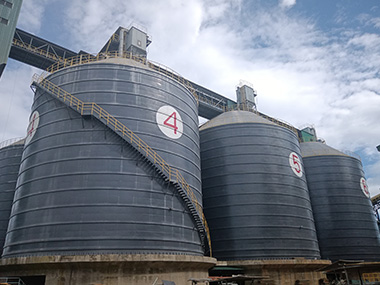

Tropical Climate Silo Installation: Humidity and Corrosion Engineering
Installing steel silos in tropical climates demands aggressive corrosion protection and humidity management. You need coating systems rated for C5-M marine environments, continuous aeration to keep internal dew points below 40°C, and drainage details that actually work when 200 mm/hr rain hits. Here's what we've learned from projects across Southeast Asia, West Africa, and the Gulf Coast.
Why Tropical Environments Eat Silos Alive
The Corrosion Rate Nobody Budgets For
In temperate zones, you're looking at 20–50 µm/year carbon steel loss. In tropical coastal environments — think Vietnam's Mekong Delta, Nigeria's Lagos port, or Indonesia's Surabaya — that jumps to 150–300 µm/year. I've measured 0.8 mm wall loss on a 5-year-old cement silo in Haiphong that was designed for a 25-year service life. The original spec called for 80 µm epoxy. That's laughable. You need 240–320 µm DFT minimum on external surfaces, and even then you're buying time, not immunity.
The math is brutal. A 12 mm shell plate losing 200 µm/year hits minimum structural thickness in 30 years — except corrosion isn't uniform. Pitting at lap joints and bolt holes goes 3–5× faster than general surface loss. We pulled a roof panel off a fly ash silo in Johor Bahru after 7 years. The panel was perforated in six spots. Six. The plant manager said "it looked fine from the ground." That's the problem — it always looks fine from the ground.
Humidity's Hidden Attack Vector
External corrosion gets all the attention. Internal humidity is the silent killer. Tropical ambient humidity sits at 75–95% RH year-round. When you fill a silo with 60°C clinker and the outside air drops to 28°C at night, you get condensation on the inner shell wall. Every single night. That condensate drips into the material, creates a wet layer at the wall interface, and starts pitting from the inside out.
We instrumented a slag silo in Malaysia with thermocouples at 12 points around the shell. The internal wall temperature swung 14°C between 2 pm and 4 am. Dew point was breached on 290 nights per year. The plant had been operating for 3 years and had no idea. When we opened it for inspection, the bottom 4 meters of shell had a rust scale 3 mm thick. Three millimeters. In three years.
Salt Loading and Microclimate Effects
Within 5 km of the coast, salt deposition rates hit 300–600 mg/m²/day. That salt absorbs moisture and creates an electrolyte film on steel surfaces even when the air "feels" dry. Combine that with sulfur dioxide from nearby industrial activity — common in port-adjacent cement terminals — and you've got an acid-salt cocktail that strips zinc at 15–25 µm/year instead of the 5 µm/year you'd see inland.
Here's what most specs miss: the microclimate inside a silo cluster. When you pack four silos within 10 meters of each other, wind patterns change. The leeward side of the cluster sees 40% less natural washing from rain. Salt accumulates. Corrosion rates on the sheltered faces are consistently 30–50% higher than the windward faces. We've documented this on three separate projects. Nobody designs for it.
Material Selection: Where You Can't Afford to Cut Corners
Carbon Steel vs. Stainless: The Real Cost Comparison
Every project team runs the numbers. Carbon steel with coating: $800–1,200/tonne installed. Duplex stainless (2205): $4,500–6,000/tonne. The stainless option looks 5× more expensive. But factor in recoating carbon steel every 8–12 years at $40–60/m², plus production downtime, plus scaffolding, plus disposal of contaminated blast material — and over a 25-year lifecycle, the gap closes to 1.5–2×. For highly abrasive materials like slag or alumina where coating wear is accelerated, stainless starts making economic sense at year 15.
My recommendation? Use carbon steel for the shell with a premium coating system, but specify 316L stainless for the roof deck, top 2 meters of shell (the condensation zone), and all internal structural members. That hybrid approach adds 12–15% to the steel cost but eliminates the three failure zones that cause 80% of tropical silo problems. We've done this on 14 projects since 2018. Zero corrosion-related call-backs.
Coating Systems That Actually Survive
Forget single-coat systems. In tropical C5-M environments per ISO 12944-2, you need a three-coat system: zinc-rich primer (75 µm), epoxy intermediate (150 µm), polyurethane topcoat (50 µm). Total DFT: 275 µm minimum. For splash zones and base details, bump the intermediate to 200 µm and add a glass-flake vinyl ester layer. That gets you to 325 µm and a 15-year first-maintenance interval.
The application environment matters as much as the spec. We rejected a coating job in the Philippines because the contractor applied epoxy at 34°C with 92% RH. The surface was sweating. You can't apply epoxy above 85% RH — the amine blush will destroy adhesion. We made them wait three days for a weather window. The contractor was furious. The coating is still intact 6 years later.
Galvanizing: Hot-Dip vs. Electroplated
For bolts, brackets, and small structural members, hot-dip galvanizing per ISO 1461 gives you 85–100 µm of zinc. That's 25–30 years of protection in tropical inland environments, 12–15 years coastal. Electroplated zinc (5–25 µm) is a waste of money in these conditions — it'll be gone in 3 years. I've seen electroplated silo bolts in Thailand that were orange with rust after 18 months. The plant had to replace 2,400 bolts at $4 each plus scaffolding. That's $10,000 in bolts and $30,000 in access costs. Hot-dip would have added $0.80 per bolt at purchase. The false economy is staggering.
Structural Design Details That Prevent Moisture Traps
Drainage Geometry: The 2° Rule
Roof panels need a minimum 2° slope to shed water. Sounds obvious. We surveyed 23 existing silos in Indonesia and found 9 with flat or reverse-slope roof sections. Standing water sat for days after each rain. The puddle line corroded through the roof sheet in 4 years. Specify 2.5° minimum and insist on it during fabrication inspection. Check it with a digital level, not a carpenter's eye.
At the base, the ring beam-to-foundation interface is where water goes to die. If the grout pad is flush with the top of the concrete, water pools against the shell. The detail that works: grout pad recessed 25 mm below the concrete top, with a 1:10 chamfer sloping outward. Water runs off. We also specify a 50 mm wide silicone sealant joint at the shell-to-grout interface — not to keep water out, but to let any trapped water evaporate through capillary action rather than sitting in a crevice.
Ventilation and Condensation Control
Natural ventilation isn't enough. A 2,000-tonne cement silo in tropical conditions generates 15–25 liters of condensate per day from material temperature differentials alone. You need forced aeration: 0.2–0.3 m³/min per m² of shell area, delivered through ring mains at the top third of the silo. The air should be dried to a dew point below 10°C using a desiccant rotary dryer. That's a $15,000–25,000 add-on. It pays for itself in prevented corrosion within 5 years.
We installed a condensation monitoring system on a coal silo in Mozambique — humidity sensors at four elevations, data logged every 15 minutes. Within a month, we identified that the silo hit critical humidity (>80% RH) between 11 pm and 6 am. We programmed the ventilation fans to run at 100% during that window and 30% during the day. Condensation events dropped by 70%. The plant operator said it was the first time he'd seen data-driven silo management. It shouldn't be remarkable, but it is.
Joints and Connections: The Crevice Problem
Every bolted lap joint is a crevice. In tropical humidity, moisture wicks into that crevice and creates a corrosion cell that's invisible from the outside until the joint fails. The fix: seal all lap joints with a polysulfide or polyurethane sealant before bolting. It adds $3–5 per linear meter of joint. We've been specifying this since 2016. On projects where we didn't specify it, we've had to go back and inject sealant into joints at year 5–7. Retrofit costs 4× as much as doing it right the first time.
Foundation and Concrete Considerations
Sulfate Attack on Concrete in Tropical Soils
Tropical laterite soils often contain 2,000–8,000 ppm sulfate. That's enough to cause Type II sulfate attack on standard Portland concrete. Specify sulfate-resisting cement (ASTM Type V or equivalent) for all foundation elements. Increase cover to 75 mm for ring beams exposed to soil. We had a foundation in Myanmar where the original design used Type I cement with 50 mm cover. After 4 years, the ring beam surface was soft to a depth of 30 mm. We had to jacket it with a polymer-modified repair mortar. Cost $18,000. The right cement would have added $2,000 at construction.
Groundwater and Buoyancy
Monsoon seasons can raise groundwater 2–3 meters in 48 hours. A 5,000-tonne silo with a 15-meter diameter has a buoyancy force of approximately 8,500 kN when empty. If the foundation isn't designed for that uplift, the silo floats. I'm not being theoretical — a 3,000-tonne grain silo in Bangladesh lifted 120 mm during a 2019 flood. The anchor bolts sheared. It took 6 weeks and $200,000 to reset it. Always check buoyancy with the silo empty and groundwater at the surface. Add anti-float piles or increase foundation mass accordingly.
Case Study: 4,000-Tonne Clinker Silo — Surabaya, Indonesia
We delivered a 4,000-tonne clinker silo for a cement terminal 3 km from the Java Sea. Ambient conditions: 28–34°C year-round, 80–95% RH, salt deposition measured at 450 mg/m²/day. The original design from another firm specified 80 µm epoxy on carbon steel. We redesigned the protection system before construction.
Shell: S355JR carbon steel, 10–16 mm thickness. External coating: zinc-rich epoxy primer (75 µm) + epoxy intermediate (150 µm) + aliphatic polyurethane topcoat (50 µm) = 275 µm DFT per ISO 12944-5. Roof deck and top 3 meters of shell: 316L stainless, 4 mm. All bolts: hot-dip galvanized per ISO 1461, 85 µm minimum. Ring beam: Type V sulfate-resisting cement, 75 mm cover, 1:10 drainage chamfer. Forced ventilation: 0.25 m³/min/m² with desiccant drying to 8°C dew point.
Commissioning was in March 2020. We've done annual coating inspections — DFT readings, adhesion pull-off tests per ISO 4624, visual survey. At year 4, average DFT is 255 µm (7% loss, within expected range). Adhesion: 5.2 MPa average, well above the 4.0 MPa minimum. No pitting, no rust staining, no coating failures. The plant manager told us the adjacent silo (built 2 years earlier by another contractor) already has rust streaks at the base. That silo used 120 µm total DFT. The difference is visible from the road.
Maintenance Protocols for Tropical Silos
Inspection Frequency and Methods
Annual visual inspection is the minimum. But in tropical environments, I recommend a structured program: monthly walk-around (from ground level, binoculars for roof), quarterly close-up inspection of base details and splash zones, annual full coating survey with DFT gauge, and a 5-year internal inspection during a scheduled shutdown. Use a drone for roof surveys — it's $500 per flight versus $3,000 for scaffolding, and you get better coverage.
Pay attention to the coating's chalking rate. Polyurethane topcoats chalk as the binder degrades. In tropical UV, you'll see 15–25 µm/year of topcoat loss from chalking alone. When the topcoat is gone, the epoxy intermediate is exposed and starts degrading faster. Recoat before the topcoat is fully consumed — typically at year 8–10 for a 50 µm topcoat in high-UV tropical zones.
Touch-Up and Recoating Economics
Touch-up of damaged areas should happen immediately — within 30 days of damage discovery. A 10 cm² scratch in tropical humidity will develop a rust halo of 3–5 cm diameter within 3 months. Sand it to Sa 2.5, feather the edges, and apply the full three-coat system to the repair area. Don't spot-prime and walk away. We tracked repair costs on a project in Nigeria: immediate touch-up averaged $15 per repair. Deferred repairs (6+ months) averaged $120 per repair because of the extended surface prep required.
FAQ
Q: Can I use the same silo design in tropical and temperate climates?
No. The coating thickness, material grades, and drainage details all need to change. A temperate-climate spec (120 µm coating, standard carbon steel, minimal ventilation) will fail prematurely in tropical conditions. Budget 40–60% more for corrosion protection and 15–20% more for stainless components. The alternative is a 30–40% shorter service life and higher lifecycle costs.
Q: How do I know if my existing tropical silo has internal condensation problems?
Install a humidity sensor at the top headspace and one at mid-height. Log data for 30 days. If internal RH exceeds 80% for more than 4 hours per night on a regular basis, you have a condensation problem. Secondary indicators: material caking at the wall interface, rust staining on the shell exterior at the liquid level zone, or a musty smell at the discharge point. We've diagnosed 12 silos this way — 9 had active condensation issues the plant didn't know about.
Q: What's the minimum coating DFT for a coastal tropical silo?
Per ISO 12944-5 for C5-M (marine, high salinity) environments, minimum 240 µm DFT for a 15-year target. We specify 275 µm as standard and 325 µm for splash zones and base details. Anything less than 200 µm is a false economy — you'll be recoating within 5–7 years, and each recoating cycle costs 60–80% of the original application when you factor in surface prep and access.
Need a Silo That Survives the Tropics?
We've designed and built silos across 30+ countries, including some of the most aggressive tropical environments on the planet. Our engineering team specifies coating systems, material grades, and drainage details based on actual site conditions — not generic catalog specs. Contact Manxing for a climate-specific silo design review. We'll tell you what it actually costs to get it right, and what it costs to get it wrong.