
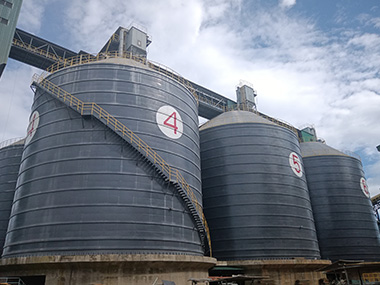

Steel Silo Stiffener Reinforcement: What Fails, Why It Fails, and How to Fix It Right
Stiffener reinforcement on a steel silo resists external wind pressure and internal vacuum loads that would otherwise buckle the shell. When stiffeners fail — and they do, more often than most engineers admit — the shell follows within seconds. Here's what we've learned from reinforcing silos across 30+ countries, including the mistakes that keep repeating.
What Stiffeners Actually Do (And Why the Shell Can't Survive Without Them)
A steel silo shell is thin. We're talking 2 mm to 6 mm plate on most cement and fly ash silos. That shell handles axial compression from the material load just fine — it's strong in that direction. But lateral pressure? Wind suction during a storm? The vacuum from a discharging screw conveyor? The shell alone can't handle any of it. It buckles like a beer can.
That's what stiffeners are for. They're the vertical ribs welded to the outside of the shell that turn a thin, flexible cylinder into a structure that can stand up to real-world loads. Without them, a 20-meter-tall cement silo would collapse under a moderate wind. With them, it survives a typhoon.
The Load Path Nobody Draws on the P&ID
Wind hits the shell. The shell tries to oval — flatten on the windward side, bulge on the leeward side. That ovaling creates bending stresses in the plate. The stiffener takes that bending load and carries it down to the foundation. Simple concept. But the load path has to be continuous: shell → fillet weld → stiffener web → stiffener flange → base plate → anchor bolts → foundation. Break any link in that chain and the stiffener might as well not exist.
I've seen plants where the stiffener base plate was sitting on a 10 mm shim pack that had rusted to nothing. The stiffener was doing exactly zero. The shell was holding on through pure luck and a coat of paint.
Vacuum Loads Are the Silent Killer
Most stiffener designs focus on wind. That's correct — wind is usually the governing load case for external pressure. But vacuum from material discharge can be just as dangerous, and it's often overlooked. A 3,000-tonne clinker silo discharging at 200 tonnes per hour through a central chute creates a vacuum of 2 to 5 kPa inside the shell. That doesn't sound like much until you realize it's acting on the entire circumference simultaneously.
Eurocode 1993-4-1 covers shell buckling under external pressure, and it's the standard we use for vacuum load cases. The problem is, a lot of older silos were designed to national codes that didn't account for vacuum at all — or used a simplified approach that underestimated the effect by 30-40%. We found exactly that on a project in Indonesia: the stiffeners were spaced at 2.2 meters, but the vacuum case demanded 1.6 meters. The shell had already started to show ripple marks between stiffeners.
How Stiffeners Fail: The Patterns We Keep Seeing
After 15 years of inspecting and reinforcing silos, I can tell you that stiffener failures follow a predictable pattern. It's not random. The same mistakes show up again and again, usually because someone cut a corner during construction or modified the silo without understanding what they were breaking.
Corrosion at the Base — The Number One Problem
The base of a stiffener is where moisture collects. Rain runs down the shell, hits the stiffener flange, and pools at the junction with the base plate. If the sealant fails — and it always fails eventually — water gets between the stiffener and the shell. You can't see it from the outside. By the time you notice rust staining, the stiffener web has lost 30-50% of its thickness.
We pulled a stiffener off a 12-year-old fly ash silo in Vietnam last year. The web was specified at 6 mm. At the base, it was down to 2.1 mm. The rest of the stiffener was fine — still 5.8 mm. That's how localized this corrosion is. The stiffener had lost most of its bending capacity right where the moment was highest.
Weld Fatigue at the Shell Connection
The fillet weld connecting the stiffener web to the shell takes every load cycle. Wind gusts, filling and discharging, temperature swings — all of it goes through that weld. A 4 mm intermittent fillet weld (the minimum most codes allow) has a fatigue life of maybe 10-15 years under cyclic loading. After that, cracks start at the weld toe and propagate into the shell.
We use continuous fillet welds on all our stiffener connections. Yes, it costs more — roughly 40% more welding time per stiffener. But I've never seen a continuous fillet weld fail in fatigue. The intermittent ones? I've seen cracks in silos as young as 6 years old.
Anchor Bolt Failure — When the Foundation Lets Go
The stiffener base plate is only as good as the anchor bolts holding it down. We specify M24 or M30 anchor bolts at 400-600 mm embedment for most silo stiffeners. But I've walked sites where someone used M16 bolts because "they looked strong enough." Under a wind load of 1.5 kPa, an M16 bolt in C30 concrete has a pullout capacity of about 12 kN. The stiffener base reaction under that same wind load? 45-60 kN. The math doesn't work. The bolts pull out, the stiffener lifts, and the shell buckles.
Here's the thing — anchor bolt failure is progressive. One bolt goes, the load transfers to the next bolt, which also goes. Within a few seconds, the entire stiffener line has lifted off the foundation. I watched this happen on a silo in the Philippines during a typhoon. The stiffener didn't bend. It just peeled off the shell like a banana skin because every anchor bolt had pulled out.
Reinforcement Methods: What Works and What Doesn't
When a silo's stiffeners are undersized, corroded, or damaged, you've got three options: add supplementary stiffeners, replace existing ones, or strengthen them in place. Each has its place. Each has traps.
Adding Supplementary Stiffeners
This is the most common approach for silos that need more capacity — maybe the plant increased throughput and the vacuum loads went up, or the local building code was updated with higher wind speeds. You weld new stiffeners between the existing ones, effectively halving the shell span between supports.
The catch: you can't just bolt them on. The new stiffeners have to be welded to the shell with the same weld specification as the originals, and they need their own anchor bolts in the foundation. If the foundation doesn't have room for new anchors, you're looking at a concrete extension ring around the base. That's a 3-4 week job on a typical 2,000-tonne silo, and it'll cost $15,000-25,000 just for the civil work.
We did this on a cement silo in Myanmar — added 8 new stiffeners to an existing 16-stiffener configuration. The original stiffeners were spaced at 2.4 meters. After reinforcement, the spacing was 1.2 meters. The shell buckling capacity under vacuum went up by a factor of 3.2. The plant manager asked why we didn't just make the original stiffeners bigger. Because welding a larger section to a loaded shell is a recipe for distortion. You'd warp the plate and create stress concentrations that would crack within a year.
Stiffener Replacement
When corrosion has eaten into the web or flange beyond repair, you cut the old stiffener off and weld a new one in its place. Sounds straightforward. It's not.
The shell under a stiffener has been carrying load for years. When you remove the stiffener, that load redistributes — and the shell can buckle locally if you don't support it properly. We use temporary external bracing rings spaced every 3 meters during replacement. Each ring is a 150 mm channel section bolted to the shell with clamps. Without them, we've seen the shell deflect 15-20 mm inward when a stiffener was removed. That's permanent deformation. You can't hammer it back.
Also, the old stiffener has been welded to the shell for years. Cutting it off leaves weld remnants, gouges, and heat-affected zones that have to be ground smooth before the new stiffener goes on. Skip this step and you're welding new material to a surface full of stress risers. We spend 2-3 hours per stiffener just on surface preparation. It's not glamorous work, but it's the difference between a repair that lasts 20 years and one that cracks in 2.
In-Place Strengthening with Cover Plates
For stiffeners that have lost section to corrosion but are still structurally sound, you can weld cover plates to the web and flange to restore the original section properties. This is the cheapest option — typically $800-1,200 per stiffener including surface prep, welding, and coating. But it only works if the remaining section is at least 60% of the original.
Below 60%, the cover plate is doing most of the work, and the connection between the cover plate and the remaining web becomes the weak point. We had a case in Kazakhstan where a contractor tried to reinforce stiffeners that were down to 35% of original section. The cover plates were welded on, looked great, and failed under the first significant wind load. The old web just peeled away from the cover plate. We ended up replacing all 24 stiffeners at twice the cost.
Design Standards and Load Cases You Can't Ignore
Stiffener design isn't guesswork. There are standards, and they exist because people got hurt when silos collapsed. Use them.
Eurocode 1993-4-1: Shell Buckling
This is the European standard for steel silos, and it's the most comprehensive treatment of shell buckling under external pressure. It gives you the critical buckling stress for a cylindrical shell with stiffeners, accounting for the stiffener spacing, the shell thickness, and the stiffener's own bending stiffness. The standard also covers the interaction between axial compression (from the material load) and external pressure (from wind or vacuum) — which is the real-world condition, not one load or the other in isolation.
The standard requires you to check the stiffener for combined axial force and bending moment. The axial force comes from the vertical load in the shell that the stiffener helps carry. The bending moment comes from wind or vacuum acting on the shell between stiffeners. Most engineers get the axial force right. The bending moment is where mistakes happen — specifically, the load distribution factor that determines how much of the shell load goes to the stiffener versus the shell plate between stiffeners.
ASCE 7 Wind Loads
For wind load calculation, we use ASCE 7 (or the local equivalent — AS/NZS 1170 in Australia, IS 875 in India). The key parameter is the gust effect factor, which accounts for the dynamic response of the silo to wind gusts. A rigid structure like a concrete silo can use a factor of 0.85. A flexible steel silo with thin walls? You're looking at 1.2-1.5 depending on the natural frequency.
I've seen designs that used the rigid structure factor for a steel silo. That underestimates the wind load by 40%. The stiffeners were undersized from day one. The silo survived because the actual wind speeds were lower than the design value — but it was a coin flip, not engineering.
EN 14491: Dust Explosion Protection
If the silo stores combustible dust — cement, fly ash, coal, some chemicals — you have to consider dust explosion loads in the stiffener design. EN 14491 specifies the explosion pressure and the dynamic load factors for structural elements. A dust explosion inside a silo generates a pressure of 6-10 bar in milliseconds. That's not a static load. It's a shock wave.
The stiffeners have to resist that shock without detaching from the shell. We design for a reduced pressure of 1-2 bar with a dynamic amplification factor of 1.5-2.0, depending on the venting arrangement. If the silo has proper explosion vents (sized per EN 14491), the pressure the stiffeners see is much lower. No vents? You're designing for the full deflagration pressure, and the stiffeners get very heavy very quickly.
Case Study: 5,000-Tonne Clinker Silo — Stiffener Reinforcement in Practice
A cement plant in central China had a 5,000-tonne clinker silo that was showing visible shell deformation between stiffeners. The silo was 12 years old, 22 meters in diameter, 28 meters tall. Original design had 36 stiffeners spaced at 1.9 meters. The plant had increased production by 30% over the years, and the discharge rate had gone up accordingly. The vacuum loads were now 40% higher than the original design assumed.
Our inspection found three problems. First, 8 of the 36 stiffeners had base corrosion — web thickness reduced from 6 mm to 3.5 mm at the bottom 300 mm. Second, the anchor bolts on 12 stiffeners were showing signs of movement — rust stains around the base plates, gaps of 2-3 mm between the plate and the foundation. Third, the shell between stiffeners had ripple deformations of 8-12 mm amplitude, indicating that the shell was buckling elastically under vacuum loads.
We replaced the 8 corroded stiffeners entirely, using temporary bracing rings to support the shell during removal. We re-anchored the 12 loose base plates with chemical anchors drilled 150 mm into the existing foundation — M24 stainless steel, rated for 50 kN pullout each. And we added 12 new stiffeners between the existing ones, reducing the spacing from 1.9 meters to 0.95 meters.
The project took 6 weeks. Total cost was $180,000 — $95,000 for materials and fabrication, $55,000 for civil work and anchoring, $30,000 for surface preparation and coating. The plant lost 6 days of production during the tie-in, which cost them roughly $40,000 in deferred clinker sales. They told me later that the original quote from a local contractor was $60,000. That quote didn't include shell bracing, didn't include anchor replacement, and used intermittent fillet welds. It would have failed within 3 years.
Three years after our reinforcement, the silo shows zero deformation. The ripple marks in the shell haven't grown. The anchor bolts are tight. The plant manager sends me a photo every Chinese New Year. I appreciate that.
FAQ
How do I know if my silo stiffeners need reinforcement?
Look for three signs: visible ripple deformations in the shell between stiffeners (anything over 5 mm amplitude is a concern), rust staining at the stiffener base indicating internal corrosion, or gaps between the stiffener base plate and the foundation. If you see any of these, get an ultrasonic thickness survey done. We typically find that 20-30% of stiffeners on a 10+ year old silo need some form of repair.
Can I reinforce stiffeners while the silo is full?
Generally no. The shell under a loaded stiffener is under axial compression from the material load. Removing or cutting the stiffener while the silo is full can cause local buckling. We've done limited reinforcement work on silos at 30-40% capacity, but only with temporary bracing and only for cover plate additions — never for stiffener replacement. For full replacement, empty the silo. It's not worth the risk.
What's the typical cost range for stiffener reinforcement?
For a standard 2,000-5,000 tonne cement or clinker silo, expect $80,000-200,000 depending on the number of stiffeners, the extent of corrosion, and whether foundation work is needed. Cover plate reinforcement runs $800-1,200 per stiffener. Full replacement runs $3,000-5,000 per stiffener including temporary bracing. Adding new stiffeners runs $2,000-3,500 per stiffener plus $15,000-25,000 for foundation extensions if required. These are 2024 costs for Southeast Asia and China — adjust up 20-30% for Middle East or Africa logistics.
Need a Stiffener Assessment on Your Silo?
We've inspected and reinforced steel silos across cement, clinker, fly ash, coal, and slag plants in 30+ countries. Our engineers have stood on silo shells in 45°C heat measuring ripple deformation with feeler gauges. We don't guess — we measure, calculate, and fix it properly the first time.
Contact Manxing's silo engineering team for a site assessment or reinforcement design review. We'll tell you what needs fixing, what doesn't, and what it'll actually cost. No generic proposals. No sales pitch. Just engineering.