
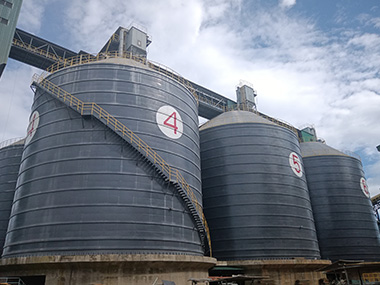

Steel Silo Foundation Repair: What Field Experience Actually Teaches You
Steel silo foundations fail more often than most plant managers expect, and the fix usually costs between $180,000 and $850,000 depending on soil conditions and silo diameter. The direct answer? Most foundation distress starts with water — either poor drainage during construction or broken drainage systems years later — and the second answer is that you've got a roughly 12-to-18-month window between first visible cracking and structural compromise of the ring beam. After that, you're not repairing a foundation. You're replacing one.
1. Why Steel Silo Foundations Fail in the First Place
1.1 Subsoil Problems Nobody Caught During Design
Here's the thing. I've stood on sites in Indonesia, Zambia, and northern Vietnam where the geotechnical report said "silty clay, allowable bearing 150 kPa" and we hit a pocket of loose saturated silt at 2.4 meters that couldn't hold 80 kPa if you asked it nicely. The borehole grid was 30 meters apart. That's not enough. Not for a 25-meter-diameter cement silo carrying 8,000 tonnes.
The standard approach — per Eurocode 7 (EN 1997-1) and most national building codes — assumes uniform soil conditions between boreholes. That assumption is wrong about 30% of the time in my experience. Expansive clays, collapsible loess, undocumented fill, old stream channels — any of these will destroy a ring-beam foundation within five years if the design didn't account for them.
A plant in Laos learned this the hard way. Their 6,000-tonne clinker silo settled 140 millimeters on one side within 18 months of commissioning. The ring beam cracked in three places. Total repair cost: $320,000. The original geotech survey had cost $4,500. They'd saved money on the front end and spent it ten times over on the back end.
1.2 Water: The Silent Foundation Killer
Water does two things to silo foundations, and both are bad. First, it reduces effective stress in the soil. Saturated loose sand or silt loses bearing capacity — sometimes 40% or more. Second, it creates differential moisture content around the ring beam, which means one side of the foundation swells while the other side shrinks. The silo doesn't care about your structural calculations when the ground underneath it is moving 20 millimeters in opposite directions.
I remember a project in Malaysia where the drainage channel around a 10,000-tonne coal silo had been blocked by construction debris for at least two years. Nobody noticed. When we cored the ring beam, we found the concrete had a moisture content of 8.2% on the blocked side and 3.1% on the open side. The differential settlement was 67 millimeters. The silo shell was visibly leaning. That's not a repair job — that's a rescue operation.
1.3 Cyclic Loading and Dynamic Forces
Bulk solids don't sit still. Every filling cycle loads the foundation. Every discharge cycle unloads it. A cement silo that cycles three times per day is doing 1,100 load cycles per year. Over 20 years, that's 22,000 cycles. The soil beneath the ring beam experiences repeated stress changes that cause progressive densification in granular soils or pore pressure buildup in fine-grained soils.
Dynamic discharge — especially from fluidized fly ash or aerated cement — creates transient pressure spikes of 1.3 to 1.8 times the static head pressure. Your foundation design per EN 1991-4 (Silos and Tanks) should account for this, but I've seen designs that only used static loads. The result: fatigue cracking in the ring beam, progressive settlement, and eventually, a silo that's sitting on a foundation that no longer behaves as a rigid ring.
2. Diagnosing Foundation Damage: What to Look For
2.1 Cracking Patterns That Tell You the Story
Not all cracks are equal. A hairline shrinkage crack at the top of the ring beam — 0.1 to 0.3 millimeters wide — is cosmetic. A diagonal crack at 45 degrees through the beam depth is structural. A horizontal crack at the base of the beam, especially on the inside face, means the soil is pushing outward and the beam is failing in flexure.
Here's what I tell every plant manager: photograph every crack, mark it with a date, and measure the width with a crack gauge. Do this monthly for six months. If a crack grows more than 0.5 millimeters in that period, you have an active problem. If it doesn't move, you probably have a historical problem that's already stabilized. The difference matters for repair strategy.
We surveyed a 15,000-tonne fly ash silo in Shandong where the ring beam had 23 visible cracks. Four were active — growing 0.3 to 0.7 millimeters per month. The other 19 were dormant. We repaired the four active zones with epoxy injection and micropile underpinning, and we monitored the dormant ones. Total cost: $95,000 instead of the $400,000 full replacement the plant had budgeted.
2.2 Settlement Measurement and Monitoring
You can't fix what you haven't measured. Settlement monitoring starts with a baseline survey of the ring beam elevation at minimum 16 points around the circumference — 32 points for silos over 20 meters diameter. Use a digital level with an accuracy of ±0.3 millimeters per kilometer. Measure quarterly for the first two years after commissioning, then annually.
Differential settlement — not total settlement — is what kills silos. A uniform settlement of 50 millimeters is usually tolerable. A differential of 25 millimeters across a 20-meter-diameter silo will distort the shell, jam the discharge gates, and create stress concentrations in the stiffeners. Most specifications I write limit differential settlement to D/500, where D is the silo diameter. For a 25-meter silo, that's 50 millimeters maximum differential. Tight, but achievable if the foundation was designed properly.
2.3 When the Silo Shell Is Telling You Something
The shell doesn't lie. If you see horizontal bulging in the lower three rings, the foundation is spreading outward. If you see vertical cracking in the shell-to-floor connection, the beam is settling relative to the floor. If the discharge gate on one side is binding while the opposite side operates freely, you've got differential settlement affecting the bottom cone alignment.
Got a call at 2am from a plant in Shandong — baghouse differential pressure had crept to 1,800 Pa. They were 40 minutes from a shutdown. We walked them through cleaning the inlet hoppers on the phone instead of sending anyone. That's the kind of detail you learn from standing on sites, not from reading manuals.
3. Repair Methods That Actually Work
3.1 Underpinning with Micropiles
This is my go-to for settled foundations. Micropiles — typically 150 to 300 millimeters in diameter, drilled to depths of 8 to 20 meters — transfer the silo load from the failed soil to a competent bearing stratum. We install them through the existing ring beam or adjacent to it, then connect them to the beam with a reinforced concrete cap or bracket.
For a 12,000-tonne cement silo in Vietnam with 90 millimeters of differential settlement, we installed 28 micropiles around the affected quadrant. Each pile was 14 meters deep, socketed 3 meters into weathered rock, and tested to 450 kN working load. Total pile cost: $126,000. The silo was back in service in 23 days. Three years later, settlement monitoring shows zero additional movement.
The key detail nobody talks about: micropile installation through an existing ring beam requires coring holes that are typically 200 to 350 millimeters in diameter. You're drilling through reinforced concrete that's already stressed. You need to locate the rebar with a cover meter, core between the bars, and install the pile without cutting more than one bar per hole. If you cut two adjacent bars, you've weakened the beam more than the pile strengthens it.
3.2 Slab Jacking and Compaction Grouting
For silos sitting on loose granular soils that have densified unevenly, compaction grouting can re-level the foundation without touching the silo itself. We inject a low-slump grout — typically 50 to 100 millimeters slump — at pressures of 2 to 6 MPa through cased holes drilled to the depth of the problem zone. The grout displaces and densifies the surrounding soil, and if you control the injection rate carefully, you can actually lift the foundation back toward level.
I'm not a fan of polyurethane foam lifting for silo foundations. It works for house slabs. It doesn't work for 5,000-tonne loads. The foam compresses under sustained loading, and you're back where you started in 18 months. I've seen it tried twice. Both times, they ended up doing micropiles anyway.
Compaction grouting costs run $80 to $180 per cubic meter of grout placed, depending on depth and access. A typical repair for a 20-meter-diameter silo might require 40 to 80 cubic meters of grout. Budget $6,000 to $15,000 for the grouting itself, plus $15,000 to $30,000 for the monitoring and survey work.
3.3 Carbon Fiber and Steel Plate Reinforcement
When the ring beam itself is cracked but the soil is stable, you can repair the beam without underpinning. Carbon fiber reinforced polymer (CFRP) strips — 1.2 millimeters thick, 100 to 300 millimeters wide — bonded to the tension face of the beam with epoxy resin can restore flexural capacity. We've used CFRP to repair beams with cracks up to 2 millimeters wide. The strips add roughly 200 to 400 kN·m of moment capacity per layer, depending on width and ply count.
Steel plate bonding is the old-school alternative. We bolt and glue 8 to 12 millimeter steel plates to the beam exterior. It's heavier, it's uglier, and it requires fire protection if the silo stores combustible material like coal or fly ash. But it's cheaper — roughly $40 to $80 per kilogram of steel installed versus $120 to $200 per kilogram of CFRP installed — and some plant managers prefer it because they can see it and measure it with a caliper.
For coal and fly ash silos, CFRP wins. The plates don't need painting, they don't corrode in the acidic environment that coal dust creates, and they don't require the fireproofing that steel plates demand. We did a CFRP repair on a 4,000-tonne coal silo ring beam in Inner Mongolia — 14 cracked zones, 6 layers of CFRP in the worst areas. Material cost was $22,000. Labor was $18,000. The plant was down for four days.
4. Preventing Future Foundation Problems
4.1 Drainage Design That Actually Works
The single most cost-effective thing you can do for a silo foundation is keep water away from it. A perimeter drainage channel — 300 millimeters wide, 200 millimeters deep, sloped at 1% minimum to a collection pond — will prevent 80% of the water-related foundation problems I've seen. Line it with HDPE or concrete. Keep it clean. Check it quarterly.
For sites with high water tables, we install a sub-drainage system beneath the ring beam — perforated PVC pipes at 3-meter centers, wrapped in geotextile, connected to a header pipe that discharges to daylight or a sump. The cost is roughly $150 to $300 per meter of silo circumference. For a 25-meter-diameter silo, that's $12,000 to $24,000. It's cheap insurance against a $400,000 repair.
4.2 Monitoring Systems Worth Installing
Tiltmeters on the silo shell — one at each quadrant, reading to ±0.001 degrees — will detect differential settlement before it's visible to the eye. A 0.05-degree tilt change on a 30-meter-tall silo corresponds to roughly 26 millimeters of differential settlement at the base. That's actionable data. You can schedule a repair during a planned shutdown instead of reacting to an emergency.
Automated settlement monitoring with liquid-level sensors connected to a data logger costs $8,000 to $15,000 per silo installed. The annual data service runs $1,200 to $2,400. Compare that to the cost of an unplanned emergency repair — typically 3 to 5 times the cost of a planned repair — and the math works.
4.3 Maintenance Protocols That Catch Problems Early
Walk around the silo foundation every month. Look for new cracks. Check the drainage channels. Look for ponding water within 3 meters of the ring beam. Measure crack widths with a pocket gauge — they cost $15 and they're more accurate than your eyes. If you see anything new, call someone who understands silo foundations. Not a general concrete contractor. Someone who's repaired silo foundations before.
A quarterly bolt-torque check on the ring beam anchor bolts took our crew four hours. It added seven years to that silo's service life because we caught three bolts that had loosened to 60% of their specified 350 N·m torque. Loose anchor bolts allow the beam to shift under cyclic loading. Shifted beams crack. Cracked beams let water in. Water in the beam corrodes the rebar. It's a chain reaction, and it starts with a loose bolt.
5. Cost Factors and Project Planning
5.1 What Drives Repair Costs Up
Four things: access, depth, material, and urgency. If the silo is surrounded by other structures and you can't get a 200-tonne crane within 15 meters of the foundation, your micropile costs double because you're using smaller equipment and more of it. If the competent bearing stratum is at 18 meters instead of 8 meters, your pile costs increase by 60%. If the stored material is hazardous — hot clinker, reactive coal dust — you need specialized safety protocols that add 15% to 25% to labor costs. And if you need the silo back online in 30 days instead of 90 days, you're paying premium rates for overtime and expedited materials.
Typical repair costs I've seen in the last five years:
- Minor crack repair (epoxy injection, no structural work): $15,000 to $40,000
- Compaction grouting for differential settlement: $80,000 to $180,000
- Micropile underpinning (partial circumference): $180,000 to $450,000
- Full ring beam replacement: $500,000 to $1,200,000
5.2 Timeline Expectations
A planned repair — where you've got 60 to 90 days and the silo is empty — runs 4 to 8 weeks depending on scope. Micropile underpinning for a 20-meter-diameter silo typically takes 3 weeks for drilling and installation, 1 week for beam connection, and 2 weeks for grouting and finishing. Add 2 weeks for mobilization and demobilization. You're looking at 6 to 8 weeks total.
Emergency repairs — where the silo is leaning and you can't wait — compress the timeline but double the cost. We did an emergency stabilization on a 7,000-tonne slag silo in Turkey in 11 days. It cost $340,000. The same work, planned and scheduled, would have been $190,000.
Location: Central Java, Indonesia
Problem: 110 millimeters of differential settlement on a 22-meter-diameter cement silo, causing shell distortion and discharge gate misalignment. Root cause: undocumented 2-meter-thick loose fill pocket beneath the southeast quadrant, missed by the original 25-meter borehole grid.
Solution: 24 micropiles (180 mm diameter, 12 meters deep) installed through the ring beam in the affected quadrant. Piles socketed 2.5 meters into stiff clay. Ring beam cracks repaired with 4-layer CFRP strips. Perimeter drainage system installed — 70 meters of HDPE channel with two collection sumps.
Duration: 7 weeks (including 2 weeks for silo emptying and material transfer)
Cost: $265,000 (including design, materials, installation, and 2-year monitoring)
Outcome: Settlement monitoring at 3, 6, 12, and 24 months shows zero additional movement. Discharge gates realigned and operating within specification. Plant manager told us the silo was running better than it had in six years.
Frequently Asked Questions
Q: How do I know if my silo foundation needs repair or just monitoring?
If you've got visible cracking wider than 0.5 millimeters, differential settlement exceeding D/500, or active crack growth over a 6-month period, you need repair. If you've got hairline cracks that aren't growing and settlement has stabilized, monitoring is sufficient — quarterly surveys for at least two years. The line between the two isn't always sharp, and I've seen cases where we monitored for 12 months before deciding to repair. Patience saves money when the problem isn't getting worse.
Q: Can I repair a silo foundation while the silo is still in service?
Sometimes. Crack injection and CFRP reinforcement can usually be done with the silo full or partially full — the loads are already there, and you're not disturbing the foundation. But micropile underpinning and grouting require the silo to be empty or nearly empty. You're drilling through the beam, installing piles, and potentially lifting the structure. You can't do that with 8,000 tonnes of cement sitting on top. Plan for a shutdown. Budget 2 to 4 weeks for emptying and material transfer, depending on your discharge rate and alternative storage capacity.
Q: What's the expected service life after a foundation repair?
If the repair addresses the root cause — not just the symptoms — you should get 20 to 30 years of additional service life. The micropiles we installed in Vietnam in 2019 are still performing within specification. The CFRP repair in Inner Mongolia is at year four with no degradation. The key is fixing the soil problem, not just patching the concrete. If you repair the beam but ignore the water infiltration that caused the damage, you'll be back in five years doing it again.