
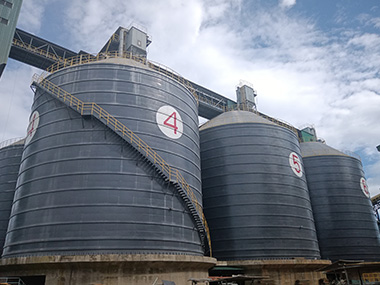

Steel Silo Structural Life Extension: What Actually Works After 15+ Years of Service
Extending a steel silo's structural life means targeted intervention — corrosion repair, structural reinforcement, and foundation remediation — not a full rebuild. Most well-maintained welded steel silos can gain 15 to 25 additional years of service with the right scope of work. The catch? You have to assess honestly, repair precisely, and stop pretending a fresh coat of paint fixes a 3mm wall loss.
Why Steel Silos Degrade Faster Than You Think
Outdoor steel structures in cement and aggregate plants don't fail from one dramatic event. They fail from a dozen small insults that compound over a decade. I've opened up silos in Vietnam where the shell looked fine from the outside, but the interior wall had lost 40% of its thickness from cement dust abrasion combined with condensation cycling. The owner had been painting the exterior every three years and calling it maintenance.
Corrosion Mechanisms in Bulk Solids Storage
Uniform corrosion is the boring kind — predictable, measurable, manageable. The dangerous kind is localized pitting, especially at the shell-to-roof junction, around bolt holes, and along the bottom ring where material sits against the wall. In coal storage silos, sulfur compounds accelerate pitting rates to 0.5mm per year in humid climates. That's not a typo. A 6mm shell plate can develop through-wall pits in 12 years if the coal moisture content sits above 8% and the silo isn't aerated properly.
Condensation is the silent killer. Every time you load hot clinker — say, 150°C discharge temperature — into a silo with 25°C ambient shell temperature, you get a condensation band about 1.5 meters below the material surface. That band cycles wet and dry with every fill-empty cycle. After 10,000 cycles, you've got crevice corrosion that doesn't show up on a visual inspection. You need ultrasonic thickness testing at 300mm grid spacing to find it. We follow EN 1993-4-1 for shell stability calculations, and that standard assumes uniform thickness reduction. Localized pitting doesn't play by those rules.
Fatigue from Thermal Cycling and Loading Cycles
A cement silo filling and emptying twice a day racks up 7,300 load cycles per year. Over 20 years, that's 146,000 cycles. The shell-to-bottom connection, hopper welts, and roof-to-shell junction are all fatigue-sensitive details. Eurocode 3 (EN 1993-1-9) gives fatigue life categories for welded joints, and most silo shell welds fall into Category 50 or 63 — meaning they're designed for roughly 2 million cycles at a given stress range. Sounds like a lot, until you realize that thermal cycling adds stress ranges the original designer never accounted for.
I remember a project in Malaysia where a 2,000-tonne fly ash silo developed a 150mm crack at the hopper-to-shell weld after 18 years. The plant had increased throughput by 30% five years earlier, which changed the filling pattern and introduced thermal shock from faster loading. The crack wasn't there at year 12. It grew to critical length in six years. We repaired it with a full-penetration weld overlay and added a stiffening ring, but the lesson stuck: operational changes kill silos faster than age does.
Abrasion from Material Flow
Limestone, clinker, slag, and sand are abrasive. In mass flow silos, material slides along the wall and grinds the steel. In funnel flow silos, the abrasion concentrates in the flow channel — often a vertical strip down one side of the shell. I've measured 2mm wall loss in a limestone silo after just eight years of service, localized to a 600mm-wide band. The rest of the shell was pristine.
The fix isn't thicker steel — it's flow pattern correction. Installing a cone-in-cone insert or a properly designed hopper liner changes the wear distribution. But you have to measure first. We use 3D laser scanning to map wall profiles and identify wear zones before recommending any intervention. Guessing costs you a repair cycle.
The Assessment Phase: Don't Skip This
Here's where most life extension projects go wrong. Someone walks around the silo with a hammer, taps a few spots, and declares it "still good." That's not an assessment. That's a guess with extra steps. A proper structural assessment for life extension has four components, and skipping any one of them is how you end up with a silo that fails three years after the "repair."
Non-Destructive Testing Methods
Ultrasonic thickness testing (UTT) is the baseline. We test at 300mm grid points on the shell, 150mm spacing on the hopper, and every bolt hole on the roof. A typical 10,000-tonne cement silo has roughly 2,500 test points. It takes a two-person crew about three days. The data goes into a wall-thickness map that shows exactly where the shell has thinned and by how much.
For weld inspection, we use magnetic particle testing (MT) on all shell-to-hopper connections, roof-to-shell junctions, and any area where visual inspection shows cracking or distortion. On a recent project in Indonesia, MT revealed 23 cracks in a silo that had passed visual inspection with zero findings. The longest crack was 80mm. That silo was three months from a structural failure that would have dumped 5,000 tonnes of clinker onto the conveyor gallery below.
We also run a geometric survey — plumbness, roundness, and settlement. A silo that's tilted more than 1:500 from vertical has a foundation problem, not a shell problem. Fixing the shell on a settling foundation is like putting new tires on a car with a bent frame.
Structural Load Analysis
Once you have the as-built thickness map, you run the structural model again. Not the original design model — a new one with the actual measured thicknesses, actual material properties (we coupon-test if the steel grade is unknown), and actual loading conditions. This is where EN 1991-4 (actions on silos and tanks) comes in. The standard gives you patch load patterns, friction loads, and thermal load cases that most original designs from the 1990s didn't include.
The output tells you which areas are overstressed and by how much. A common finding: the bottom shell course is at 110% of capacity due to wall loss, but the courses above are at 70%. You don't need to reinforce the whole silo — just the bottom three courses. That's a 60% cost reduction compared to a blanket reinforcement approach.
Remaining Life Calculations
Remaining life isn't a single number. It's a function of corrosion rate, fatigue cycle accumulation, and the safety factor you're willing to accept. We calculate it three ways: corrosion-based (how long until the thinnest point reaches minimum required thickness), fatigue-based (how many cycles until crack initiation at critical details), and settlement-based (how long until foundation movement exceeds allowable limits).
The governing case is usually corrosion-based for silos over 15 years old. If you're losing 0.1mm per year and you have 1.5mm of excess thickness beyond the minimum required, you've got 15 years left — assuming the corrosion rate doesn't accelerate. We always assume it accelerates. Condensation, material changes, and coating failure all speed things up. So we apply a 1.5x acceleration factor for conservative estimates.
Proven Life Extension Techniques
Not every technique works for every silo. The right intervention depends on the failure mode, the remaining shell thickness, the foundation condition, and the plant's operational requirements. I've seen companies spend $200,000 on a coating system when the real problem was a cracked foundation. I've also seen plants reinforce a silo shell when the actual issue was a flow pattern causing asymmetric loading. Diagnosis first. Always.
Protective Coating Systems
A coating system is not structural repair. It's corrosion prevention. But it's the most cost-effective life extension measure when the shell still has adequate thickness. For cement and clinker silos, we specify a zinc-rich epoxy primer (75μm) followed by two coats of high-build epoxy (125μm each), totaling 325μm dry film thickness. That system gives you 15 to 20 years of protection in a temperate climate, 10 to 12 years in a tropical coastal environment.
Surface preparation is everything. We blast to Sa 2.5 (ISO 8501-1) with a profile of 50 to 75μm. I've seen coating failures at 18 months because the blaster skipped the salt contamination test. On a coastal plant in Gujarat, India, we measured 80μg/cm² of soluble salts on the shell before blasting. The spec allows 20μg/cm². That silo needed two blast cycles and a freshwater wash before we could coat. The contractor wanted to skip it. We didn't let them.
For abrasion zones, we use a different approach: ceramic-filled polyurethane liners or basalt tile liners. These don't prevent corrosion, but they take the wear instead of the steel. A 15mm basalt liner in a limestone silo hopper lasts about 12 years before replacement. The steel underneath stays at original thickness.
Structural Reinforcement
When wall loss exceeds 20% of original thickness, or when the structural analysis shows overstress, you reinforce. The most common method is external stiffening rings — rolled steel sections welded or bolted to the shell at calculated intervals. For a 20m-diameter cement silo, we typically add rings at 2.5m vertical spacing over the affected zone. Each ring is designed to carry the hoop tension that the thinned shell can no longer handle.
We follow EN 1993-4-1 for shell design and EN 1993-1-1 for the stiffening members. The connection detail matters enormously. A stiffening ring welded directly to a shell with residual wall loss creates a stress concentration that can initiate cracking. We use a continuous fillet weld with a minimum leg length of 6mm, and we preheat the shell to 100°C before welding if the carbon equivalent exceeds 0.42%. That's not optional — that's how you avoid hydrogen-induced cracking in the heat-affected zone.
For hopper reinforcement, we sometimes add an external hopper liner — a new steel cone installed inside the existing hopper, connected with through-bolts. This is messy work. You're welding inside a confined space with residual material dust. We've done it with the silo half-full, using temporary supports and cold-cutting techniques. It's not fun, but it works.
Foundation Remediation
Foundation problems show up as shell distortion, door-frame misalignment, or cracking in the silo base. The most common issue is differential settlement — one side of the ring foundation sinks more than the other. We've measured 45mm of differential settlement on a 25m-diameter silo in the Philippines. The shell had buckled inward at the point of maximum settlement.
The repair is micropile underpinning. We install 150mm-diameter steel-cased micropiles through the existing foundation ring, bearing on competent soil or rock. A typical silo needs 12 to 16 micropiles, each carrying 200 to 400kN. The piles are connected to the existing foundation with a reinforced concrete cap. Total cost for a 10,000-tonne silo: $80,000 to $120,000. That's cheaper than a new foundation, and you don't have to empty the silo for more than 48 hours.
When Repair Isn't Enough: Replacement vs. Extension
There's a point where life extension costs more than replacement. The industry rule of thumb is 60% — if the repair estimate exceeds 60% of a new silo's cost, you're probably better off building new. But that rule assumes you can afford the downtime for a new silo, which is typically 90 to 120 days. If the silo is the only storage for a running plant, downtime costs can flip the calculation.
Cost-Benefit Analysis
A new 5,000-tonne welded steel cement silo — including foundation, steel structure, and coating — runs $350,000 to $500,000 depending on location and seismic requirements. A comprehensive life extension (coating, stiffening rings, foundation repair, and flow correction) runs $120,000 to $200,000. That's a 40 to 60% cost saving, and you get 15 to 25 more years. The math is straightforward when the shell is fundamentally sound.
Where it gets complicated is when the silo has multiple simultaneous failure modes. Corrosion plus settlement plus fatigue cracking means you're repairing everything at once, and the interaction between repairs can create new problems. We had a project in Nigeria where the foundation repair changed the shell stress distribution, and a crack that had been stable for five years started growing again. We caught it during post-repair monitoring, but it added $30,000 to the scope.
Decision Criteria
We use a scoring system: remaining shell thickness (30% weight), foundation condition (25%), fatigue status (20%), coating condition (15%), and operational criticality (10%). A silo scoring above 70 out of 100 is a good candidate for life extension. Below 50, you're throwing good money after bad. Between 50 and 70, it depends on the plant's risk tolerance and capital budget.
Operational criticality is the wildcard. A standalone silo with a backup is a different decision than the only silo feeding a kiln. If losing the silo means a plant shutdown costing $50,000 per day, you'll accept a higher repair cost and a shorter remaining life. That's not engineering — that's business. But the engineer's job is to present the options honestly.
Maintenance Protocols That Actually Extend Life
Life extension doesn't end when the repair crew leaves. The biggest mistake plants make is treating a repaired silo exactly like a new one. It's not new. It has a history, and that history dictates a different maintenance protocol.
Inspection Schedules
For a silo that's had life extension work, we recommend ultrasonic thickness testing every three years for the first six years after repair, then every five years after that. Visual inspection of the coating system annually. Foundation settlement monitoring quarterly for the first two years, then semi-annually. Weld inspection at all repaired details every two years.
That sounds like a lot. It's not. A UTT survey of a 5,000-tonne silo takes two days and costs $3,000 to $5,000. A foundation survey takes four hours and costs $500. Compare that to the $150,000 you just spent on repairs. The maintenance budget is 2 to 3% of the repair cost per year. That's not expensive — that's insurance.
Preventive Measures
Aeration systems prevent condensation. If your silo doesn't have aeration, install it. A basic aeration system for a cement silo costs $15,000 to $25,000 and reduces interior corrosion rates by 60 to 80%. The payback period is two to three years in coating maintenance savings alone.
Level monitoring prevents overfilling. An overfilled silo loads the shell beyond design limits and can cause roof uplift failure. We've seen radar level sensors fail silently — the display shows 80% full, but the silo is actually at 105%. A redundant level system (radar plus mechanical high-level switch) costs $2,000 and prevents a $200,000 roof repair.
Monitoring Systems
Continuous structural monitoring is becoming affordable. We install strain gauges at critical details — shell-to-hopper connection, stiffening ring-to-shell junction, and the bottom course. The data feeds into a cloud dashboard that alerts you when strain levels exceed 80% of the design limit. A monitoring system for a single silo costs $8,000 to $12,000 installed, with a $500 annual data service fee.
Is it necessary for every silo? No. But for silos over 20 years old, or silos that have had structural repairs, it's cheap insurance. We caught a developing crack in a silo in Colombia because the strain gauge data showed a 15% increase over three months. The crack was 40mm long when we found it. Six months later, it would have been through-wall.
Case Study: 12,000-Tonne Clinker Silo Life Extension
A cement plant in central Vietnam had a 12,000-tonne clinker silo built in 2003. By 2021, the plant was experiencing intermittent structural alarms — the silo's original strain monitoring system (installed by the builder) was showing erratic readings. The plant called us for an assessment.
Findings: Wall thickness mapping revealed an average loss of 1.2mm on the bottom four shell courses (original thickness 10mm), with localized pitting to 6.5mm in the condensation zone. The hopper had 2.3mm loss on the upstream face from clinker abrasion. The foundation showed 18mm of differential settlement on the north side. Three cracks were found at the hopper-to-shell weld, the longest being 120mm.
Scope: We replaced the bottom two shell courses (total 48 new plates, 10mm thickness, S355J2 steel per EN 10025). We installed four external stiffening rings on courses 3 through 6. We repaired the hopper with a 6mm internal liner plate over the worn areas. We underpinned the foundation with 14 micropiles. We applied a full coating system — zinc-rich epoxy primer plus two coats of high-build epoxy, 325μm total. We installed a new continuous monitoring system with 16 strain gauges.
Results: Total project cost: $185,000. Duration: 28 days (including 10 days of silo empty time). The silo returned to service with a calculated remaining life of 22 years. The plant's alternative was a new silo at $620,000 with 120 days of downtime. The life extension saved $435,000 and avoided a production loss estimated at $2.4 million.
FAQ
Q: How do I know if my silo needs life extension work?
A: If your silo is over 15 years old and hasn't had a comprehensive structural assessment, it needs one. The warning signs are visible coating failure on the interior, distortion of the shell or hopper, cracking at welded connections, or unexplained settlement of the foundation. But absence of warning signs doesn't mean absence of problems. We've assessed silos that looked perfect and had 40% wall loss hidden under a coating that was holding rust in place like a bandage on a fracture.
Q: Can I extend a silo's life while it's still in operation?
A: Partially. Coating repair, external stiffening, and foundation work can all be done with the silo in service. But shell plate replacement and internal hopper repair require the silo to be empty. We typically plan the work during a scheduled plant shutdown. For a 5,000-tonne silo, emptying takes 3 to 5 days at normal discharge rates. We've done shell replacements with the silo at 10% capacity using temporary supports, but that's risky and expensive. Empty is better.
Q: What's the typical return on investment for silo life extension?
A: Compared to new construction, life extension typically saves 40 to 60% on capital cost and 70 to 80% on downtime. The ROI is straightforward when you factor in avoided production losses. A cement plant producing 3,000 tonnes per day at $50 per tonne margin loses $150,000 per day of downtime. A 28-day life extension project versus a 120-day new build saves 92 days — that's $13.8 million in avoided margin loss. The engineering cost is noise in that calculation.
Get an Honest Assessment of Your Silo's Remaining Life
We've assessed over 200 silos across 30 countries. We'll tell you what needs fixing, what doesn't, and what's a waste of money. No upsell. No generic recommendations. Just a wall-thickness map, a structural analysis, and a scope you can take to your board with confidence.