
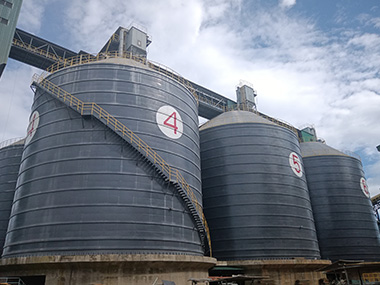

Steel Silo Maintenance Budget Planning: What It Actually Costs and How to Get It Right
A well-maintained welded steel silo handling cement, clinker, or fly ash will run 20 to 25 years with annual maintenance costs between $8,000 and $15,000 for a 3,000-tonne unit. Budget for recoating every 3 to 5 years at $25,000 to $40,000, and set aside a contingency of 15 to 20 percent of your total maintenance spend for the unexpected — because something always breaks at 3am in monsoon season.
Why Silo Maintenance Budgets Fail Before They Start
The "Run It Till It Breaks" Trap
Most plants I visit don't have a maintenance budget. They have a repair fund — money they throw at problems after something's already failed. That's not a budget. That's panic spending.
I remember standing on a clinker silo in central Vietnam, 40°C heat, watching a crew weld a 600mm crack that had been leaking for three weeks. The plant manager told me they'd "been meaning to inspect it." The repair cost $47,000. A proper inspection six months earlier would have caught the stress concentration at the weld toe for about $2,500. That's the difference between a budget and a gamble.
What You're Actually Budgeting For
Steel silo maintenance isn't one line item. It's four distinct cost centers that each follow different timelines:
Structural integrity — wall thickness monitoring, weld inspection, bolt-torque checks on roof and hopper connections. This is your baseline. Skip it and everything else becomes more expensive.
Corrosion management — internal coating degradation, external paint systems, galvanic corrosion at dissimilar metal contacts. In coastal or high-humidity environments, you'll see 0.1 to 0.5mm of wall loss per year on unprotected carbon steel.
Mechanical systems — aeration pads, blowers, dust collectors, rotary valves, slide gates. These have moving parts. Moving parts wear out on a schedule you can predict if you're tracking hours.
Safety and compliance — explosion vent inspection, pressure monitoring calibration, grounding verification, dust emission testing. This isn't optional. Regulators don't care about your budget constraints.
The Real Cost Breakdown: Where the Money Goes
Structural Inspection and Repair
Annual visual inspection by a competent engineer runs $3,000 to $5,000 for a single silo. Add ultrasonic wall-thickness testing at 12 to 16 points around the shell and you're at $5,000 to $8,000. That's your floor. Every year. No exceptions.
EN 1993-4-1 (Eurocode 3: Design of steel structures — Silos) gives you the framework for assessing shell buckling, hopper stability, and anchor bolt loads. I've seen plants skip the annual inspection for three years running, then spend $80,000 on emergency anchor-bolt replacement because nobody noticed the nuts backing off. The bolts didn't fail. The maintenance program did.
Minor weld repairs — cracking at nozzle connections, roof-to-shell junctions — typically run $1,500 to $4,000 per incident if caught early. Wait until it's a through-thickness crack and you're looking at $15,000 to $30,000 with scaffolding, NDT verification, and a welder qualified to EN 15085.
Corrosion Management
Here's where budgets get eaten alive. A 3,000-tonne cement silo with a 1,200m² internal surface area needs recoating every 3 to 5 years depending on material abrasiveness and humidity. At $20 to $35 per square meter for surface preparation and epoxy coating application, you're budgeting $25,000 to $40,000 per recoat cycle.
External paint systems last longer — 7 to 10 years for a three-coat system in moderate environments. But in coastal plants or chemical-adjacent facilities, I've seen external coating failure in 4 years. Budget accordingly. A full external repaint on a 30m-tall silo runs $15,000 to $25,000.
ISO 9223 gives you corrosion rate categories for carbon steel in different atmospheres. C3 (urban/industrial) gives you roughly 25 to 50µm/year. C5 (coastal/high humidity) jumps to 50 to 80µm/year. If your silo wall is 6mm thick and you're losing 0.08mm/year, you've got a 30-year window before you hit the 4.8mm minimum most engineers design around. But that assumes uniform corrosion. Pitting doesn't read the standard.
Mechanical Systems
Aeration systems are the most neglected maintenance item in my experience. The pads clog, the blowers lose efficiency, and suddenly your discharge rate drops from 200 tonnes/hour to 80. A quarterly aeration system check — pad inspection, blower performance test, air-pressure verification — costs $800 to $1,200. Annual pad replacement runs $3,000 to $6,000 depending on silo diameter.
Dust collectors need filter media replacement every 18 to 36 months. A typical baghouse on a 3,000-tonne silo has 120 to 200 bags at $25 to $45 each. Budget $4,000 to $8,000 per change-out including labor. Skip it and your differential pressure climbs past 1,500 Pa, the bags blind, and you're looking at a $12,000 emergency shutdown.
Rotary valves and slide gates need bearing replacement and seal inspection annually. $1,500 to $3,000 per valve. Most silos have 2 to 4 valves. Do the math.
Building a Maintenance Budget That Survives Contact with Reality
Annual vs. Lifecycle Budgeting
Annual budgeting is what most finance departments want. Lifecycle budgeting is what actually works. The problem is that recoating doesn't happen every year. Major structural repairs don't happen every year. If you budget annually, you'll either underspend for three years and then panic when the recoating bill arrives, or you'll spread the cost evenly and nobody will understand why you're spending $8,000 on a silo that "looks fine."
I recommend a rolling 5-year maintenance plan with annual allocations. Year 1: full inspection + minor repairs ($8,000 to $12,000). Year 2: mechanical system overhaul ($6,000 to $10,000). Year 3: recoating ($25,000 to $40,000). Year 4: inspection + safety system certification ($5,000 to $8,000). Year 5: contingency reserve build-up ($10,000 to $15,000). Average it out and you're at $11,000 to $17,000 per year. That's your number.
Material-Specific Cost Drivers
Not all stored materials are equal. Cement is relatively benign — mildly abrasive, low moisture sensitivity. Budget the baseline numbers above.
Coal is a different animal. You've got sulfur compounds, moisture migration, and spontaneous combustion risk. Add 20 to 30 percent to your maintenance budget for coal silos. You'll need more frequent internal inspections, temperature monitoring system calibration, and explosion vent maintenance per EN 14491.
Slag and aggregate are abrasive as hell. Internal coating wear rates double compared to cement. Recoat every 2 to 3 years, not 4 to 5. Budget an extra $10,000 to $15,000 per cycle.
Fly ash is fine, fluidizable, and gets into everything. Dust collector maintenance costs run 30 to 40 percent higher than cement. Seal inspections on rotary valves need to be quarterly, not annually.
Contingency Planning
Set aside 15 to 20 percent of your total annual maintenance budget as contingency. Not "emergency fund" — contingency. There's a difference. Emergency funds are for catastrophic failures. Contingency is for the stuff you know will happen but can't predict exactly when.
Aeration line blockage during a production peak. A dust collector bag failure that takes out three adjacent bags. A roof vent that seizes open and lets rain in during a storm. These aren't emergencies. They're maintenance events that weren't on the schedule. If you don't have contingency, you'll defer the next scheduled maintenance to cover the unplanned event. That's how silos die.
Inspection Schedules That Catch Problems Early
Visual and Drone Inspections
Monthly walk-around inspections by plant personnel cost nothing but time. Check for visible corrosion, paint blistering, unusual silo settlement, and roof drain blockage. Document it. A photo log from your phone is better than nothing.
Annual drone inspections run $2,000 to $4,000 and give you high-resolution imagery of the entire external surface, roof, and surrounding structure. I've found cracks in roof welds via drone that nobody had seen from the ground in five years. The drone doesn't replace a hands-on inspection, but it extends your eyes.
Non-Destructive Testing
Ultrasonic thickness testing every 2 to 3 years on the shell and hopper. Magnetic particle inspection on critical welds every 3 to 5 years. Acoustic emission testing if you've had a history of cracking or if the silo is over 15 years old.
EN 1993-4-1 specifies minimum wall thicknesses for different loading conditions. If your UT survey shows you've lost more than 10 percent of original wall thickness at any point, you need an engineering assessment. Not next year. Now.
What to Look For by Material Type
Cement and clinker: Focus on internal coating wear at the aeration zone (typically 1.5 to 2.5m above the hopper) and condensation-induced corrosion on the roof underside.
Coal: Check for material bridging in the hopper, temperature sensor functionality, and explosion vent membrane integrity. A vent that's been painted over is a vent that won't work.
Fly ash: Monitor dust collector performance weekly. Check for material buildup on internal structural members. Fly ash bridges can create asymmetric loads that the shell wasn't designed for.
Case Study: 5,000-Tonne Cement Silo — Central Vietnam
The situation: A 5,000-tonne welded steel silo, 12 years old, storing Portland cement. The plant had been running it with no formal maintenance program — just reactive repairs when something visibly failed. Annual "maintenance spend" was whatever the repair invoices totaled, averaging $3,000 to $4,000 per year. The plant manager thought they were saving money.
What we found: During a comprehensive assessment, we measured wall thickness at 24 points. Original shell thickness was 8mm. We found 3 areas below 6.2mm — a 22.5 percent loss. The internal coating had failed completely in the lower 3m of the shell. Two anchor bolts had sheared. The dust collector differential pressure was 1,900 Pa — nearly double the design limit of 1,000 Pa. The explosion vent membrane had been replaced with a steel plate "temporarily" three years earlier.
The fix and the cost: We developed a 3-year recovery plan. Year 1: structural repair (anchor bolt replacement, shell patching in thin areas), dust collector overhaul, explosion vent replacement — $62,000. Year 2: full internal recoating, mechanical system rebuild — $48,000. Year 3: external coating touch-up, safety system certification, baseline inspection — $18,000. Total recovery cost: $128,000 over three years.
The lesson: If they'd spent $12,000 per year on proper maintenance from year 5 onward, they'd have spent $84,000 over 7 years and avoided the $128,000 recovery. The "savings" cost them $44,000 plus three years of elevated risk. That's not an unusual story. I see versions of it on every continent.
Frequently Asked Questions
How often should I recoat the inside of a cement silo?
Every 3 to 5 years for Portland cement in a temperate environment. In coastal or high-humidity locations, plan on 2.5 to 3.5 years. For abrasive materials like slag or aggregate, 2 to 3 years. The trigger isn't time — it's coating thickness measurement. When you're down to 50 percent of original dry-film thickness in the high-wear zones, schedule the recoat. Don't wait for bare metal.
What's the minimum wall thickness I should accept before patching?
There's no universal number — it depends on the silo diameter, height, material density, and the original design code. But as a rule of thumb, if you've lost more than 10 to 15 percent of original wall thickness at any point, get an engineering assessment per EN 1993-4-1 before you decide whether to patch, monitor, or replace. I've seen 6mm shells running at 4.8mm with no issues on small-diameter silos. I've also seen 8mm shells at 7mm that needed immediate patching because of local buckling risk. Context matters.
Can I skip the annual inspection if the silo looks fine?
No. That's like skipping your annual medical because you feel healthy. The problems that kill silos — internal corrosion, anchor bolt fatigue, coating failure under insulation — aren't visible from the ground. A $5,000 inspection that finds nothing is still cheaper than a $50,000 repair that finds everything. I've never had a client tell me they regretted spending money on an inspection. I've had several tell me they regretted skipping one.
Get a Maintenance Budget Assessment for Your Silo
Manxing has designed, built, and commissioned steel silos across 30+ countries for cement, clinker, coal, fly ash, slag, and aggregate plants. We don't just build silos — we help you plan for the 20-year cost of owning one. Contact our engineering team for a site-specific maintenance budget assessment based on your silo dimensions, stored material, and operating environment.
Email: [email protected] | Web: www.manxingstorage.com
Tell us your silo diameter, height, stored material, and location. We'll send you a preliminary maintenance cost model within 5 working days.