
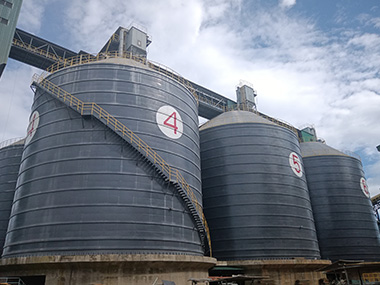

Steel Silo Retrofit Cost-Benefit: When Repairing Beats Replacing
Retrofitting an existing steel silo typically costs 40–60% less than building new, provided the foundation and shell are structurally sound. The break-even point usually lands between 8 and 15 years of extended service life. This article breaks down exactly where the money goes, what conditions make retrofit viable, and how we evaluate whether your silo is a candidate — or a liability.
1. When a Silo Is Worth Saving (and When It Isn't)
I've walked around enough corroded shells to know the difference between a silo that needs work and one that needs a crane and a wrecking ball. The call isn't always obvious from the outside.
1.1 The Structural Audit Checklist
Before we talk money, you need a proper condition assessment. We follow a five-point protocol that takes 2–3 days for a standard 2,000–5,000 m³ silo:
Shell thickness measurement. We use ultrasonic testing at 120+ points around the circumference, focusing on the lower third where abrasion and moisture concentrate. If remaining wall thickness drops below 60% of original spec, patchwork won't cut it — you're looking at panel replacement or full decommissioning. For a 6 mm original wall, that means 3.6 mm is the hard floor.
Foundation settlement check. Differential settlement exceeding 1:500 ratio (measured by precision levelling over a 24-hour thermal cycle) tells you the foundation is moving. I've seen a 4,000-tonne clinker silo in Indonesia with 18 mm of differential across an 8 m diameter base. That silo was re-leveled with micropiles and is still running — but the fix cost $180,000. Without it, the shell would have torn within two years.
Bolt integrity on bolted silos. On a 30-year-old bolted shell, expect 15–25% of bolts to be under-torqued or corroded. We torque-test a minimum of 10% of all bolts. If failure rate exceeds 30%, full bolt replacement is more economical than selective swaps.
1.2 Material-Specific Degradation Patterns
Not all stored products punish a silo equally. Here's what I've observed across different materials:
Cement and fly ash: Relatively benign on steel. The main issue is moisture ingress causing internal condensation and rust. A well-maintained cement silo shell lasts 25–35 years without major intervention.
Coal: Abrasion is the killer. Pulverized coal moving at 2–3 m/s through a conveying line eats through unprotected steel at roughly 1.5–2 mm per year in the discharge zone. We've measured 4 mm wall loss in 18 months on a coal silo in South Africa that had no wear liner.
Slag: The worst of both worlds — abrasive and hygroscopic. Slag absorbs moisture, clings to walls, and creates localized corrosion cells. Retrofit candidates storing slag need full internal lining assessment, not just thickness checks.
Sand and aggregate: External wear from loading cycles and wind, internal abrasion at impact zones. The conical bottom takes the beating — we routinely see 30–50% thickness loss in the lower cone after 15 years of operation.
1.3 The Hard No-Go Criteria
Some conditions make retrofit a waste of money. I'll tell you straight:
Foundation failure beyond repair. If the ring beam is cracked through or the soil bearing capacity has degraded below 120 kPa (common in flood-prone areas), you're building new. No amount of shell work fixes a bad base.
Shell deformation exceeding 2% of diameter. A 20 m diameter silo with 400 mm of out-of-round distortion is past the point of economic straightening. We tried hydraulic re-rounding on a silo in Vietnam — spent $90,000 and got it back to 1.2%. Still wouldn't hold a proper seal.
Weld seam cracks propagating beyond 300 mm. Short cracks can be excavated and re-welded. Long ones indicate systemic fatigue. That silo is cycling itself to death.
2. The Real Cost Breakdown of a Steel Silo Retrofit
Everyone wants a number. I'll give you ranges, but understand that a retrofit on a 3,000 m³ cement silo in Germany costs nothing like the same work in Nigeria. Labor rates, access, and local material availability swing the total by ±30%.
2.1 Shell Rehabilitation
Surface preparation and recoating: $25–45 per m² for full abrasive blast to Sa 2.5 followed by a two-coat epoxy system (150 μm DFT per coat). For a 3,000 m³ silo with roughly 800 m² of shell surface, that's $20,000–36,000 just on the coating. Internal coating runs 20–30% higher because of containment and ventilation requirements.
Panel replacement: When localized corrosion has eaten through, we cut out and weld in new sections. Expect $800–1,500 per m² of replaced panel, including scaffolding, welding, NDT inspection, and coating. A typical 2 m × 3 m patch runs $5,000–9,000.
Wear liner installation: Bolt-on AR400 steel liners or ceramic-embedded rubber liners for abrasion zones. AR400 at 6 mm thickness runs $120–180 per m² installed. A full cone lining on a 15 m diameter silo (roughly 85 m²) costs $10,000–15,000.
2.2 Mechanical and Conveying System Upgrades
This is where most retrofit budgets blow up — and where the biggest operational gains live.
Fluidization and aeration system replacement: Old cement silos with failed aeration pads are money pits. New aeration pad systems (rubber-cloth composite, rated for 0.5–1.0 bar) cost $80–150 per pad. A typical silo floor has 40–80 pads. Full replacement: $5,000–15,000 in materials, plus 3–5 days of installation labor.
Discharge system overhaul: Replacing a rotary valve, butterfly valve, and silo outlet flange assembly runs $8,000–25,000 depending on diameter (DN200–DN400) and material spec. Add $5,000–10,000 if the outlet transition cone needs re-lining.
Dust collection upgrade: A new baghouse rated for 10,000–15,000 m³/h with pulse-jet cleaning, explosion venting per EN 14491, and differential pressure monitoring runs $25,000–50,000. If your existing dust collector is pre-2010 and has no explosion isolation, this isn't optional — it's insurance.
2.3 Structural Reinforcement
Stiffener addition: External stiffener rings (typically 150 × 8 mm flat bar or L100 × 10 angle) welded to the shell to restore buckling resistance. Material cost is low — $50–80 per linear meter — but scaffolding and welding access drives the installed cost to $200–400 per meter. A silo needing three stiffener rings at 18 m circumference each: $12,000–22,000.
Anchor bolt replacement: If the existing anchors are corroded below 70% of original diameter, we drill new epoxy-grouted anchors alongside the old ones. $150–300 per anchor installed. A 20 m diameter silo base ring has 48–64 anchors. Budget $10,000–20,000 for a full anchor retrofit.
3. Benefit Quantification: What You Actually Gain
Retrofit isn't just about saving money versus new construction. The operational improvements often pay for the work independently.
3.1 Extended Service Life
A properly executed retrofit adds 15–25 years of service life to a steel silo. That's not a guess — it's based on coating system performance data (ISO 12944 life-to-first-maintenance predictions) and structural fatigue analysis per Eurocode 3.
Put it in financial terms: a new 3,000 m³ bolted steel silo costs $350,000–500,000 installed. A comprehensive retrofit costs $120,000–200,000. If the retrofit gives you 20 more years, you've avoided a $400,000 capital expenditure. That's a net saving of $200,000–280,000, or $10,000–14,000 per year of avoided cost. Compare that to any maintenance budget.
3.2 Operational Efficiency Gains
Discharge rate improvement: A silo with degraded aeration might discharge at 60–80% of design rate. New aeration pads and a properly sized blower restore 95–100% of rated throughput. On a 100 t/h cement silo, recovering 20 t/h of lost capacity is worth $50,000–100,000 annually in reduced truck waiting time and batch plant downtime.
Energy savings: Fluidization air is expensive to produce. A well-designed aeration system uses 0.8–1.2 kWh per tonne of material discharged. A degraded system with air leaks and clogged pads can hit 2.5–3.5 kWh per tonne. On 50,000 tonnes annual throughput, that's 85,000–135,000 kWh saved per year. At $0.10/kWh, that's $8,500–13,500 annually — enough to pay for the aeration retrofit in 1–2 years.
3.3 Safety and Compliance Value
This is the benefit nobody puts on a spreadsheet until something goes wrong.
Explosion protection compliance: EN 14491 requires dust explosion venting or suppression on silos handling combustible dust. If your silo was built before 2007 and has no venting, you're non-compliant. Retrofit venting (vents plus flame-quenching devices) costs $15,000–35,000 per silo. The alternative is a potential explosion that kills people and destroys a $500,000 asset. I don't need to do that math for you.
Structural code compliance: Seismic and wind load codes have tightened. Eurocode 1 (EN 1991-1-4 for wind, EN 1998-1 for seismic) demands more than older national codes. A retrofit that adds stiffeners and upgrades anchor bolts brings your silo into compliance — and keeps your insurance valid.
4. New Construction vs. Retrofit: The Decision Framework
Here's the decision tree we use with clients. It's not complicated, but it keeps emotions out of the budget conversation.
4.1 Cost Comparison at Scale
We analyzed 14 retrofit projects completed between 2019 and 2024, ranging from 1,000 m³ to 8,000 m³ capacity. The data:
Average retrofit cost: $45–85 per m³ of silo capacity. A 3,000 m³ silo averaged $165,000 for a full mechanical and coating retrofit.
Average new construction cost: $110–180 per m³ installed, including foundation. Same 3,000 m³ silo: $390,000–540,000.
Retrofit as percentage of new: 38–52% of replacement cost. The savings increase with silo size because foundation costs (which you don't repeat in a retrofit) are proportionally larger on bigger structures.
4.2 Timeline Comparison
Retrofit wins on schedule too. A new 3,000 m³ silo takes 4–6 months from foundation pour to mechanical completion. A retrofit takes 6–10 weeks of on-site work, typically executed during a planned shutdown.
But here's the catch — you need 8–12 weeks of engineering and procurement lead time before the shutdown window. If you call me in March and your shutdown is in April, I can't help you. Plan ahead.
4.3 Risk Factors That Tip the Scale Toward New
Despite the savings, sometimes new construction is the right call:
Multiple previous retrofits. If the silo has been patched three times already, you're throwing good money after bad. Each retrofit removes material — thinner shell, more distortion, fewer options.
Capacity increase needed. Retrofit doesn't add volume. If you need 5,000 m³ and your existing silo is 2,000 m³, no amount of internal optimization gets you there.
Product change. Switching from cement to slag or coal changes the abrasion and corrosion profile dramatically. A shell that's fine for cement may have 5–8 years of life left — but only 1–2 years under slag service. The economics collapse.
5. Case Study: 4,500 m³ Cement Silo Retrofit — Poland, 2023
A cement plant outside Kraków contacted us about two 4,500 m³ bolted steel silos built in 1998. Both had severe external corrosion on the lower 4 m of shell, failed aeration pads, and dust collectors with no explosion venting.
Assessment findings: Shell thickness in the corrosion zone averaged 3.8 mm (original 6 mm — 37% loss). Foundation was sound — differential settlement measured at 4 mm across the 14 m diameter base, well within tolerance. All anchor bolts tested above 85% of original diameter. Bolted shell connections showed 12% under-torqued bolts, within acceptable range.
Scope of work:
- Lower shell panel replacement: 18 panels (1.2 m × 2.5 m each), total 54 m²
- Full external recoating: 1,200 m², Sa 2.5 blast + 300 μm epoxy system
- Internal aeration pad replacement: 64 pads per silo, new blowers (7.5 kW each)
- Dust collector upgrade: New baghouse with explosion venting per EN 14491
- Two external stiffener rings per silo
Costs: Total project cost for both silos: €285,000. Per-silo cost: €142,500. Equivalent new construction estimate: €380,000 per silo. Savings: €237,500 per silo, or 62%.
Timeline: 9 days of on-site work per silo, executed during a planned 12-day shutdown. We used the extra 3 days as buffer — needed 2 of them when we found two panels thinner than the UT survey indicated.
Result: Discharge rate restored from 72 t/h to 105 t/h (design: 110 t/h). Aeration energy consumption dropped from 2.8 kWh/t to 1.1 kWh/t. Both silos passed EN 14491 compliance inspection. Projected service life extension: 20+ years.
6. Planning Your Retrofit: Critical Steps
The difference between a retrofit that lasts 20 years and one that fails in 3 comes down to planning.
6.1 Pre-Engineering Survey
Don't skip this. A proper survey costs $5,000–10,000 and takes 2–3 days. It includes ultrasonic thickness mapping, foundation levelling, bolt torque sampling, coating adhesion testing (pull-off per ISO 4624), and photographic documentation of every defect. This report becomes the basis for your scope of work and cost estimate.
I remember a project in Malaysia where the client skipped the survey to save money. We scoped the retrofit based on visual inspection alone. Once we started blasting, we found internal corrosion that doubled the panel replacement scope. The change order added $40,000 and 4 days to the schedule. The survey would have caught it.
6.2 Shutdown Window Planning
Most retrofits happen during planned maintenance shutdowns. Here's a realistic timeline for a 3,000–5,000 m³ silo:
- Days 1–2: Scaffolding erection, surface preparation (blasting)
- Days 3–4: Panel replacement and welding, NDT inspection
- Days 5–6: Coating application (primer + intermediate + topcoat, with 6–8 hour recoat windows)
- Days 7–8: Mechanical installation (aeration, discharge, dust collector)
- Days 9–10: Commissioning, leak testing, load testing
Weather is the wildcard. Epoxy coating application requires minimum 5°C and 85% relative humidity ceiling. In northern climates, that narrows your window to May–October. Plan accordingly.
6.3 Coating System Selection
This is where most retrofits fail prematurely. The coating system must match the stored product and environment:
Interior — cement/fly ash: Epoxy primer (75 μm) + epoxy topcoat (150 μm), total 225 μm DFT. Expected service life: 12–15 years in dry service.
Interior — coal/slag (moisture present): Zinc-rich epoxy primer (75 μm) + high-build epoxy (250 μm), total 325 μm DFT. Expected service life: 8–12 years.
Exterior — moderate climate: Zinc-rich primer (75 μm) + polyurethane topcoat (60 μm), total 135 μm DFT. Expected service life: 15–20 years per ISO 12944 C3 category.
Exterior — coastal/industrial: Thermal-sprayed aluminum (150 μm) + epoxy sealer (25 μm) + polyurethane topcoat (60 μm), total 235 μm DFT. Expected service life: 20–25 years per ISO 12944 C5-M category.
FAQ
Q: How do I know if my silo is a retrofit candidate or if I should just build new?
A: The three critical factors are foundation condition, shell remaining thickness, and deformation. If the foundation is sound (differential settlement under 1:500), shell thickness is above 60% of original in all zones, and out-of-round is under 2% of diameter, you're a retrofit candidate. If any one of those fails, get a second opinion — but start budgeting for new construction.
Q: What's the typical payback period for a silo retrofit?
Q: Can a retrofit increase my silo's storage capacity?
A: Not the physical volume — the shell is what it is. But retrofit can restore rated capacity that's been lost to bridging, rat-holing, or slow discharge. We've seen silos operating at 60–70% of nominal capacity due to poor aeration. A new aeration system and internal lining can bring that back to 95–100%. It's the same silo, but you're actually using what you built.
Get a Silo Condition Assessment from Manxing
We've assessed and retrofitted steel silos across 30+ countries — cement, clinker, fly ash, coal, slag, and aggregate. Our engineering team delivers a detailed condition report with thickness mapping, structural analysis, and a costed retrofit scope you can take straight to your capital planning committee.
Contact Manxing's silo engineering team for a pre-assessment consultation: https://www.manxingstorage.com
Send us your silo specifications (diameter, height, capacity, year built, stored product) and we'll give you a preliminary retrofit viability opinion within 5 working days — no commitment required.