
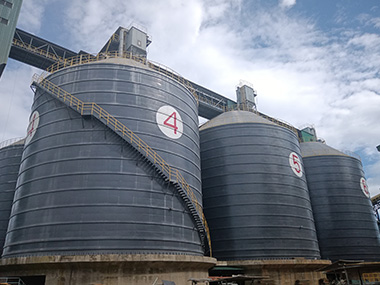

Steel Silo Spare Parts Inventory Economics: What to Stock, What to Skip, and the Numbers Behind Both Decisions
Maintaining a spare parts inventory for steel silos isn't about hoarding bolts in a back room — it's a calculated economic decision with real downtime costs on the other side. The short answer: stock the long-lead, failure-prone components that can shut down your entire operation, and don't stock structural steel that you can fabricate locally in 48 hours. The better answer depends on your silo count, your distance to suppliers, and how much an unplanned shutdown actually costs you per hour.
The Real Cost of an Empty Shelf
Downtime Math That Changes Your Mind About Spare Parts
I've been on commissioning sites where a single missing solenoid valve — a $220 part — shut down a 5,000-tonne cement terminal for 11 days. The plant was losing roughly $45,000 per day in missed shipments. The valve sat in a warehouse in Germany. Nobody had thought to stock it because "we've never had one fail before."
That's the trap. You calculate spare parts cost against purchase price. You should calculate it against consequence. Here's the framework I use with clients:
- Critical path parts — anything whose failure stops discharge or filling. Think: rotary valve bearings, aeration fan motors, high-level sensors, butterfly valve actuators.
- Lead time — if the replacement takes more than 72 hours to reach your site, it belongs on your shelf regardless of cost.
- Failure probability — components in abrasive service (fly ash, slag, coal) fail on predictable cycles. You can plan for them.
A cement plant running four silos with pneumatic discharge will typically see 2-3 aeration fan motor failures per year across the system. Each motor costs $800-$1,400. Stocking one spare costs less than a single day of lost production at most plants. The math isn't complicated — most plants just never do it.
The Carrying Cost Nobody Talks About
On the flip side, I've walked into warehouses in Jiangsu where plants had $180,000 worth of spare parts sitting untouched for six years. Dust-covered cartons of gasket material that had degraded past usability. Filter bags that had absorbed moisture and developed mold. Bearings where the preservative grease had separated.
Inventory carrying cost runs about 18-25% of inventory value per year when you factor in storage, insurance, obsolescence, and capital tied up. That $180,000 warehouse was costing the plant $32,000-$45,000 annually just to hold parts that were slowly becoming garbage.
The sweet spot? Most single-silo operations need $8,000-$15,000 in active spare parts inventory. Multi-silo terminals (4+ silos) typically run $25,000-$60,000. Beyond that, you're probably overstocking — or you haven't analyzed your failure data properly.
Which Parts Actually Fail (and Which Ones Sit Forever)
The High-Failure Components You Should Always Stock
After reviewing maintenance logs from about 200 silo systems across 30+ countries, here's what breaks first and most often:
Aeration system components. Aeration pads, air control solenoid valves, and pressure relief diaphragms live in the harshest environment inside a silo — constant moisture, abrasive dust, and temperature swings. In coal and slag applications, aeration pads typically need replacement every 18-30 months. Solenoid valves on sequencing systems fail every 2-4 years depending on cycle frequency. Stock at least 10% of your total aeration pad count and 2 spare solenoid valves minimum.
Dust collector filter elements. This is the single most commonly stocked spare for good reason. A typical baghouse on a 3,000-tonne cement silo runs 72-120 filter bags. Bag life ranges from 18 months (coal, high-moisture applications) to 4+ years (clean cement, low-humidity environments). Stock a full set. When one fails, others are close behind — it's rarely an isolated event.
Rotary valve and feeder components. The rotor tip clearance on a rotary valve handling fly ash closes up from abrasion. End plate wear, bearing seals, and drive chain components all have predictable service intervals. In slag applications, you're looking at rotor rebuilds every 8-12 months. Stock a full rotor assembly kit and two sets of bearings.
Level sensors and monitoring electronics. Radar level transmitters, capacitive probes, and pressure switches fail from moisture ingress, lightning surges, and simple electronic aging. These are long-lead items — 4-8 weeks from European or Japanese manufacturers. Stock one spare per silo for critical measurement points.
The Parts You're Probably Overstocking
Here's where I'll probably ruffle some feathers. You don't need spare silo shell plates. You don't need spare stiffeners. You don't need spare roof structural members.
Why? Because structural steel doesn't fail catastrophically without warning — you see corrosion, you measure thickness, you plan the repair. A qualified fabricator can cut and weld replacement panels in 2-3 days. The steel itself costs $650-$900 per tonne. Stocking a spare shell plate "just in case" ties up capital for a scenario that, in 15 years, I've seen happen exactly twice — both times from foundation settlement, not material failure.
Similarly, spare bolts beyond your standard maintenance stock (typically 5% overage of installed quantities for M16-M24 structural bolts) are wasted money. Bolts don't fail in service — they either get torqued correctly during installation or they don't. If you're losing bolts, your problem isn't inventory, it's installation quality.
Ladders, platforms, handrails — fabricate on demand. Hopper liners in non-abrasive service — they'll outlast the silo. Roof vents and pressure/vacuum relief valves — these are standard catalog items available in 3-5 business days from most industrial suppliers globally.
Building an Inventory Strategy That Actually Works
ABC Classification for Silo Spare Parts
The ABC classification method works well for silo parts when you adapt it to failure consequence rather than just purchase price:
- Class A — Critical, long lead time. These parts stop production and take more than 5 days to procure. Examples: aeration fan motors (110-220 kW), rotary valve gearboxes, PLC modules for automated discharge systems, radar level transmitters. Stock 1-2 spares minimum. Review quarterly.
- Class B — Important, moderate lead time. These parts degrade performance or create safety risks but don't immediately halt operations. Examples: filter bags, aeration pads, solenoid valve assemblies, butterfly valve actuators. Stock per calculated consumption rate plus 20% safety buffer. Review semi-annually.
- Class C — Commodity, short lead time. Gaskets, standard fasteners, lubrication fittings, indicator lights, pressure gauges. Stock minimum quantities for scheduled maintenance only. Reorder as consumed.
The mistake I see constantly is plants treating everything as Class A because "we can't afford downtime." That's not strategy — that's anxiety with a purchase order. You can't eliminate all risk. You allocate capital where it has the highest return in risk reduction.
Vendor-Managed Inventory and Consignment Programs
For multi-silo operations, vendor-managed inventory (VMI) programs can cut your carrying cost by 30-40%. The principle is simple: your equipment supplier stocks critical spares at their facility, you pay only when you pull them, and they guarantee availability within a contracted lead time — typically 48-72 hours for Class A items.
We've set up consignment programs for cement terminals in Vietnam and Indonesia where the client holds zero spare parts on-site for their dust collection and aeration systems. The parts live in our regional warehouse. When something fails, we ship within 24 hours. The client pays a quarterly management fee — typically $2,000-$5,000 depending on inventory scope — and actual part cost only on withdrawal.
This works when you have a reliable supplier relationship and clear failure history data. It doesn't work when you're buying from three different OEMs who won't coordinate. Consolidate your equipment supply chain first, then layer on VMI.
The 72-Hour Rule
Here's a rule I've used on every project since 2012: if a part failure can shut down your silo and the replacement takes more than 72 hours to reach your site from order to installation, that part belongs in your inventory. No exceptions.
This rule has saved more production hours than any predictive maintenance program I've seen. It's brutally simple. You don't need software. You don't need a reliability engineer. You just need a spreadsheet with two columns: "time to failure" and "time to replace." Where the second number exceeds 72 hours, buy a spare.
Case Study: Fly Ash Terminal Inventory Optimization
Client: Thermal power plant fly ash storage and dispatch terminal, central China. Four 2,000-tonne steel silos with pneumatic conveying, aeration systems, baghouse dust collection, and automated truck loading.
Situation: The plant was experiencing an average of 4.7 unplanned downtime events per year related to silo systems, averaging 14 hours each. Annual downtime cost: approximately $280,000. Their spare parts inventory was valued at $95,000 but consisted mostly of structural fasteners, spare ladders, and redundant gasket sheets — none of the parts that were actually causing shutdowns.
Analysis: We reviewed 36 months of maintenance records. The actual failure drivers were:
- Dust collector filter bag blowouts (62% of downtime events)
- Aeration fan motor bearing failures (18%)
- Rotary valve rotor jamming from ash compaction (12%)
- Level sensor malfunctions (8%)
Solution: We restructured the inventory to focus on actual failure modes:
- Full set of filter bags per silo (4 sets total) — $14,800
- 2 spare aeration fan motor assemblies — $3,600
- 4 rotary valve rotor kits — $6,400
- 4 spare radar level transmitters — $9,200
- 20 spare aeration pads — $1,100
- 6 spare solenoid valve assemblies — $2,100
- Consolidated gasket and fastener stock — $2,800
Total optimized inventory: $40,000 — a 58% reduction from the previous $95,000.
Results (12-month post-implementation):
- Unplanned downtime events: reduced from 4.7 to 1.2 per year
- Average downtime per event: reduced from 14 hours to 3.5 hours (faster diagnosis and replacement)
- Annual downtime cost: reduced from $280,000 to approximately $62,000
- Inventory carrying cost saving: $10,000-$14,000 per year
- Net annual benefit: approximately $228,000
The plant manager told me something I think about a lot: "We spent $55,000 less on spare parts and saved $218,000 in production. Nobody in accounting believed the numbers at first."
Procurement Timing and Lead Time Realities
Global Supply Chain Lead Times You Should Plan Around
This is where most inventory plans fall apart — they assume parts are available when you need them. Here are realistic lead times I've experienced in the past three years (2022-2025):
- European-manufactured dust collector bags (Nomex, PTFE membrane): 6-10 weeks from order to delivery in Asia/Africa. Rush orders at 30-40% premium: 3-4 weeks.
- Japanese radar level transmitters (24 GHz, silo-rated): 8-12 weeks standard. Some models are allocation-limited.
- Chinese domestic aeration fan motors (standard IEC frame sizes): 1-3 weeks. Custom voltage/frequency: 4-6 weeks.
- Rotary valve gearboxes (European OEM): 10-16 weeks. This is the longest-lead mechanical component in most silo systems.
- Solenoid valve assemblies for aeration sequencing: 2-6 weeks depending on manufacturer and coil voltage specification.
If your operation is in Sub-Saharan Africa, South America, or Central Asia, add 2-4 weeks to all of the above for shipping and customs clearance. I've seen filter bags stuck in Mombasa port for three weeks because the customs classification was disputed. That's not an outlier — that's normal.
Bulk Purchasing vs. Just-in-Time for Consumables
For high-consumption items like filter bags, aeration pads, and gaskets, bulk purchasing at 12-24 month intervals typically saves 15-25% compared to quarterly ordering. The trade-off is storage space and carrying cost.
Here's the break-even: if your annual filter bag consumption costs more than $8,000, buying a 24-month supply upfront almost always wins. The unit price discount (typically 12-18% at quantity breaks) exceeds the carrying cost of holding inventory for an extra year. Below that threshold, quarterly ordering keeps your capital free for other priorities.
For gaskets and sealing materials, I'd caution against bulk purchases. Rubber and PTFE gasket materials have shelf lives — typically 5 years for PTFE, 3-4 years for compressed fiber, 2-3 years for rubber. Buy what you'll consume within the material's shelf life, regardless of price breaks.
FAQ
How do I determine the right spare parts inventory value for my silo operation?
Start with your failure history. If you have 2+ years of maintenance records, identify the parts that caused unplanned downtime and calculate the cost of each event. Stock spares for any component where (probability of failure × cost of downtime) exceeds (cost of spare × carrying cost). For most single-silo operations, this lands between $8,000 and $15,000. For multi-silo terminals, $25,000-$60,000. If you don't have failure history yet, budget 2-3% of total silo system capital cost as your initial spare parts allocation, then adjust after 18 months of operation data.
Should I stock spare parts for brand-new silos, or wait until I have failure data?
Stock the long-lead items from day one — specifically dust collector filter bags, aeration fan motors, and level sensors. These have predictable failure rates regardless of your specific operating conditions, and their lead times (6-12 weeks for some components) make reactive purchasing risky. For everything else, wait 12-18 months. You'll have real failure data by then, and you'll avoid stocking parts your specific application never needs. The warranty period (typically 12-24 months on mechanical components) also covers premature failures, so you have a buffer.
What's the minimum spare parts kit I need to keep a cement silo operational during an unplanned failure?
For a standard cement silo with mechanical or pneumatic discharge, the absolute minimum is: one full set of dust collector filter bags, one spare aeration fan motor (or at minimum a spare V-belt set and bearing kit), two spare solenoid valves for aeration control, one spare level sensor (matching your installed type), and a basic gasket kit for flanged connections. Total cost: typically $5,000-$12,000 depending on silo size and equipment specification. This kit covers 80%+ of failure scenarios that cause unplanned downtime. Store it in a clean, dry indoor location — not next to the silo in the weather.
Get a Site-Specific Spare Parts Strategy From Manxing
We've designed and built steel silo systems for cement, clinker, fly ash, coal, slag, and aggregate plants across 30+ countries. Every project we deliver includes a tailored spare parts inventory recommendation based on your specific materials, climate, equipment selection, and operational criticality — not a generic parts list copied from a catalog.
Contact our engineering team at manxingstorage.com for a spare parts audit of your existing silos, or to discuss inventory planning for a new installation. We'll give you the numbers — failure rates, lead times, carrying costs, and the actual parts you need on your shelf.