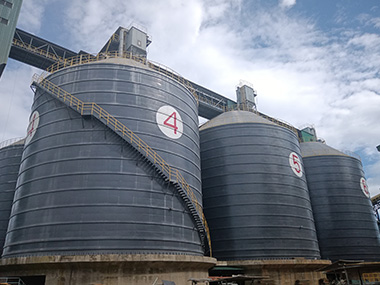
What are typical energy costs for steel silo operations, and how do you benchmark them against industry standards? Aeration systems typically consume 0.8–2.5 kWh per ton annually, while material handling adds 1.5–4.0 kWh/ton depending on conveying distance. Benchmarking involves measuring actual consumption against commodity-specific baselines, accounting for climate, throughput, and equipment age to identify efficiency gaps exceeding 15–30% above optimal levels.
Understanding Energy Cost Components in Steel Silo Operations
Figure 1Figure 2Figure 3
Aeration System Energy Consumption
Aeration fans represent the single largest continuous energy draw in steel silo storage. For grain silos with ambient aeration, fan power ranges from 0.1 to 0.3 kW per 1,000 bushels of capacity. Low-volume aeration systems (0.1–0.2 cfm/bu) typically consume 0.8–1.5 kWh/ton/year in temperate climates, while hot-arid regions may push consumption to 2.5 kWh/ton/year. Fan selection directly impacts long-term costs: a 10% oversizing in fan power increases annual energy expenditure by approximately 12–15% due to cubic relationships between airflow and power draw.
Material Handling Equipment Loads
Bucket elevators, belt conveyors, and tripper systems account for 40–60% of total silo facility energy use during intake and discharge cycles. A standard 100-ton-per-hour elevator with a 30-meter lift consumes 5.5–7.5 kW, translating to roughly 1.8–2.5 kWh per ton handled. Conveying distances beyond 50 meters add 0.3–0.5 kWh/ton per additional 10 meters. Facilities with multiple transfer points see cumulative losses of 8–12% per additional handling stage.
Climate Control and Ventilation Costs
Temperature-controlled silos for specialty commodities (cement, fly ash, food-grade materials) incur supplementary energy costs for ventilation and humidity management. Cement storage silos with aerated homogenizing systems consume 3.5–6.0 kWh/ton annually, while food-grade facilities requiring temperature maintenance within ±2°C may see HVAC-related costs of 4.0–8.0 kWh/ton/year depending on ambient conditions and insulation quality.
Industry Benchmarks and Cost Metrics
kWh Per Ton Standards by Commodity
Industry benchmarks establish baseline consumption rates: grain storage (wheat, corn, soybean) averages 1.5–3.0 kWh/ton/year including aeration and handling; cement and fly ash silos range from 4.0–7.5 kWh/ton/year due to fluidization requirements; plastic pellets and chemical powders typically fall between 2.0–4.5 kWh/ton/year. Facilities exceeding these ranges by more than 20% should prioritize energy audits and equipment upgrades.
Seasonal Variation Factors
Energy consumption fluctuates significantly with seasonal conditions. Summer months in subtropical regions can increase aeration costs by 40–60% compared to winter baselines due to higher ambient temperatures and humidity. Tropical facilities report peak-to-trough ratios of 1.8:1, while temperate regions experience 1.3:1 variation. Benchmarking must normalize for seasonal factors using degree-day calculations or equivalent full-load hour metrics to enable valid cross-facility comparisons.
Comparative Analysis: Steel vs. Concrete Silo Energy Profiles
Steel silos generally demonstrate 10–20% lower aeration energy requirements than concrete alternatives due to thinner wall profiles reducing thermal mass and enabling faster temperature equalization. However, uninsulated steel silos in extreme climates may incur 15–25% higher cooling energy costs. Insulated steel silo designs with 50–100mm polyurethane or mineral wool cladding reduce thermal bridging and cut seasonal energy variation by 30–45%, delivering payback periods of 3–5 years in climates with temperature swings exceeding 25°C annually.
Measurement and Monitoring Frameworks
Submetering Best Practices
Effective benchmarking requires granular energy measurement at the equipment level. Install dedicated power meters on aeration fan circuits, elevator drives, and dust collection systems. Minimum monitoring intervals should capture 15-minute demand data to identify peak loads and idle consumption. Facilities implementing comprehensive submetering typically identify 12–18% energy waste within the first 90 days, primarily from fans running during non-essential periods and equipment operating at partial load with poor power factors.
Data Collection Intervals and KPIs
Key performance indicators for silo energy benchmarking include: specific energy consumption (kWh/ton handled), fan runtime hours per week, average power factor (target ≥0.92), and peak demand (kW) relative to installed capacity. Monthly data aggregation enables trend analysis, while quarterly reviews support capital planning. Leading facilities track energy intensity ratios against throughput, detecting degradation signals when kWh/ton increases by more than 5% quarter-over-quarter without operational changes.
Energy Audit Methodologies
Walk-through audits should examine fan inlet conditions, duct leakage rates, motor efficiency ratings, and control logic. Thermal imaging identifies insulation failures and bearing friction losses. Airflow measurement at fan discharge verifies actual versus design performance—field studies show 20–35% of installed aeration fans operate at less than 70% of rated airflow due to duct restrictions, filter loading, or impeller wear. Comprehensive audits typically yield 8–15% energy reduction recommendations with implementation costs recovered within 18–36 months.
Optimization Strategies to Reduce Energy Costs
Variable Frequency Drive (VFD) Integration
Installing VFDs on aeration fans delivers the highest single-point energy savings, typically 25–40% reduction in fan energy consumption. By matching airflow to actual storage conditions rather than running at fixed speed, VFDs eliminate throttling losses and reduce motor heating. For a 10,000-ton grain silo with 37 kW aeration fans, VFD retrofit costs of $15,000–$25,000 yield annual savings of $8,000–$14,000 at $0.08/kWh, achieving payback in 18–30 months. Modern VFDs also provide soft-start capabilities, reducing mechanical stress on fan assemblies.
Aeration Scheduling Optimization
Time-based and condition-based aeration scheduling reduces unnecessary fan runtime by 30–50%. Implementing temperature-differential controls—activating fans only when grain temperature exceeds ambient by defined thresholds—eliminates cooling during already-favorable conditions. Advanced systems using predictive weather algorithms pre-cool grain before hot periods, reducing peak demand by 20–35%. Facilities transitioning from continuous to optimized scheduling report annual energy reductions of 150–400 kWh per 1,000 tons of storage capacity.
Insulation and Thermal Management
External insulation of steel silo shells and roofs reduces solar heat gain by 60–80% in high-insulation regions. A 75mm polyurethane coating on a 15-meter-diameter silo reduces internal temperature rise from solar radiation by 8–12°C during peak summer conditions. This translates to 20–30% lower aeration energy for temperature maintenance. Combined with reflective roof coatings (solar reflectance index ≥82), total thermal management packages deliver 25–40% energy savings with 4–7 year paybacks in regions receiving more than 2,000 kWh/m² annual solar irradiation.
Pro Tip: Benchmark your silo energy costs quarterly using normalized kWh/ton metrics adjusted for throughput and climate. Facilities that implement continuous monitoring with automated alerts for consumption deviations exceeding 10% from baseline achieve 15–25% lower annual energy costs than those relying on annual utility bill reviews alone.
Case Study: Cement Silo Energy Optimization
A cement storage facility in Southeast Asia operating six 5,000-ton steel silos with fluidizing aeration systems recorded annual energy consumption of 6.8 kWh/ton—35% above the industry benchmark of 5.0 kWh/ton for comparable operations. An energy audit identified three primary issues: continuous fan operation (24/7) regardless of discharge schedules, air compressor inlet filters at 60% of original flow capacity, and uninsulated aeration piping causing 15% pressure losses.
The facility implemented three corrective measures: (1) automated fan scheduling tied to dispatch operations, reducing runtime from 8,760 to 3,200 hours annually; (2) filter replacement and duct sealing, restoring compressor efficiency from 78% to 94%; and (3) VFD installation on two primary aeration fans. Post-implementation monitoring over 12 months showed energy consumption reduced to 4.2 kWh/ton—16% below the industry benchmark—yielding annual savings of $42,000 against a total investment of $38,000, achieving full payback in 10.8 months.
Frequently Asked Questions
What is the average energy cost per ton for steel silo storage?
Industry averages range from 1.5–3.0 kWh/ton/year for grain storage and 4.0–7.5 kWh/ton/year for cement and bulk powder storage. At $0.08–$0.12/kWh electricity rates, this translates to $0.12–$0.36 per ton annually for grain and $0.32–$0.90 per ton annually for cement. Actual costs vary based on climate, throughput frequency, and equipment efficiency.
How often should silo energy performance be benchmarked?
Monthly data collection with quarterly benchmarking reviews is recommended for facilities exceeding 5,000-ton capacity. Smaller operations may benchmark semi-annually. Continuous monitoring systems with automated reporting enable real-time deviation detection and should trigger investigation when consumption exceeds baseline by more than 10% for two consecutive periods.
Which energy optimization offers the fastest payback for steel silos?
Aeration scheduling optimization typically delivers the fastest payback—often under 12 months—since it requires minimal capital investment (primarily control system programming). VFD retrofits follow with 18–36 month paybacks. Insulation upgrades offer longer paybacks of 4–7 years but provide compounding benefits through reduced equipment wear and improved material quality preservation.
Optimize Your Steel Silo Energy Performance with Manxing
Manxing delivers EPC silo solutions engineered for energy efficiency from design through commissioning. Our integrated approach combines optimized aeration system design, VFD-ready