
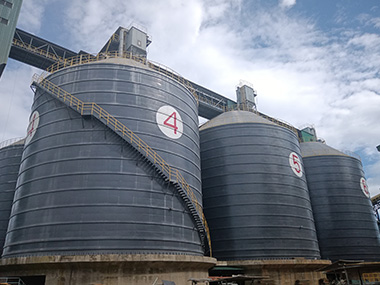

Steel Silo ROI Calculation Methods: What Actually Pays Back (And What Doesn't)
Steel silo ROI is calculated by comparing total lifecycle cost — capital expenditure plus 20-30 years of operation and maintenance — against the value of stored material protected, handling efficiency gained, and downtime avoided. For most cement, clinker, and fly ash applications, welded or bolted steel silos deliver payback within 2.5 to 4 years compared to equivalent concrete storage. Here's how to run the numbers yourself, and where most plants get it wrong.
1. Capital Expenditure Breakdown — Where the Money Actually Goes
Nobody builds a silo for the steel alone. The shell is usually 28-35% of the total installed cost. The rest is foundations, internals, dust systems, and erection labor. If your ROI model only looks at the silo price tag, you're already underestimating by a factor of 1.6 to 2.2.
1.1 Civil Works and Foundations
Foundation costs vary wildly by soil conditions. On competent rock or dense gravel, a ring-beam foundation for a 5,000-tonne cement silo runs $180-260 per cubic meter of concrete. On soft clay or reclaimed land — which I've seen at plants in Indonesia and Bangladesh — you're looking at pile foundations that push that figure to $340-480 per cubic meter. A 3,000-tonne silo with a 14-meter diameter typically needs 180-250 cubic meters of foundation concrete. Do the math: that's $45,000-120,000 just for the pad, before a single steel plate arrives on site.
Concrete silos need more foundation because they're heavier — roughly 2.3 to 2.8 times the dead load of an equivalent steel silo. That's not a small difference when you're designing piles in a seismic zone.
1.2 Steel Shell and Fabrication
Welded steel shells for cement storage typically use 6-12 mm plate in the lower rings, stepping down to 4-6 mm in the upper sections. Bolted galvanized panels — the kind we use for agricultural-adjacent applications like grain terminals or smaller fly ash silos — run 0.8-2.0 mm thick with zinc coating at 275 g/m² (that's Z275, per EN 10346).
Fabrication cost for a welded carbon steel shell sits around $1,100-1,600 per tonne of steel erected, including surface preparation and painting to ISO 12944 C4 corrosion category. For a 5,000-tonne silo weighing roughly 85-110 tonnes of steel, that's $95,000-175,000 in shell fabrication and painting alone. Bolted panel silos are cheaper per tonne of steel but use less total steel — the landed cost difference narrows to 10-15% once you factor in shipping and assembly.
1.3 Internals, Aeration, and Dust Collection
This is where budgets get eaten. A cement silo with fluidizing aeration floors, a bin activator at the outlet, and a baghouse rated for 10,000-15,000 m³/h airflow adds $60,000-140,000 depending on capacity. The baghouse alone — with pulse-jet cleaning, explosion venting per EN 14491, and a fan pulling 2,500-3,500 Pa — accounts for $25,000-55,000 of that.
Skip the dust system to save money and you'll pay for it three times over: material loss, regulatory fines, and respiratory claims. I've seen a plant in North Africa lose 1.2% of throughput to wind-blown dust from an open-top silo. On 500,000 tonnes per year, that's 6,000 tonnes of cement — roughly $480,000 annually at current prices.
2. Operational Savings — The Numbers That Quietly Compound
Capital cost is one decision. Operational cost is the next twenty years. Steel silos win on opex in three specific areas: energy for material handling, material degradation losses, and labor for maintenance.
2.1 Energy Consumption for Discharge
Fluidized cement discharge from a steel silo draws 0.8-1.5 kWh per tonne, depending on the aeration system design and material moisture content. A concrete silo with a similar capacity but less efficient outlet geometry — because you can't as easily fabricate complex cone shapes in cast-in-place concrete — typically consumes 1.3-2.2 kWh per tonne.
At a plant moving 200,000 tonnes per year through a single silo, that difference of 0.5 kWh/tonne adds up to 100,000 kWh annually. At $0.08/kWh industrial rate in Southeast Asia, that's $8,000 per year. Doesn't sound dramatic until you multiply by 20 years: $160,000 in today's dollars, before energy price escalation.
2.2 Material Degradation and Spoilage
Cement stored in a properly sealed steel silo with desiccant breathers and moisture-controlled aeration loses less than 0.3% of its quality metrics over 90 days. Open storage or poorly sealed concrete silos in humid climates can lose 1.5-3.0% — not spoilage in the food sense, but strength degradation that downgrades the product.
Here's the thing. I remember a project in Malaysia where a competitor's concrete clinker silo had been leaking at the construction joints for two years. The clinker had absorbed enough moisture to add 4.2% water content by weight. The downstream grinding circuit's energy consumption jumped 8% because the mills were grinding wet material. Nobody connected the dots until we measured the moisture at the silo outlet versus the pile. That plant was burning an extra $220,000 per year in electrical costs because of a silo nobody thought to waterproof properly.
2.3 Maintenance Labor Hours
Steel silos require external visual inspection annually and internal inspection every 5-7 years per EN 1993-4-1 (the Eurocode standard for shell structures). Typical annual maintenance labor: 16-40 man-hours for a single silo, including bolt-torque checks on access doors, gasket replacement on the baghouse, and liner wear inspection at impact zones.
Concrete silos need crack monitoring, carbonation testing, and joint sealant replacement. Annual labor runs 40-80 man-hours. The difference isn't huge per year, but over a 25-year service life, that's 600-1,000 additional hours. At fully loaded labor rates of $45-75/hour in most markets, that's $27,000-75,000 in cumulative maintenance labor savings for steel.
3. Payback Period vs. Concrete — A Direct Comparison
This is the calculation plant managers actually care about. Not lifecycle cost in year 25 — payback. When does the steel silo pay for itself compared to the alternative?
3.1 The Baseline Assumptions
Let's use a 5,000-tonne cement silo as the reference case. Welded steel, 14-meter diameter, 28-meter high to eaves, with fluidizing aeration, baghouse, and complete discharge system. Concrete equivalent: cast-in-place slip-formed silo with the same capacity and a mechanical extraction system.
Installed cost for steel: $420,000-580,000 (depending on region and soil conditions). Installed cost for concrete: $510,000-720,000. The steel silo is cheaper upfront by roughly $90,000-140,000 in most markets. But the real advantage compounds in year-on-year opex.
3.2 Annual Operating Cost Differential
Steel silo annual opex (energy + maintenance + dust losses): $18,000-32,000. Concrete silo annual opex: $32,000-55,000. The difference of $14,000-23,000 per year means the steel silo's initial cost advantage widens every single year.
If the steel silo costs $120,000 less to install and saves $18,000 per year in operations, the simple payback on choosing steel over concrete is negative — steel is cheaper from day one. The real question is: what's the ROI on the total investment versus the next best alternative (which might be renting storage space or using open stockpiles).
3.3 ROI Against Open Storage
Open stockpiles are the real baseline for many developing-market plants. Zero silo cost, but material losses of 2-5% annually from wind and rain, plus quality degradation, plus the land footprint (a 5,000-tonne cement pile needs roughly 800-1,200 m² of covered or uncovered storage area).
At 3% annual loss on 200,000 tonnes of cement throughput, that's 6,000 tonnes lost — $480,000/year in material value. A $500,000 steel silo that eliminates 90% of that loss pays for itself in 14 months. That's an ROI north of 80% in year one.
4. Lifespan and Residual Value — Don't Ignore Year 20
ROI calculations that stop at year 5 or 7 are incomplete. Steel silos have a designed service life of 30-50 years with proper maintenance. Concrete silos also last decades, but their maintenance trajectory curves upward after year 15 — carbonation, chloride ingress, and reinforcement corrosion start accelerating.
4.1 Depreciation and Tax Treatment
In most jurisdictions, steel silos are classified as equipment (depreciable over 7-15 years) rather than buildings (25-40 years). That accelerated depreciation shields taxable income in the early years — exactly when the silo is generating the most operational savings. A $500,000 silo depreciated over 10 years straight-line gives $50,000/year in non-cash deduction. At a 25% corporate tax rate, that's $12,500/year in tax savings for a decade.
Concrete silos, classified as structures, depreciate over 25-40 years. The annual deduction is smaller, and the tax benefit is spread thinner.
4.2 Residual Value and Relocation
A steel silo can be dismantled, transported, and reassembled at a new site. The recovery value of a used steel silo is typically 25-40% of the original installed cost, depending on condition and market demand. Concrete silos are demolition projects — residual value is negative (you pay to tear them down).
This matters more than people think. Plant relocations happen. I've been involved in three projects where a cement producer moved operations within 10-15 years. The steel silos were unbolted, trucked 200-400 km, and reassembled with new foundations. Total relocation cost: 35-45% of a new silo. Try doing that with a concrete silo.
5. Risk-Adjusted ROI — Accounting for What Can Go Wrong
Straight-line ROI is a fairy tale. Real projects have delays, weather, soil surprises, and commissioning hiccups. A risk-adjusted calculation adds contingency and discount rates to reflect reality.
5.1 Schedule Risk and Construction Duration
Steel silos go up fast. A 5,000-tonne welded silo takes 8-12 weeks from foundation completion to mechanical completion. A concrete silo of the same capacity takes 16-24 weeks. That 2-3 month difference means earlier revenue generation — or earlier cost avoidance if the silo replaces rented storage.
Every month of delayed commissioning on a silo project costs $15,000-40,000 in extended project management, idle equipment rental, and delayed production. Steel's faster schedule isn't just convenient — it's a quantifiable ROI factor.
5.2 Discount Rate Selection
Use a discount rate that matches your cost of capital. For state-owned enterprises in stable markets, 6-8% is reasonable. For private producers in emerging markets with higher borrowing costs, 10-14% is more realistic. At a 10% discount rate, $18,000 in annual savings has a present value of roughly $153,000 over 20 years. That's nearly a third of the silo's installed cost, returned purely through operational efficiency.
5.3 Failure Cost Scenarios
What happens if the silo underperforms? A blocked outlet that stops dispatch for 24 hours at a plant shipping 800 tonnes per day costs $48,000-64,000 in demurrage, customer penalties, and emergency trucking. A silo with redundant discharge systems (dual bin activators, backup aeration pads) costs $15,000-25,000 more upfront but eliminates single-point failure risk.
That's not a theoretical concern. Got a call at 2am from a plant in Shandong — their single-outlet silo had a seized bin activator. They were loading trucks at 40% rate and had 16 vessels waiting at the port. We walked the maintenance team through a manual bypass procedure on the phone. Took 18 hours to fully resolve. They've since added a secondary discharge on every silo. The ROI on redundancy paid for itself in that one incident.
6. Case Study: 10,000-Tonne Clinker Silo Project
Project: Greenfield clinker storage silo for a 3,000 TPD cement plant in Vietnam. Options evaluated: Single 10,000-tonne welded steel silo vs. two 5,000-tonne concrete silos.
Steel silo option: 20m diameter × 32m high, welded carbon steel shell (8-14mm plate), fluidizing aeration floor, twin baghouses rated at 12,000 m³/h each, explosion venting per EN 14491 with flameless venting devices on the roof. Installed cost: $680,000. Construction time: 14 weeks from foundation pour to mechanical completion.
Concrete option: Two 5,000-tonne slip-formed silos, 14m diameter × 26m high each, with mechanical belt-extraction systems. Installed cost: $820,000. Construction time: 26 weeks (sequential slip-forming, not parallel due to crane availability).
ROI outcome: The steel silo cost $140,000 less upfront and came online 12 weeks earlier. At the plant's clinker production rate and market price, those 12 weeks of earlier operation represented $340,000 in additional throughput that didn't need to be stockpiled or diverted. Combined with $22,000/year in lower maintenance and energy costs, the steel option delivered a net present value advantage of $410,000 over 15 years at an 8% discount rate.
The plant chose steel. They're now specifying steel silos for all new storage — including a second 10,000-tonne silo for gypsum and a 3,000-tonne fly ash silo added in 2023.
Frequently Asked Questions
Q: What's the typical payback period for a steel cement silo versus open storage?
A: For plants with annual throughput above 100,000 tonnes, payback against open storage is typically 12-24 months when you factor in material losses of 2-5% annually. For smaller operations (under 50,000 tonnes/year), payback extends to 3-5 years — still well within the silo's service life.
Q: How do I account for corrosion in a 20-year ROI model?
A: Use a maintenance reserve of 1.5-2.5% of the shell fabrication cost per year for repainting and patch replacement in C4 corrosive environments (per ISO 12944). In marine or high-humidity coastal sites, bump that to 3-4% and specify a higher paint system — 240-300 µm total dry film thickness with zinc-rich primer. Over 20 years, cumulative corrosion maintenance runs $40,000-90,000 for a medium-sized silo. It's real money, but it doesn't change the ROI conclusion versus concrete.
Q: Are bolted steel silos worth the premium over welded for ROI purposes?
Get a Project-Specific ROI Analysis
Manxing provides detailed capital and operational cost modeling for every silo project we quote — including lifecycle cost projections, payback calculations against your current storage method, and risk-adjusted NPV at your cost of capital. We've delivered EPC silo projects across 30+ countries for cement, clinker, fly ash, coal, slag, and alumina plants.
Contact our engineering team →
Site survey → Design → Fabrication → Erection → Commissioning. Full EPC scope or individual engineering services available.