
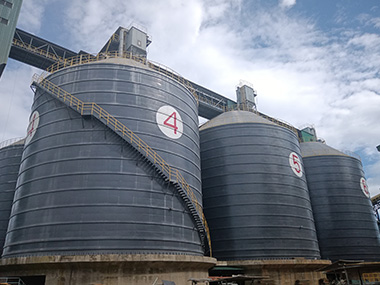

Steel Silo Weight Scale Load Cells: What Every Plant Engineer Needs to Know
A load cell converts mechanical force into an electrical signal — it's the sensor that tells you how much material sits inside your silo. For steel silo weighing, you'll almost always use strain-gauge load cells rated between 10 and 100 tonnes each, mounted beneath the support structure. Get them wrong and your inventory numbers are fiction. Get them right and you've got real-time stock data accurate to within 0.1% of full scale.
How Load Cells Actually Work in Silo Weighing Systems
The Strain Gauge Principle
Inside every modern load cell, you'll find a metal body — usually alloy steel or stainless steel — with bonded strain gauges arranged in a Wheatstone bridge configuration. When the silo load deforms that metal body, even by fractions of a millimeter, the strain gauges change resistance. That resistance change becomes a millivolt-per-volt (mV/V) signal your indicator reads.
Most industrial silo load cells output 2 mV/V or 3 mV/V at rated capacity. A 50-tonne cell with 2 mV/V sensitivity gives you 100 mV at full load when excited with 10V DC. That's a tiny signal. Your junction box, cabling, and indicator all have to preserve it without adding noise. I've seen plants lose 3-4% accuracy just because someone ran the load cell cable next to a VFD power line for 80 meters.
Shear Beam vs. Compression vs. S-Type — Which One for Your Silo
For steel silo support legs, shear beam load cells dominate. They handle off-center loading better than compression cells, and they're easier to retrofit. A typical 3,000-tonne cement silo on six legs uses six 50-tonne shear beam cells — one per leg. That's the standard configuration I've specified on projects from Indonesia to Morocco.
Compression cells make sense when you're mounting directly under a support beam or pedestal. They're stiffer, handle higher capacities (some go to 500 tonnes), and work well for large clinker silos where you might have only four support points. S-type cells? Those are for tension applications — hopper scales, belt weighfeeders — not silo leg mounting. Don't let a supplier talk you into S-type for a standing silo. It's the wrong tool.
Here's a number that matters: the combined error of a good load cell should be ≤0.02% of rated output. That includes nonlinearity, hysteresis, and creep. Cheap cells advertise 0.05% and deliver 0.15% in practice. On a 5,000-tonne silo, that's the difference between knowing your stock within 1 tonne and being off by 7.5 tonnes. Multiply that by cement at $80/tonne and you've got a real accounting problem.
Installation: Where Most Projects Go Wrong
Foundation and Support Stiffness
The load cell doesn't just measure silo weight. It measures everything that pushes down on it — including forces from thermal expansion, wind loading, and material bridging. Your foundation has to be stiff enough that it doesn't deflect under load. I've seen silos in Southeast Asia where the concrete pad cracked within 18 months because the soil bearing capacity was 80 kPa and the design assumed 150 kPa. The load cells started reading 12% high on one side because the pad was tilting.
Rule of thumb: the support structure beneath each load cell should deflect no more than 0.5 mm under full load. If you're using a ring-beam foundation for a large silo, check the beam stiffness — a 600 mm × 800 mm reinforced concrete beam on good soil usually works for silos up to 4,000 tonnes. Beyond that, you're looking at piled foundations, and the load cell mounting has to account for potential differential settlement between piles.
Thermal Expansion and Lateral Force Management
Steel expands. A 20-meter-tall silo in direct sun can grow 8-10 mm taller on the south-facing side compared to the shaded north side. That lateral movement creates horizontal forces on your load cells. If the cell is rigidly fixed top and bottom, those horizontal forces show up as vertical reading errors — sometimes 2-3% of the actual weight.
The fix is simple: use load cells with self-aligning mounting hardware. Shear beam cells with rocker-style load pedestals allow the top plate to tilt slightly, accommodating lateral movement without introducing false loads. I've specified cells with stainless steel rocker pedestals on every project since 2016. The cost premium is maybe $40 per cell. The accuracy improvement is 1-2%. That's not a hard sell.
Wiring and Junction Boxes in Harsh Environments
Load cell cable is 4-core or 6-core, typically 0.5 mm² cross-section, with braided shielding. Run it in conduit — not open cable tray — and keep it at least 300 mm away from power cables. At the junction box, you'll sum the signals from all cells. A good junction box has trim potentiators for each channel so you can equalize the output from all cells. This matters because no two load cells have exactly the same sensitivity, and your silo legs won't carry exactly equal loads.
IP67 junction boxes are the minimum for outdoor installation. I've opened junction boxes in coastal Vietnam that were full of condensation after two monsoon seasons. The copper traces on the summing board had green corrosion. The plant was getting weight readings that drifted 5% over a week. We replaced the box with an IP68 unit, added desiccant packs, and the drift disappeared. Cost: $120. The plant had been living with bad data for two years.
Calibration, Accuracy, and Real-World Performance
What "0.05% Accuracy" Actually Means on a 5,000-Tonne Silo
Manufacturer accuracy specs are measured in a lab at 23°C with a calibrated dead-weight tester. Your silo operates at -10°C to +50°C, with wind, with material sticking to walls, with aeration systems vibrating the structure. Real-world accuracy is always worse than the lab number.
Here's what I tell clients: expect 0.1% to 0.2% of full scale as your practical accuracy. On a 5,000-tonne silo with 300 tonnes of live stock, that's ±5 to ±10 tonnes. For inventory management, that's acceptable. For trade weighing — where you're buying or selling by silo weight — you need 0.05% or better, and you'll need certified dead-weight calibration every six months.
Temperature compensation in modern load cells is good — typically 0.0015% of rated output per °C. But that's the cell itself. The junction box, cable, and indicator all have their own temperature coefficients. A full system calibration at operating temperature is worth the effort. I've done calibrations at 3am in a Shandong cement plant because that's when the silo was empty and the temperature was stable. The plant manager thought I was crazy. The data proved it was necessary.
Calibration Methods — Dead Weight vs. Certified Reference
Dead-weight calibration is the gold standard. You empty the silo, zero the system, then apply known weights — usually certified test masses — and check the reading at 25%, 50%, 75%, and 100% of capacity. For a large silo, that's impractical. You'd need 5,000 tonnes of test weights.
Most plants use the "substitution method." You empty the silo, zero it, then load a known quantity — say, 200 tonnes of clinker from a calibrated weighbridge — and adjust the indicator to match. It's not perfect. The weighbridge itself has uncertainty, maybe ±0.5%. But it's practical and repeatable. I recommend doing this quarterly for the first year, then biannually once you've established a baseline.
Some plants skip calibration entirely. They trust the factory calibration and never check. I've seen a 2,000-tonne fly ash silo in India that was reading 18% low because one load cell had drifted. The plant kept ordering more fly ash than they needed, thinking they were running low. They'd overspent by $40,000 over eight months. A two-hour calibration check would have caught it.
Common Failure Modes and How to Avoid Them
Moisture Ingress and IP Ratings
Load cells fail from moisture more than from overload. Water gets into the strain gauge cavity, corrodes the solder joints, and creates erratic readings. The cell might read fine for months, then suddenly jump 20% or drop to zero. IP67 means temporary immersion — 30 minutes at 1 meter depth. IP68 means continuous immersion. For silos in rainy climates, IP68 is the right choice.
The cable entry is the weakest point. Use a cable gland with a rubber seal, not a simple compression fitting. And route the cable with a drip loop before the gland — so water running down the cable hits the loop and drips off before it reaches the entry point. It's a $2 detail that prevents 80% of moisture failures.
Lightning and Surge Protection
A steel silo is a lightning target. A nearby strike induces voltage surges in the load cell cable — enough to destroy the strain gauges, which are tiny and fragile. Surge arrestors on every load cell channel are non-negotiable. I've seen a plant in Brazil lose all six load cells in one storm. The replacement cost was $3,800. Surge arrestors for all six channels would have cost $600.
Grounding matters too. The silo structure should be grounded to a dedicated earth electrode with resistance below 10 ohms. The load cell cable shield should be grounded at one end only — usually the indicator end — to avoid ground loops. I've measured 2V of ground potential difference between the silo foundation and the control room in a plant in Nigeria. That's enough to corrupt your signal without surge protection.
Mechanical Damage from Thermal Cycling
Daily temperature swings cause the silo shell to expand and contract. Over years, that cycling fatigues the welds around load cell mounting points. I inspected a 10-year-old slag silo in South Korea where the mounting plate welds had cracked on two of four cells. The cells were still reading, but the readings were erratic — jumping 5-10% with every temperature change. The repair required emptying the silo, cutting out the old plates, and re-welding with preheat to 150°C to avoid hydrogen cracking in the thick steel.
Prevention: specify mounting plates with full-penetration welds, not fillet welds. The extra $15 per plate in fabrication cost saves you a $20,000 repair five years later.
Integration with Plant Control Systems
Analog vs. Digital Signal Transmission
Traditional load cells output an analog mV/V signal. That signal degrades over distance — cable resistance adds error, and electromagnetic interference adds noise. For runs over 50 meters, you're looking at potential errors of 0.1% or more just from cable resistance.
Digital load cells solve this. They have a built-in ADC and transmit a digital signal — usually RS-485 or CAN bus — that's immune to cable resistance and most EMI. The downside: they cost 3-4 times more than analog cells, and they need a compatible indicator. For new installations on large silos, I'm specifying digital cells more often. The accuracy improvement is real, and the wiring is simpler — you daisy-chain the cells instead of running individual cables back to a junction box.
Inventory Management and ERP Integration
Your silo weight data is only useful if it reaches the people who need it. Most plants connect the weight indicator to the PLC via 4-20 mA or Modbus RTU. From there, the SCADA system calculates inventory in tonnes, and the ERP system uses that for purchasing and production planning.
The calculation isn't trivial. You need to account for the silo's dead weight (the tare), the material density (which varies with moisture and compaction), and the silo geometry (cylindrical section plus conical hopper). A typical cement silo has a cylindrical section 15 meters in diameter and 30 meters tall, plus a conical hopper with a 3-meter discharge opening. The volume calculation is straightforward, but the density correction is where most systems fail. Bulk cement density ranges from 1.1 to 1.3 t/m³ depending on aeration state. If your system assumes 1.2 t/m³ and the actual density is 1.15, you're overreporting inventory by 4%. On a 5,000-tonne silo, that's 200 tonnes of phantom stock.
Case Study: 6,000-Tonne Clinker Silo Weighing System — Vietnam
A cement plant in central Vietnam needed a weighing system for a new 6,000-tonne clinker silo. The silo sat on eight support legs on a piled foundation — 12-meter-long driven concrete piles because the soil was soft alluvial clay with bearing capacity around 60 kPa. We specified eight 100-tonne shear beam load cells with IP68 rating and stainless steel rocker pedestals. The junction box was IP68 with individual trim pots and surge arrestors on every channel.
The installation hit a problem on day three. The contractor had welded the load cell mounting plates with fillet welds, not the full-penetration welds specified. Our site supervisor caught it during a visual inspection — the weld throat was 6 mm instead of the required 10 mm. We made them cut out all eight plates and re-weld. It added two days to the schedule and $1,200 to the cost. The plant manager was annoyed. I told him: "In five years, you won't remember the two days. You'll remember the welds didn't crack." He agreed.
Calibration was done using clinker from a calibrated truck weighbridge — 150 tonnes loaded in three batches of 50 tonnes each. The system accuracy after calibration was 0.08% of full scale, well within the 0.1% target. After 18 months of operation, a recalibration check showed drift of only 0.03% — well within acceptable limits. The plant now uses the silo weight data for their ERP system, and their clinker purchasing decisions are based on actual stock levels, not guesswork.
FAQ
How many load cells do I need for my silo?
One per support point. A silo on four legs needs four cells. A silo on eight legs needs eight. The capacity of each cell should be approximately 1.5 times the maximum load per leg — that's the silo's total weight (full) divided by the number of legs, times 1.5 for safety factor. For a 3,000-tonne silo on six legs with a dead weight of 200 tonnes, each leg carries 533 tonnes. Use 50-tonne cells? No — that's too close to capacity. Use 75-tonne or 100-tonne cells. I typically specify 100-tonne cells for anything over 2,000 tonnes total capacity.
Can I retrofit load cells to an existing silo?
Yes, but it's not simple. You need to jack up the silo — just 10-15 mm — to install the cells under each leg. That means emptying the silo first, or at least reducing the load to minimum. The jacking has to be synchronized; you can't lift one leg at a time or you'll distort the shell. I've done retrofits on silos up to 4,000 tonnes. The jacking takes a full day with four hydraulic jacks and a manual pump. The cell installation takes another day. Budget three days total including calibration.
What's the expected service life of a load cell?
A good load cell — properly installed, IP68 rated, with surge protection — should last 10-15 years. I've seen cells fail in three years due to moisture ingress, and I've seen cells still performing within spec after 18 years. The difference is installation quality and environment. Coastal plants with high humidity and salt air are the worst case. Inland plants in dry climates get the longest life. Annual inspection of junction boxes, cable glands, and mounting hardware will catch problems before they become failures.
Need Help Specifying Load Cells for Your Silo Project?
Manxing has designed and installed silo weighing systems on over 200 projects across 30+ countries. We specify the right load cells, the right mounting hardware, and the right integration for your specific material and operating conditions. No generic solutions. No guesswork.
Contact our engineering team at manxingstorage.com for a free load cell specification review.