
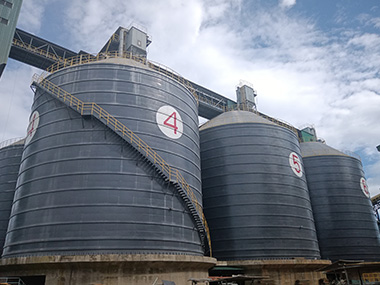

Steel Silo Weighing Systems: What Actually Works in Industrial Bulk Storage
A steel silo weighing system tells you how much material is inside — live, accurate, and without climbing the roof with a tape measure. The two technologies that dominate industrial installations are strain-gauge load cells mounted under the silo legs or weighbridges with integrated batching logic. Both work. The difference is in the details nobody talks about until something breaks.
Why Silo Weighing Matters More Than You Think
Most plants install weighing because the accountant wants inventory numbers. That's fine. But the real value shows up when your process engineer needs to know — right now — whether that 2,500-tonne cement silo is at 78% or 91% before the next tanker arrives. A 13% gap at that scale is 325 tonnes of material. That's three trucks. That's a scheduling disaster if you get it wrong.
Inventory Accuracy and Process Control
Radar level sensors tell you distance to the material surface. They don't tell you mass. Bulk density shifts — cement at 1.1 t/m³ when aerated, 1.5 t/m³ when settled, 1.3 t/m³ somewhere in between on a Tuesday afternoon. A level reading of 18 metres means nothing if you don't know the density profile. Weighing cuts through that ambiguity. You get mass directly, regardless of how the material's sitting inside.
I've seen plants in Vietnam running on level sensors alone, ordering deliveries based on a "full" alarm that triggered at 85% actual capacity because the material had rat-holed around the extraction point. They were paying for trucks that weren't needed. A basic load-cell system would've paid for itself in four months.
Structural Safety and Overload Prevention
Here's the thing nobody puts in the brochure: a weighing system is also a safety device. EN 1991-4 (Eurocode 1, Part 4: Actions on silos and tanks) requires that silo structures be designed for full-capacity loading plus dynamic effects during filling and discharge. But design assumptions and reality diverge. Material builds up in corners. Extraction becomes uneven. One side of the silo carries 60% of the load while the other side carries 40%.
When you've got load cells on every leg, you see that asymmetry in real time. A 15% differential between opposite legs on a 3,000-tonne clinker silo is a structural conversation you need to have immediately. Without weighing, you don't know until the shell starts buckling.
Load Cell Technologies for Steel Silos
Two types dominate industrial silo weighing: compression load cells and shear beam load cells. Both use strain gauges bonded to a metal element. The gauge deforms under load, resistance changes, the transmitter converts that to a weight signal. Simple physics. The engineering is in the mounting, the environmental protection, and the signal processing.
Compression vs. Shear Beam Load Cells
Compression load cells sit directly under the silo leg or support stool. The load path is vertical, straight through the cell. They're the go-to for large-capacity silos — 50-tonne to 500-tonne per cell, accuracy classes C3 and C4 per OIML R60 (0.02% to 0.03% of rated output). A 2,000-tonne cement silo on four supports typically uses four 500-tonne compression cells. Total system accuracy lands around ±0.5% of full scale, which is ±10 tonnes. For inventory management, that's more than adequate.
Shear beam cells mount differently — they're installed in a weigh platform or under a beam structure, and they measure shear force rather than direct compression. They're more common in smaller installations, hopper scales, and batching systems. Capacity per cell is lower, usually 50 kg to 5,000 kg. Accuracy can be excellent — C6 class cells hit 0.006% of rated output — but the mounting hardware introduces more variables. Every bolt, every pivot point, every alignment tolerance adds potential error.
For most industrial silos above 500 tonnes total capacity, I recommend compression cells. The load path is cleaner, the mounting is simpler, and there are fewer mechanical failure points. Shear beams have their place — in dosing systems, in small hoppers, in retrofit situations where you can't modify the support structure. But for the silo itself, compression wins.
Capacity Ranges and Accuracy Classes
Load cell selection isn't just about matching the silo's total weight. You need to account for:
- Dead weight of the silo structure (typically 8-15% of total capacity for bolted steel silos)
- Dynamic loads during pneumatic filling — can add 20-30% momentary surge
- Wind loading on the shell, which creates uneven leg loads
- Thermal expansion of the steel shell changing load distribution
A common mistake: sizing cells for the silo's nominal capacity. Don't do that. Size for 125% of maximum expected load per support point, then select the next standard capacity up. For a 1,500-tonne fly ash silo on four legs with a 10-tonne shell, that's roughly 385 tonnes per leg. Add 25% safety margin — 481 tonnes. Use 500-tonne cells. The extra capacity doesn't hurt accuracy; modern transmitters handle the range fine.
Accuracy class matters more than most buyers realize. A C3 cell (3,000 divisions) on a 500-tonne cell gives you 167-gram resolution. A C4 cell (4,000 divisions) gives 125 grams. For inventory tracking, C3 is sufficient. For trade weighing or custody transfer, you need C6 or better — and that's a different conversation entirely, involving legal metrology certification that most industrial plants don't need.
Installation and Structural Integration
The best load cell in the world is useless if it's installed wrong. I've seen €40,000 weighing systems produce garbage data because the mounting surface wasn't flat, the thermal expansion wasn't accommodated, or the junction box was installed where rain pooled every afternoon.
Mounting Configurations
Three mounting approaches cover 90% of industrial silo installations:
Direct leg mounting: The load cell sits between the silo leg base plate and the foundation anchor plate. Simplest, most common, lowest cost. Requires a flat, level foundation surface — flatness tolerance of ±2 mm across the base plate contact area. The cell needs a top plate and bottom plate, both machined flat, with a self-centering mechanism (usually a ball cup or rocker pin) to accommodate minor misalignment.
Weigh stool mounting: A separate steel stool is bolted to the foundation, and the silo leg sits on the load cell mounted in the stool. This is the approach we prefer for new construction because it isolates the weighing system from the silo leg's thermal movement. The stool can be precisely leveled during construction, and the load cell is accessible for maintenance without jacking the silo.
Weigh beam mounting: Used when the silo sits on a structural steel frame rather than individual legs. Shear beam cells are installed in the beam structure, and the entire frame becomes the weighing platform. More complex, more expensive, but necessary for large-diameter silos on ring foundations.
One detail that separates professional installations from amateur ones: the junction box. This is where all the load cell signals are summed and trimmed. It needs to be IP65 minimum, installed in a location that doesn't exceed 60°C ambient, and accessible without a ladder. I've opened junction boxes in Indonesia that were full of condensation because they were mounted on the north side of the silo in direct rain. The trimming potentiometers had corroded. The system hadn't been accurate in two years.
Environmental and Temperature Considerations
Load cells are temperature-compensated, but compensation has limits. Most industrial cells are compensated for -10°C to +40°C. In a plant in Saudi Arabia where the steel shell surface hits 65°C in August, that compensation range is exceeded. The cell's output drifts — not dramatically, maybe 0.02% per 10°C outside the compensated range, but on a 500-tonne cell that's 100 kg of apparent weight change per 10°C. Over a 25°C excursion, you're looking at 250 kg of drift per cell. On a four-cell system, that's a tonne of phantom weight.
The fix: thermal isolation. A simple steel shroud over the load cell, or mounting the cell in a weigh stool that's thermally decoupled from the shell, keeps the cell within its compensated range. It costs maybe €200 per cell in additional fabrication. It saves you from chasing ghosts in your weight data.
Lightning protection is non-negotiable. A silo is a tall steel structure in an open yard. It will get struck, or it will pick up induced surges from nearby strikes. Every load cell cable needs surge protection at the junction box, and the junction box needs a dedicated earth connection — not shared with the plant's general earth, a dedicated rod driven to less than 10 ohms. I've replaced 16 load cells on a silo in Brazil after a single storm because the installer had run the signal cable alongside the power cable in the same conduit. The induced surge cooked every cell. €12,000 in cells, three days of downtime, all because of a cable routing decision made by someone who didn't understand electromagnetic interference.
Calibration, Maintenance, and Common Failures
A weighing system is only as good as its calibration. And calibration in an operating plant is a logistical challenge — you can't exactly fill a 2,000-tonne silo with certified test weights.
Calibration Procedures
Three methods, in order of preference:
Dead weight calibration: Place certified weights on the silo — usually on a platform built into the silo structure or on the roof. You need at least 20% of the silo's capacity in test weights for a meaningful calibration. For a 1,000-tonne silo, that's 200 tonnes of weights. Expensive to transport, slow to install, but it's the gold standard. We do this during commissioning when the silo is empty and the crane is already on site.
Material substitution calibration: Fill the silo with a known quantity of material weighed on a certified truck scale or rail scale. The truck scale needs to be calibrated to at least three times better accuracy than the silo system — so if your silo system is ±0.5%, the truck scale needs to be ±0.15% or better. This is the most practical method for most plants. It takes time — you're making dozens of truck trips — but it's accurate and uses material you're already handling.
Hydraulic calibration: A hydraulic jack applies a known force to the silo structure while the load cells measure the reaction. Fast, doesn't require material or weights, but it only calibrates the load cells — it doesn't verify the entire system including the structure's load distribution. Use this for periodic verification, not initial calibration.
After initial calibration, verify quarterly for the first year, then semi-annually if the system is stable. Use a known-weight test — even a single 1-tonne certified weight placed on the silo roof gives you a reference point. If the reading is off by more than 0.5%, investigate before trusting the data.
What Goes Wrong in the Field
After 15 years of troubleshooting weighing systems, the failure modes are remarkably consistent:
- Moisture ingress into load cells: Accounts for maybe 40% of field failures. The cell's IP rating (usually IP67 or IP68) is only as good as the cable entry seal. If the installer doesn't torque the cable gland properly, water gets in. It's slow — the cell works fine for months, then starts drifting as corrosion builds on the strain gauge bonds. The telltale sign: readings that are stable at low load but diverge at high load.
- Mechanical binding: The silo settles, the foundation shifts, the leg base plate binds against the load cell's side restraint. The cell can't deform freely, so it under-reads. You'll see this as a consistent negative offset that doesn't change with load — the binding force is constant, so it shows up as a zero shift.
- Cable damage: Rodents, UV degradation, physical damage from maintenance activity. Signal cable for load cells is shielded, low-voltage (typically 10V excitation, mV-range output). Any damage to the shield introduces noise. Any damage to the signal conductor introduces error. Run cable in conduit. Not direct-buried. Not clipped to the silo shell where it bakes in the sun.
- Junction box corrosion: The trimming resistors inside the junction box are sensitive to humidity. A corroded junction box gives you inconsistent readings between cells, which shows up as load distribution errors. Replace the junction box desiccant annually. If you're in a humid climate, use a heated junction box.
Here's a tip that'll save you hours of troubleshooting: keep a spare load cell on the shelf. When a cell fails, swap it immediately, then diagnose the failed one at your leisure. A silo without weighing is flying blind — and in most plants, that means manual level checks, conservative inventory estimates, and the occasional panic call when the silo's emptier than expected.
Field Tip: When commissioning a new weighing system, record the "empty" weight reading of each individual load cell before the silo is filled. This baseline is your diagnostic reference for the life of the system. If Cell #3 reads 12.4 tonnes empty at commissioning and 14.8 tonnes empty two years later, something has changed — mechanical binding, moisture ingress, or structural settlement. Without that baseline, you're guessing.
System Integration and Data Output
The load cells produce a signal. That signal needs to become useful data. The path from strain gauge to SCADA screen involves several components, and each one is a potential failure point.
PLC and SCADA Integration
Modern weighing transmitters output 4-20 mA, 0-10 V, or digital signals (Modbus RTU, Profibus, Ethernet/IP, or CANopen). For industrial silos, 4-20 mA to the plant PLC is still the most common — it's simple, noise-resistant over long cable runs, and every PLC in the world can read it. The transmitter sits near the junction box, sums the cell signals, applies the calibration curve, and outputs a linear weight signal.
Digital bus connections are gaining ground, especially on new builds. Modbus TCP over Ethernet lets you read individual cell weights, diagnostic data, and calibration parameters from the transmitter. That's valuable — if you can see that Cell #2 is reading 8% less than the others, you know there's a problem before it becomes a failure. With a 4-20 mA system, you only see the summed output. A failing cell is invisible until the total weight is obviously wrong.
The PLC program needs to handle tare weight (the silo's own structure), apply any calibration offsets, and convert the raw weight to engineering units. It should also monitor for fault conditions — signal out of range, excessive load differential between cells, communication loss. These alarms should go to the SCADA system, not just sit in the PLC. An alarm that nobody sees is worse than no alarm — it creates a false sense of security.
Remote Monitoring Capabilities
For plants with multiple silos or remote locations, cloud-based monitoring is increasingly common. The weighing transmitter connects to an edge gateway (cellular or Ethernet), which pushes data to a cloud platform. You can check silo levels from your phone, set up automated alerts for low-level or high-level conditions, and generate inventory reports without walking to each silo.
The cost is modest — a cellular gateway runs €300-500, cloud platform subscription is typically €20-50 per silo per month. For a plant with 10 silos, that's €500/month. Compare that to the cost of one emergency delivery because a silo ran empty unnoticed. The math works.
One caveat: remote monitoring is a supplement to, not a replacement for, local instrumentation. The control room still needs a local display showing silo weight. If the cellular connection drops — and it will, eventually — the plant operator needs to see the weight locally. We specify a local display panel at the silo base as standard, with remote monitoring as an add-on.
Case Study: 3,000-Tonne Clinker Silo Weighing System — Cement Plant, Oman
A cement plant in Oman commissioned a new 3,000-tonne clinker silo in 2022. The silo is 32 metres tall, 14 metres diameter, supported on eight concrete columns with steel stool structures at the top of each column. The plant needed weighing for inventory management and for truck loading — clinker is dispatched by tanker, and the plant wanted to load trucks to a target weight without a separate belt scale.
We specified eight 500-tonne compression load cells (C3 class, OIML R60), one per column, mounted in weigh stools with rocker-pin self-centering. Each cell has IP68 rating with a hermetically sealed strain gauge cavity — important in an environment where summer temperatures exceed 45°C and dust is constant. The junction box is a heated, IP67 unit mounted in a weatherproof enclosure at ground level, with individual cell trimming and surge protection on every input.
The transmitter outputs 4-20 mA to the plant's Siemens S7-1500 PLC and Modbus TCP to a local edge gateway for cloud monitoring. The PLC program handles tare weight (the silo structure is 285 tonnes), applies a live density correction based on the clinker's measured bulk density (1.2-1.4 t/m³ depending on particle size), and triggers alarms for load differential exceeding 10% between adjacent cells.
Calibration was done by material substitution — 47 truckloads of clinker, each weighed on a certified rail scale (accuracy ±0.1%). Total calibration time: three days. System accuracy achieved: ±0.35% of full scale, which is ±10.5 tonnes on a 3,000-tonne silo. For truck loading, the system controls the discharge gate — when the target weight is reached (typically 30 tonnes per truck), the gate closes automatically. Loading time per truck dropped from 12 minutes to 7 minutes because the operator no longer had to manually estimate the flow rate and close the gate early to compensate for material in flight.
Total installed cost for the weighing system: approximately €45,000, including cells, mounting hardware, junction box, transmitter, cabling, and commissioning. The plant recovered that cost within eight months through reduced overloading fines (trucks were previously loaded by volume, which consistently resulted in 2-3% overweight) and eliminated one manual level-check shift per day.
Frequently Asked Questions
How accurate does a silo weighing system need to be?
For inventory management, ±0.5% of full scale is the industry standard. That's ±10 tonnes on a 2,000-tonne silo — accurate enough for stock reconciliation and delivery scheduling. For trade weighing or custody transfer, you need ±0.1% or better, which requires C6-class cells, more rigorous calibration, and legal metrology certification. Most industrial plants don't need that level of accuracy. Don't pay for precision you won't use.
Can I retrofit a weighing system onto an existing silo?
Yes, but it's more complex than new construction. You need to jack the silo — even temporarily — to install the load cells under the legs. The silo must be empty or nearly empty during installation. Foundation modifications are usually needed to create flat, level mounting surfaces. Expect 3-5 days of downtime for a typical retrofit on a medium-sized silo. The load cells themselves are the easy part; the civil works and jacking operation are where the cost and risk live.
What's the expected service life of load cells in an industrial environment?
Quality compression load cells from reputable manufacturers are rated for 100,000+ load cycles and 10-15 years of service life in normal conditions. In harsh environments — high humidity, temperature extremes, abrasive dust — expect 7-10 years. The weak points are the cable entry seal and the junction box, not the cell body itself. Annual inspection of seals and junction box condition, plus quarterly calibration verification, will catch problems before they cause system failure.
Need a weighing system designed for your silo? Manxing engineers weighing systems for cement, clinker, fly ash, coal, and slag silos worldwide — from initial load calculations through commissioning and calibration. We've installed systems on silos ranging from 200 to 10,000 tonnes across 30+ countries. Contact our engineering team for a site-specific weighing system proposal.