
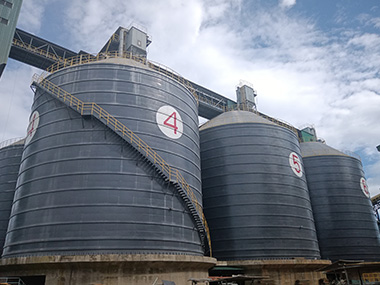

Silo Ventilation and Aeration Design: Keeping Bulk Solids Flowing and Safe
Silo ventilation removes harmful gases and moisture, while aeration fluidizes material to prevent bridging. Both are non-negotiable for safe, efficient bulk solids storage. Get them wrong, and you're looking at a 5,000-tonne block of cement that won't move, or a coal silo filling with carbon monoxide.
The Physics of Stagnant Material
Bridging and Rat-holing: The Silent Capacity Killers
Bulk solids don't behave like liquids. They don't flow hydrostatically. Instead, they form arches. A bridge is a stable arch formed over the discharge hole, bearing the full weight of the material above it. A rat-hole is a vertical channel that forms against the wall, leaving the rest of the silo packed tight. Both rob you of live storage capacity. A 3,000-tonne cement silo can easily lose 40% of its usable volume to a stable rat-hole.
The angle of repose dictates the problem. Fly ash sits at 15 degrees. Slag can hit 35 degrees. When the material compacts under its own weight—or worse, absorbs moisture—the cohesive strength spikes. You're no longer storing powder; you're storing a solid block. The structural load shifts too. Instead of vertical pressure on the floor, you get horizontal jacking forces against the walls. EN 1991-4 accounts for these patch loads, but it assumes the material actually flows. If it bridges, the load distribution goes haywire.
Moisture Migration and Condensation
Here's the thing. Silos breathe. Hot material goes in. The air inside heats up, expands, and pushes out the vent. Cool night air gets sucked back in. That air hits the cooler roof steel and condenses. Every single day, you're adding water to the top layer of your product. In tropical climates, a 40°C day dropping to 10°C at night generates massive condensation. That water wets the wall lining, increases friction, and creates a hard crust right at the fill point.
I walked into a coal silo in Malaysia where the aeration had failed. The smell hit me first — that sharp, acidic stench of wet, oxidizing coal. 200 tonnes had turned into a solid plug. All because one fan controller was wired to the wrong phase. The material had been sitting there for three weeks, slowly turning into concrete.
Aeration System Design: Air is a Tool, Not a Cure-All
Calculating Aeration Rates by Material Density
Aeration isn't about blowing air into a silo and hoping for the best. It's about controlled fluidization. You need to introduce enough air to reduce the internal friction between particles, but not so much that you fluidize the whole mass and cause segregation. The rule of thumb for cement is 0.2 to 0.5 Nm³/h per tonne of stored material. For heavy slag, you're looking at 1.0 Nm³/h per tonne. Fly ash is tricky—it's light, around 0.6 tonnes per cubic meter, but it packs tight. You need 0.3 Nm³/h per tonne, but the air has to be bone dry. Wet air turns fly ash into a sticky paste.
The fan selection matters. Positive displacement blowers give you constant volume against varying system resistance. Centrifugal fans are cheaper, but their flow drops off fast as the material depth increases. For a 20-meter-deep silo, the static pressure at the aeration pads can hit 60 kPa. A standard centrifugal fan will stall out at that pressure, delivering zero flow. You're left with a very expensive paperweight.
Aeration Pad Layout and Air Distribution
You can't just drill a hole in the wall and pump air in. The air will take the path of least resistance, creating a channel. The rest of the material stays dead. You need a distribution system. Half-floor aeration uses a false floor pitched at 5 degrees, covering roughly 40% of the silo cross-section. Full-floor systems cover 100%, but they cost 30% more in structural steel and concrete.
The pads themselves are usually porous ceramic or woven polyester. Ceramic handles the heat—up to 200°C for hot clinker. Polyester is fine for cement at 80°C. The spacing is critical. Pads should be no more than 150 millimeters from the wall. Any further, and you get a dead zone where the material sticks. I've seen contractors install pads 300 millimeters from the wall to save on piping. The silo owner ended up needing a man with a sledgehammer every morning.
Ventilation: Managing Gases and Dust
Natural vs. Mechanical Ventilation
Natural ventilation relies on thermal buoyancy and wind. Hot air rises, pulling fresh air in through bottom vents. It works fine for inert materials like sand or aggregate. But for coal, you're dealing with carbon monoxide off-gassing. CO is slightly lighter than air, but it mixes easily. A gooseneck vent on the roof won't cut it. You need mechanical exhaust. The standard is 10 air changes per hour minimum. For a 5,000-cubic-meter silo, that's 50,000 cubic meters of air per hour. You need a fan, ducting, and a weather hood that doesn't let rain in.
Got a call at 2am from a plant in Shandong — baghouse differential pressure had crept to 1,800 Pa. They were 40 minutes from a shutdown. We walked them through cleaning the inlet hoppers on the phone instead of sending anyone. The silo was pressurizing because the dust extraction couldn't keep up with the fill rate. If that pressure relief valve had failed, the roof would have peeled open like a tin can.
Dust Collection Integration
Every time you fill a silo, you displace air. That air is loaded with dust. ISO 15012 dictates the capture velocity at the fill point. You need at least 1.0 m/s to pull the dust into the filter. The baghouse has to handle the peak flow during filling, not the average. Size it for the conveying air volume plus a 15% safety margin. If you undersize the filter, the bags blind off, the fan sucks a vacuum, and the silo walls implode. EN 1991-4 gives you the buckling resistance formulas for thin-walled steel silos, but they assume you respect the pressure limits.
Structural and Safety Considerations
Pressure Differentials and Silo Wall Loading
Aeration adds pressure. A lot of it. When you fluidize material, the silo wall sees an additional 2.5 kPa of internal pressure. That doesn't sound like much until you realize a 15-meter-diameter silo has a wall area of over 700 square meters. That's 1,750 kilonewtons of outward force. The stiffeners have to handle it. If you're retrofitting aeration into an existing silo, you must check the wall thickness and stiffener spacing. A 6mm wall might handle the vertical load, but it'll buckle under aeration pressure.
Ventilation creates negative pressure. Exhaust too much air, and you pull a vacuum. The walls buckle inward. The roof collapses. I've seen a 3,000-tonne silo fail because the exhaust fan was running while the fill line was blocked. The fan pulled a 5 kPa vacuum. The walls folded like an aluminum can. The standard approach has a flaw nobody talks about: most relief valves are set for overpressure, not vacuum. You need both.
Explosion Risk and Inerting
Coal, alumina, certain chemical powders—they're combustible. ISO 21873 defines the testing methods for dust explosion characteristics. You need to know the Kst value and the minimum ignition energy. If the material is explosive, your aeration system becomes an ignition source. Static electricity from air moving across porous pads can build up. You must ground the pads and the ducting. The resistance to ground must be under 10 ohms.
EN 14491 covers explosion protection. You can suppress it, vent it, or inert it. Inerting replaces the oxygen with nitrogen. You inject N2 into the aeration air, keeping the O2 below 8%. It's expensive, but it's the only safe way to store high-volatile coal in a bulk silo. Explosion vents on the roof work, but they direct a flame blast straight up. If the silo is in a plant building, that flame hits the ceiling. Not ideal.
Real-World Commissioning: Where Theory Meets Mud
The Fan Sizing Trap
Engineers love safety factors. They see a calculation for 50 kPa, so they spec a 70 kPa fan. Big mistake. An oversized aeration fan blasts too much air. The material fluidizes completely. Fine particles migrate to the center, coarse particles settle at the edges. You get segregation. Your cement at the center is a different fineness than the cement at the edges. The kiln operator complains. The quality control manager yells. The fix? Install a bypass valve or a variable frequency drive. Run the fan at 60% speed. Match the air to the material, not the spec sheet.
Ducting Layouts That Actually Work
Keep the duct runs short. Every 90-degree elbow adds equivalent length. Use long-radius bends. The transport velocity in the duct must stay above 12 m/s, or the dust drops out and plugs the line. I remember a project in Vietnam where the contractor ran the aeration header under the concrete foundation. It was a 40-meter run with six elbows. The pressure drop was 15 kPa before the air even reached the pads. We ripped it out, ran it externally along the wall, and cut the pressure drop to 3 kPa. The silo started flowing perfectly.
Case Study: 10,000-Tonne Coal Silo Retrofit
A power plant in Indonesia had a 10,000-tonne coal silo. The original design had no aeration and natural ventilation only. The coal bridged constantly. They were using air cannons, but the cannons just created a 1-meter hole while the rest of the coal stayed stuck. Worse, CO levels inside the silo hit 50 ppm, triggering safety shutdowns.
We designed a retrofit. Half-floor aeration system with ceramic pads, spaced 150mm from the wall. Two 15 kW positive displacement blowers, one duty, one standby. Mechanical exhaust ventilation with a 20,000 m³/h fan and a CO monitor interlocked to the fan. The ducting was run externally to keep the pressure drop under 4 kPa. We added explosion vents on the roof per EN 14491, sized for a Kst of 150 bar-m/s.
Commissioning took three days. The first day, we ran the blowers at 30% speed. The coal started moving. By day three, we had full mass flow. The CO levels dropped to under 24 ppm. The plant manager told me it was the first time in five years he'd seen the silo empty completely without a man going inside with a hammer.
FAQ
What's the difference between aeration and ventilation?
Aeration introduces air directly into the material to reduce friction and promote flow. Ventilation exchanges the headspace air to remove gases, dust, or moisture. They use different fans, different ducting, and different controls. Don't try to use one system for both.
How often should aeration pads be inspected?
Every six months. Pores clog with dust and moisture. A blinded pad creates a dead zone. Pull a pad, check the airflow, and clean it with compressed air or replace it. A ceramic pad should last five years. Polyester lasts two.
Can I retrofit aeration into an existing silo?
Yes, but it's messy. You have to cut a hole in the wall or roof for the air supply. If you're doing a half-floor system, you need to pour a new concrete slab inside the silo. That means emptying the silo completely. It's a 4-to-6-week shutdown. Plan it during a major overhaul.
Manxing: Your EPC Partner for Silo Ventilation and Aeration
At Manxing, we don't just design silos. We design the systems that make them work. Our EPC team has commissioned aeration and ventilation systems across 30+ countries, handling everything from explosive alumina to sticky, wet slag. We run the pressure calculations, we spec the right fans, and we make sure the ducting doesn't choke. If you're dealing with bridging, rat-holing, or gas buildup, we've seen it before. We know how to fix it. Contact Manxing today for a site assessment and a ventilation design that actually works in the real world.