
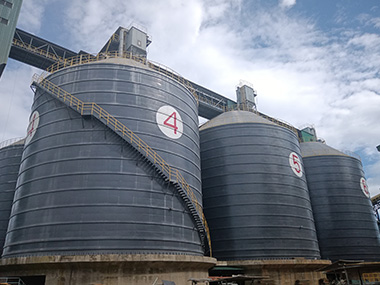

Steel Silo Freight and Logistics Costs: What Actually Drives the Price Tag
Freight for a 3,000-tonne cement silo typically runs 8–15% of total project cost, depending on destination and shipping mode. The single biggest cost driver isn't distance — it's whether your components fit in standard containers or require breakbulk handling. Here's what we've learned moving silo kits to 30+ countries.
What You're Actually Shipping — Silo Components and Their Freight Profiles
People picture a silo as one big cylinder. It's not. It's 200–600 individual pieces, each with its own freight personality. The shell panels are light but bulky. The roof trusses are awkward. The screw conveyor is dense and long. You're not shipping one thing — you're shipping a puzzle, and every piece has different dimensional weight, stacking constraints, and handling requirements.
Rolled Shell Sections vs. Bolted Panels
We build two types: bolted (thin panels, 1.5–4 mm, stacked flat) and welded (thick plates, 8–20 mm, rolled into curved sections). Bolted panels are the freight dream. A 40-foot container holds roughly 12–15 tonnes of stacked panels. Welded shell sections? They're curved, they don't stack efficiently, and you're looking at 6–8 tonnes per container. Same silo capacity, double the container count.
I remember a project in Vietnam where the client insisted on welded construction for a 5,000-tonne clinker silo. The freight alone added $180,000 compared to the bolted alternative. We told them. They chose welded anyway — local contractor preference. That's fine, but they knew the number going in.
Heavy Components: Roof Structures, Cone Assemblies, and Aeration Floors
The cone assembly on a large silo weighs 8–25 tonnes. It's a single piece, usually 6–12 meters in diameter. That's flat-rack or breakbulk territory. No container will take it. You're paying for vessel deck space at $80–150 per freight ton, plus port handling fees that vary wildly. In West Africa, we've seen port charges hit $4,000–$7,000 per heavy lift. In Southeast Asia, it's closer to $1,500–$3,000.
Aeration floors are another headache. The perforated steel plates and air channels come in bundles that are light but enormous — 3 meters by 6 meters per bundle. They eat container volume without adding weight. You end up paying dimensional weight rates on air, essentially.
Ancillary Equipment: Conveyors, Dust Collectors, and Electrical Panels
The silo is maybe 60% of the shipment by volume. The rest is the mechanical and electrical kit: bucket elevators, belt conveyors, rotary valves, baghouse dust collectors, level indicators, aeration blowers, control panels. These are dense, high-value, and fragile. A baghouse with 200 filter bags can't get wet. A control panel can't take vibration. You're shipping these in closed containers with desiccant and shock indicators, and you're insuring them at 1.5–2% of declared value.
Shipping Modes and Their Real Cost Implications
There's no universal answer. The right mode depends on your site's distance from a deep-water port, the road network beyond that port, and how fast you need the equipment. I've seen projects where sea freight was 40% of logistics cost and road haulage was 60%. I've seen the reverse. It's site-specific, and anyone giving you a rule of thumb without looking at your route is guessing.
Breakbulk and Flat-Rack for Oversized Loads
Anything over 2.5 meters wide or 3 meters high won't go in a standard container. That's most large silo components. Breakbulk shipping — where your cargo sits on the vessel deck, strapped down — runs $120–$250 per freight ton depending on the route and season. Flat-rack containers are cheaper: $80–$150 per freight ton, but you're exposed to weather and salt spray. We wrap everything in VCI (vapor corrosion inhibitor) film and add silica gel packs. Still, I've opened a flat-rack in Dar es Salaam to find surface rust on unpainted edges. It's cosmetic, but the client doesn't see it that way.
Container Shipping for Smaller Components
For bolted silo kits under 2,000 tonnes capacity, most of the shell and accessory components fit in standard 40-foot high-cube containers. Current rates from Shanghai to major African ports run $3,500–$6,500 per container. To South America, $4,000–$7,500. To the Middle East, $1,800–$3,200. These numbers swing 30–40% depending on the season and fuel surcharges. We budget at the 75th percentile and tell clients to expect ±20%.
One thing that catches people off-guard: container demurrage. You get 7–10 free days at destination. After that, it's $100–$200 per day per container. If customs clearance stalls — and it will, in some countries — a 20-container shipment can rack up $15,000 in demurrage before anyone touches a wrench.
Road Haulage: The Last Mile That Eats Budgets
The port is halfway. Getting components from port to site is where logistics gets real. In East Africa, we've used 6-axle lowbed trailers rated for 40 tonnes. They cost $1.50–$2.50 per kilometer on decent roads. On bad roads — and "bad" means unpaved, 200 mm of laterite dust, no drainage — that jumps to $3.00–$4.50 per kilometer, and you're limited to 15 km/h. A 300 km haul from Mombasa to an inland site can take 3 days and cost $12,000–$18,000 per truck.
We survey the route before we quote. Not Google Maps — an actual drive, with a local transport contractor, noting bridge weight limits, overhead clearances, and turning radii. In Indonesia, we found a bridge rated for 15 tonnes on the only access route. Our truck weighed 38 tonnes. We had to offload, cross with a smaller truck, and reload on the other side. Added two days and $4,000. That's the stuff that doesn't show up in a freight quote.
Site Logistics — Where Freight Costs Don't End
Delivery to site isn't the finish line. It's the starting gun for a whole new set of costs: unloading, staging, inventory management, and assembly sequencing. If you don't plan this, you'll pay for it in crane rental, idle labor, and damaged components.
Unloading and Staging on Congested Sites
A cement plant under construction is a busy place. The foundation contractor is still finishing the silo base. The kiln area is being steel-erected. There's no empty space. We've had to rent adjacent land — $500–$2,000 per month — just to stage silo components within crane reach. And you need a level, compacted surface. Mud is not a staging area. I've seen panels warp because they were laid on uneven ground for three weeks.
Unloading with a mobile crane runs $800–$1,500 per day for a 50-tonne unit. A 200-tonne crane? $3,000–$5,000 per day. If your shipment arrives in the wrong sequence — roof panels before shell panels — you're paying the crane to sit while you dig through the pile.
Crane Access and Assembly Sequencing
This is where freight planning and erection planning collide. We sequence shipments so that components arrive in reverse order of assembly need: foundation bolts first, shell panels second, roof last. Sounds obvious. But if your freight forwarder consolidates with another shipper to save cost, your sequence gets scrambled. We've had shell panels arrive in week one and the anchor bolts in week four. The erection crew stood around for 18 days. That's $25,000–$40,000 in idle labor on a typical project.
We now specify in the freight contract: no consolidation without written approval, and components must be containerized by assembly sequence. It adds 3–5% to freight cost. It saves 15–20% on erection cost. The math isn't close.
Weather Delays and Seasonal Constraints
Monsoon season in Southeast Asia, winter in Central Asia, rainy season in West Africa — every region has a window where outdoor erection slows or stops. If your freight arrives during that window, you're paying storage and weatherproofing. We budget $2,000–$5,000 per month for tarpaulins, raised staging, and corrosion prevention during weather delays.
In Kazakhstan, we had a silo kit arrive in November. Site temperature hit -25°C. Steel becomes brittle, bolts don't torque properly, and the erection crew can't work more than 2-hour shifts. We lost six weeks. The freight was on time. The weather didn't care.
Hidden Costs That Blow Budgets
The freight quote is the visible part. Below the waterline, there's a mass of charges that can add 20–35% to your logistics line if you're not watching.
Customs Clearance and Import Duties
Steel silo components typically fall under HS code 7309.00 (iron/steel tanks) or 7308.90 (structural steel). Import duties range from 5% in East African Community countries to 15–25% in some South American markets. But the duty isn't the killer — it's the clearance process. In Nigeria, we've seen customs hold a shipment for 6 weeks while they "verify" the declared value. Storage charges at Lagos port run $50–$100 per day per container. That's $3,000–$6,000 for a delay that has nothing to do with you.
We engage a local customs broker before the shipment leaves China. They pre-clear documentation, verify HS codes, and establish relationships with port authorities. It costs $1,500–$3,000 per shipment. It saves weeks.
Damage in Transit and Insurance Gaps
Marine insurance covers total loss and major damage. It doesn't cover the bent panel, the scratched flange, the baghouse with a dented inlet. Those are "partial losses" and often fall below the deductible. We insure at 110% of CIF value, which runs 0.8–1.5% of the insured amount depending on the route. For a $2 million silo project, that's $16,000–$30,000.
But here's the gap: insurance pays for the damaged piece. It doesn't pay for the erection crew that can't work while you wait for a replacement. We've had to air-freight a replacement cone section — $25,000 for a 4-tonne piece from Shanghai to Peru — because the original arrived cracked and the erection schedule couldn't slip. Air freight is 8–12 times sea freight per kilogram. Use it only when the schedule demands it.
Storage and Demurrage Charges
Port storage is the silent budget killer. Most ports give 5–7 free days. After that, charges escalate daily. In some South American ports, the rate triples after day 10. A 30-container shipment stuck in customs for 21 days can generate $20,000–$35,000 in storage fees. That's not a typo.
We build a 15-day contingency into every logistics budget. If clearance goes smooth, we save the contingency. If it doesn't, we're covered. On a $500,000 logistics budget, that's $15,000–$25,000 set aside. Clients don't love seeing it. But they love a budget overrun even less.
How to Reduce Silo Freight Costs Without Cutting Corners
You can't negotiate physics. But you can negotiate design, timing, and packaging. Here's where we've found real savings.
Design for Transport Efficiency
Every meter of width over 2.5 meters pushes you from container to flat-rack. Every meter of height over 3 meters does the same. When we design a silo, we check component dimensions against standard container internal dimensions (12.03 m × 2.35 m × 2.69 m for 40HC) before we finalize. A roof truss that's 3.2 meters wide costs 40% more to ship than one that's 2.4 meters wide. Sometimes we split the truss into two bolted sections. It adds two hours of on-site assembly. It saves $8,000 in freight.
We also standardize bolt hole patterns and connection details across projects. That way, if a panel gets damaged, we can ship a replacement from stock instead of fabricating a new one. Lead time drops from 4 weeks to 5 days. Freight cost drops from $15,000 (air) to $2,000 (sea).
Consolidation and Shipping Windows
If you're building multiple silos — say, a 3-silo cement terminal — ship them together. One consolidated shipment of 40 containers gets a better per-container rate than three shipments of 13. The savings are 10–15% on ocean freight alone. But you need all silos designed and fabricated simultaneously, which means your engineering and procurement schedules have to align. That's a project management challenge, not a logistics one.
We also avoid peak shipping seasons. Rates from China spike 20–35% in August–September (pre-Christmas rush) and January–February (pre-Lunar New Year). If we can shift a shipment by 4 weeks, we save $5,000–$12,000 on a typical silo project. The client's erection schedule has to flex, but most do.
Local Sourcing vs. Full-Package Export
For projects in regions with steel fabrication capability — India, Turkey, South Africa, Brazil — we sometimes source shell panels locally and ship only the proprietary components (aeration systems, specialized valves, control panels) from China. Local panels cost 10–20% more per tonne, but you save 60–70% on freight for those panels. On a 500-tonne silo, that's a net saving of $30,000–$60,000.
The catch: local fabrication has to meet our specs. We send detailed shop drawings, require third-party inspection (usually TÜV or Bureau Veritas), and reject anything that doesn't pass. I've rejected panels in India because the bolt hole tolerance was ±3 mm instead of ±1 mm. The local shop wasn't happy. But a panel that doesn't align on site costs more than the freight savings.
Case Study: 5,000-Tonne Clinker Silo — Tanzania
Project: One 5,000-tonne clinker silo for a cement plant near Dar es Salaam. Bolted construction, 32 m diameter, 42 m height. Total steel weight: 280 tonnes. Ancillary equipment: 15 tonnes (dust collector, aeration blower, level indicators, ladder/guardrail system).
Shipping route: Shanghai → Dar es Salaam (sea), then 420 km road haul to site. Sea freight: 14 containers (40HC) + 6 flat-racks for roof trusses and cone assembly. Ocean freight cost: $68,000. Insurance at 110% CIF: $4,200. Port charges and customs clearance: $8,500. Road haulage: 18 truck-loads, 3 days each way, $42,000 total. Site unloading and staging: $6,800. Contingency (15%): $19,500.
Total logistics cost: $149,000. That's 11.2% of the total silo EPC price of $1,330,000. The project finished on budget — the first time on that project that any line item came in at or under estimate. The key was route survey (we found a bridge that needed reinforcement, budgeted $3,500, did it before the trucks arrived) and pre-clearance (customs took 4 days instead of the usual 14).
Frequently Asked Questions
What's the typical freight cost as a percentage of total silo project cost?
For bolted steel silos shipped from China to international destinations, freight and logistics typically run 8–15% of total EPC cost. Welded silos run 12–20% because the heavier, bulkier components require more breakbulk shipping. Projects within 500 km of a Chinese port — Mongolia, parts of Central Asia — can see freight as low as 5–7% because road haulage is short and rates are lower.
How do you handle freight for remote sites with no nearby port?
Multi-modal: sea freight to the nearest deep-water port, then rail or road to an inland hub, then road to site. For a project in the DRC, we shipped to Durban (South Africa), railed to Lubumbashi, then trucked 200 km to site. The rail leg was $12,000 cheaper than all-road, but it added 3 weeks. For remote sites, we always survey at least two routes and present the client with a cost-time tradeoff. They choose. We execute.
Who bears the risk of damage during shipping — the supplier or the client?
Under standard FOB (Free on Board) terms, risk transfers to the buyer once goods pass the ship's rail at the loading port. Under CIF (Cost, Insurance, Freight), the seller arranges and pays for freight and insurance, but risk still transfers at the loading port. In practice, we insure through destination and file claims on behalf of the client if damage occurs. For high-value projects, we recommend CIP (Carriage and Insurance Paid To) terms, where the seller bears risk until the goods reach the named destination. It adds 2–3% to the logistics cost but eliminates disputes when something goes wrong at sea.
Planning a Silo Project? Let's Talk Logistics Before We Talk Steel.
Freight costs are too big to estimate from a spreadsheet. We've surveyed routes in 30+ countries, negotiated rates with major carriers, and learned the hard way which ports to avoid during monsoon season. Before you finalize your silo design, get a logistics assessment from someone who's actually moved the equipment.
Contact Manxing's project team for a site-specific freight estimate. We'll survey your route, check your port, and give you a logistics number you can budget against — not a guess, not a range, but a line item with assumptions you can verify.